 United States Wagner, Tristan und Isolde: Soloists, Metropolitan Opera Orchestra and Chorus / Yannick Nézet-Séguin (conductor). Metropolitan Opera, New York, 17.3.2026. (RP)
For the second time this season, the Metropolitan Opera has a runaway hit on its hands. The first was Mason Bates’s The Amazing Adventures of Kavalier and Clay, which prompted the Met to schedule additional performances in February. This month, it is the all-but-sold-out run of Tristan und Isolde, which the blogosphere has proclaimed the hottest opera ticket in the world. An accolade due, without doubt, to the superb performances of Lise Davidsen and Michael Spyres in the title roles. Such was the demand that the Met scrambled to add another performance, with Stuart Skelton replacing Spyres as Tristan.
Yuval Sharon, in his Met debut as director, might have heeded Coco Chanel’s timeless advice, ‘Before you leave the house, look in the mirror and take one thing off’. With his Tristan und Isolde that translates into jettisoning a few sub-themes and visual elements, but simplicity and clarity weren’t Sharon’s aesthetic goals. Nonetheless, his simplest strokes are the most captivating and effective.
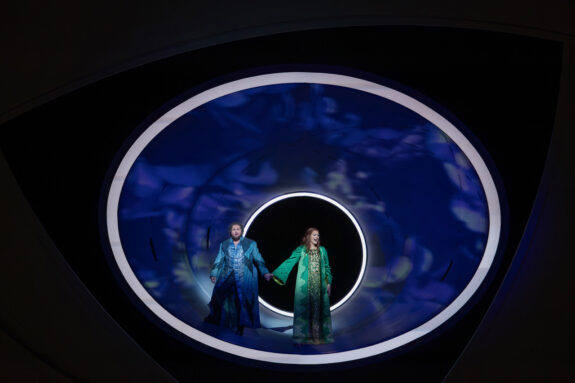
The tunnel, or vortex, that dominates the Met stage is sublimely beautiful in all its permutations, serving as porthole, lens or kaleidoscope to focus action, and often providing stunning visuals. Subtle lighting enhances the tunnel in all its forms, whether through simple lines or by bathing it in color. A long row of backlit colored decanters, from which Isolde chooses a potion, is neat and clean. The two most striking scenes are the tunnel’s opening reduced to the outline of a knife’s blade and, later, its division into two floating ovals that frame the doomed lovers’ passionate exchanges and eventually merge into one.
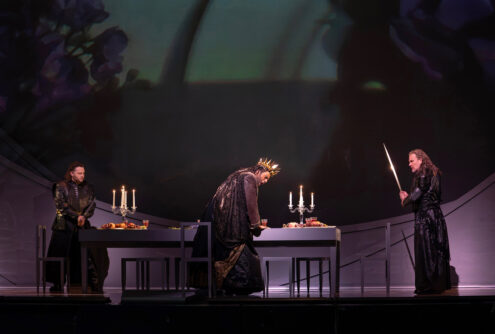
The video projections are more of a mixed bag. Close-ups of Spyres’s face are disconcerting, and that of a moth drawn to a candle flame leans into banality. The overhead view of vintage medical instruments neatly arranged near the dying Tristan drew a few titters from the audience. The visual representation of King Marke’s despair over Tristan’s betrayal was a shattered white plate surrounded by purple poppies. Whether it was necessary is debatable, but it was pretty.
Sharon introduces what he calls a ‘split reality’ into the production by having the action unfold in two different worlds. As stated in the program, he seeks to shift the focus to the story’s metaphysical aspects, rather than the opera’s literal setting. Sharon does so by introducing a contemporary couple – actually two interchangeable ones – who silently enact the psychological drama unfolding in the opera. While they never sing, they do move about and emote a great deal.
The non-singing couple is hardly noticeable in the first act as they are mostly in the dark, and all attention is focused on Davidsen and Spyres suspended above them. In the subsequent two acts, they are more obtrusive. In the final act, a mute Tristan makes four appearances. He repeatedly rises from the table where he lies dying, walks off the stage and then returns to switch places with Spyres. Yet there is more.
Pedro R. Díaz plays the English horn with beauty and sensitivity while walking about in a stunning, architecturally-structured white robe. He is the equivalent of a snake charmer, mesmerizing what appears to be the inmates of an asylum (given the dancers’ jerky movements). Tristan is apparently having an out-of-body experience, as Spyres is in their midst, looking deranged but singing gloriously, with a double lying on the table.
Yannick Nézet-Séguin relishes painting with a broad musical brush, especially when it comes to volume and color. With Lise Davidsen, he has the perfect partner to sculpt Wagner’s tremendous musical lines. Davidsen’s voice rode effortlessly over thrilling torrents of sound, and the high Cs in the Act II ‘Love Duet’ were stunning. Even at a mere whisper, her voice was clearly heard above shimmering waves of sound that Nézet-Séguin drew from the orchestra.
Davidsen was the most generous of colleagues, as was Nézet-Séguin, both sensitive to balance especially regarding the other voices in the cast that do not equal hers in size. Sharon’s tunnel had acoustical hot spots which occasionally threw off their carefully calibrated balancing act. When standing in just the right spot, Davidson’s soprano took on a harsh, metallic quality, but the acoustical phenomenon only added presence to Spyres’s sound.
Spyres triumphed as Tristan, even though his heroic voice is not cut from Heldentenor cloth. He husbanded his vocal resources at first, expressing Tristan’s anguish in baritone-like timbre as suited to Lieder as to a Wagnerian hero. In the Act II ‘Love Duet’, his voice began to rival Davidsen’s in intensity and thrust. Ultimately, in Tristan’s delirious Act III monologue, Spyres unleashed his voice, letting it ring out magnificently.
Ekaterina Gubanova’s compelling mezzo-soprano was unsettled at first, but that was fleeting and her Brangäne gained vocally and dramatically. Tomasz Konieczny’s hearty Kurwenal lent bonhomie to the opening scenes and gravitas to the final one in which he tended to the dying Tristan. As King Marke, Ryan Speedo Green was as majestic in appearance as he was in voice. He imbued King Marke’s monologue with an overwhelming sense of betrayal and sorrow, transforming Isolde and Tristan’s romantic ecstasy into all-consuming tragedy.
Modern-day directors are obviously prone to deviating from the libretto. In the last Met production of Tristan und Isolde, director Mariusz Trelinski had Isolde slash her wrists. Sharon introduces the concept of rebirth, which culminates in the modern-day Isolde giving birth just before the Liebestod begins.
With Gubanova’s Brangäne cradling the baby in her arms. Davidsen, who recently gave birth to twins, sang its first words, ‘Mild und leise wie er lächelt’ (‘Softly and gently how he smiles’), with all the warmth and tenderness imaginable. This wasn’t what Wagner intended, but transfiguration comes in many guises, and it was lovely.
The Met’s Live in HD series will broadcast Tristan und Isolde on 21 March 2026. For more information, click here.
Rick Perdian
Featured Image: Michael Spyres (Tristan) and Lisa Davidsen (Isolde) © Karen Almond/Met Opera
Production:
Director – Yuval Sharon
Sets – Es Devlin
Costumes – Clint Ramos
Lighting – John Torres
Projection – Jason H. Thompson
Videos – Ruth Hogben
Choreographer – Annie-B Parson
Cast:
Isolde – Lise Davidsen
Tristan – Michael Spyres
Brangäne – Ekaterina Gubanova
Kurwenal – Tomasz Konieczny
King Marke – Ryan Speedo Green
Steersman – Ben Brady
Shepherd – Jonas Hacker
Sailor – Ben Reisinger
Melot – Thomas Glass
Isolde doubles – Cecily Campbell, Caitlin Scranton
Tristan doubles – Tim Bendernagel, Simon Catillon
English horn solo – Pedro R. Díaz