
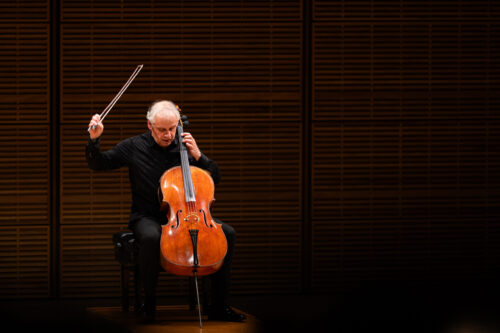
 United States Orchestra of St. Luke’s (OSL) Bach Festival [1]: Pieter Wispelwey (cello). Zankel Hall at Carnegie Hall, New York, 7.6.2026. (ES-S)
Bach – Suite No.1 in G major, BWV1007; Suite No.2 in D minor, BWV1008; Suite No.3 in C major, BWV1009; Suite No.4 in E-flat major, BWV1010; Suite No.5 in C minor, BWV1011; Suite No.6 in D major, BWV1012
Few musicians have been so intensely involved with Bach’s Six Suites for Solo Cello as Pieter Wispelwey. Over many decades, the Dutch cellist has recorded the cycle multiple times, explored its historical mysteries alongside scholars and fellow musicians and continually refined his understanding of these works while never ceasing to re-examine his own assumptions and conclusions. Hearing him perform the complete cycle at Zankel Hall therefore felt less like an encounter with a canonical masterpiece frozen in stone than an opportunity to observe an artist engaged in a lifelong search.
The peculiar status of the Bach Suites themselves helps explain such an approach. Unlike many masterpieces of the Baroque repertoire, they survive without Bach’s autograph manuscript. Performers must instead navigate a web of later copies, the most famous associated with Anna Magdalena Bach, whose transcription contains ambiguities, inconsistencies and apparent errors. Questions of how notes should be connected, articulated and grouped into phrases, how bowing and slurring should shape the musical line, and even how certain notes should be read remain matters of debate. The result is that few works in the core repertoire offer such interpretative freedom while simultaneously imposing such responsibility. Every performer is ultimately challenged to decide not only what Bach wrote but what he may have meant.
The cellist approaches these questions from a historically informed perspective though not one primarily concerned with reconstruction. The most striking aspect of the afternoon was the sense that, after decades of performing the works, Wispelwey remains unwilling to settle for definitive answers. Nothing suggested a ritual repeated out of habit. On the contrary, one constantly felt the presence of an active musical mind testing possibilities, reconsidering assumptions and probing alternative paths through familiar terrain.
Wispelwey’s Bach has been described as ‘speech-like’, with phrases unfolding like a succession of thoughts, each carrying its own inflection and emphasis. Yet the term only partially captures what occurred in practice. His playing suggested an art poised between speech and song. Individual notes emerged with sharply etched articulations, almost like consonants in a language, before merging into harmonic resonance, and repeated notes acquired distinct identities and functions. Yet these rhetorical gestures never felt merely expressive. Occasional hesitations, subtle fluctuations of pulse and rhetorical inflections never gave the impression of a performer imposing a particular manner upon the music. Tempi and dynamics, too, seemed to derive their meaning less from fixed values than from their relationship to the surrounding musical context. All these elements appeared inseparable from the music’s harmonic logic, as if speech and harmony were being continually reconciled, allowing the listener to experience the music simultaneously as discourse and as architecture.
Having established the contours of his approach in the opening suites, as the cycle progressed Wispelwey revealed an increasingly rich world of possibilities within Bach’s musical language. The Suite No.5 emerged as the afternoon’s center of gravity: dark and tragic yet difficult to define with a single adjective. The famous Sarabande seemed to move between lament, meditation and philosophical reflection without ever fully settling into any of them. Like the other Sarabandes in the cycle, it unfolded as an intimate monologue – questioning, vulnerable and exposed.
The Suite No.6 provided an equally telling conclusion. Written for a five-string instrument, it occupies a special place within the cycle and reflects Bach’s increasingly adventurous imagination. In Wispelwey’s hands, the work felt less like a culmination than the point of departure for another journey, as though the additional string were opening the door to an entirely new soundscape.
What ultimately distinguished this performance was that it didn’t feel like the respectful laying of a wreath at a monument. It was the work of an artist still in conversation with the music.
Edward Sava-Segal