 Austria Zemlinsky, A Florentine Tragedy; Bartók, Duke Bluebeard’s Castle: Soloists, Orchestra of Vienna State Opera / Alain Altinoglu (conductor). 8.10.2026 Vienna State Opera performance (directed by Jakob Pitzer) livestreamed on 10.10.2026. (JPr)
Bela Bartók’s Duke Bluebeard’s Castle is a one-act symbolist masterpiece two-hander. The legend of Bluebeard and his possible real-life counterparts were much discussed in the early years of the 1900s; it was perhaps the increasing emancipation of women that brought out the deep-seated anxieties lurking in the psyche of artists and intellectuals. The opera’s dedicatee, the composer’s first wife Márta Ziegler, was 12 years his junior and Béla Balázs’s libretto may have been more than just a little autobiographical for Bartók. It would need an expert in Freud or Jung to let me know whether any of this is true but similar thoughts may have influenced Vasily Barkhatov’s Konzept as you may read later.
Bluebeard’s new wife Judith is ‘carried over the threshold’ and then their marital troubles start. Judith, by her relentless coaxing, reveals Bluebeard’s secret world by opening the castle doors to let light in. Actually, what she is really doing is trying to find the truth behind all the rumours circulating about him. By doing this – in the original libretto – she seals her own fate and will live on as the Lady of the (Mid)Night incarcerated behind the seventh door, joining the Ladies of the Dawn, of Noon and of Evening. Bluebeard seems resigned to what will happen and does little to prevent the inevitable; but at the end, totally desolate, realises he has preserved his secret in ‘darkness, darkness, darkness’.
There are a number of companion pieces that will fill an evening alongside Bluebeard’s Castle and in Vienna it is Zemlinsky’s one-act three-hander A Florentine Tragedy which compared to the Bartók opera – also composed in the second decade of the twentieth century – is late-Romantic and post-Richard Straussian. It features a verismo crime-of-passion which now reminded me – and perhaps Barkhatov deliberately highlighted this – of Puccini’s Il tabarro (The cloak) again from the same era. Florentine Tragedy – based on an unfinished play by Oscar Wilde – is a Renaissance psychodrama between Simone (a middle-aged cloth merchant), Bianca (his young wife) and Guido Bardi (the Prince of Florence). There is infidelity, jealousy, murderous rage and ultimately desire because Bianca is aroused by Simone strangling Guido: ‘Why did you not tell me you were so strong? to which Simone replies ‘Why did you not tell me you were so beautiful?’ Bianca is widely believed to be based on Alma Schindler, who rejected Zemlinsky for the more prominent Gustav Mahler.
So Barkhatov in Vienna unites these two works with his new overall Konzept which this extract from words protected onto the stage at the start of Florentine Tragedy will help explain: ‘3 October New Patient: Bianca S. (35). Married for 10 years, she has become completely estranged from her husband. A typical case: no emotional attachment, no sex, no shared interests. She is determined to save the marriage.’ There is a follow-up appointment when we learn how the method of the couples therapist (which Guido now is!) ‘is called “Seven Doors to a Happy Marriage’. The first door we need to unlock is jealousy.’ So you should now see where this is going! Later we read ‘Now we’re going to act out a role play. Think of living in a different era. Let’s make it Renaissance Italy’.
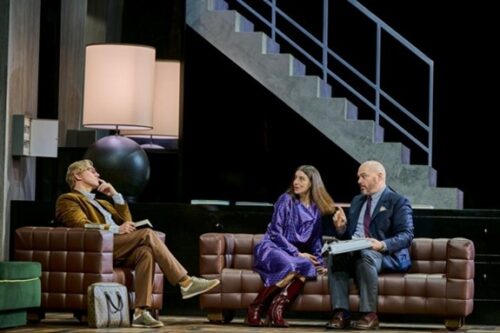
And so it begins. We have Simone opening his interior design studio/furniture store which is where he has agreed to meet the therapist. It will be a single set for the two operas, predominantly grey with a staircase to an upper floor. We are in the twenty-first century and everything appears to be for sale, including Bianca it seems in the role play. There are lamps, cushions, interior design books, folders of samples, curtain poles, a large bed, a brown leather chair and a matching sofa (priced at 14,400 euros!). Bianca (in two-piece, blue-patterned dress) seems obsessed with her mobile phone and otherwise bored and disinterested. Simone in blue jacket, grey slacks, shirt and tie, is doing a hard sell of all he has to offer since the brown moleskin-jacketed Guido – who is constantly taking notes or recording on a dictaphone – offers him 100,000 crowns. Simone suggests all Bianca is good for is ‘to keep the house and spin’ while Bianca says of Simone, ‘I hate him, soul and body!’. The mutual attraction between Guido and Bianca reaches fever pitch (with Simone seething and planning his revenge) and they kiss though Bianca appears shocked by it. By now there is a bed sheet and small table lamp on the floor which encourages thoughts of the Puccini opera. But eventually Simone challenges Guido to curtain poles at dawn before strangling him on the bed and applying the coup de grâce with one of the poles.
The spoken introduction to Bluebeard’s Castle comes courtesy of the therapist’s dictaphone; ‘Once upon a time … or maybe not. Ancient fable, what does it mean, ladies and gentlemen … an old castle, the tale is truly ancient, and you shall hear it.’ Judith (Bianca) and Bluebeard (Simone) are in a post-coital embrace on the bed beside the corpse of the murdered Guido. It never entirely becomes clear why the therapist had to be murdered in this revision, but the unfolding drama has a grip which never lessens. It is now Judith’s turn to help heal their marriage, even at one point briefly donning the therapist’s glasses and having his notebook in her hands. She sings ‘I see great closed doorways, seven black, closed doorways! Open them, open them! Open them for me!’
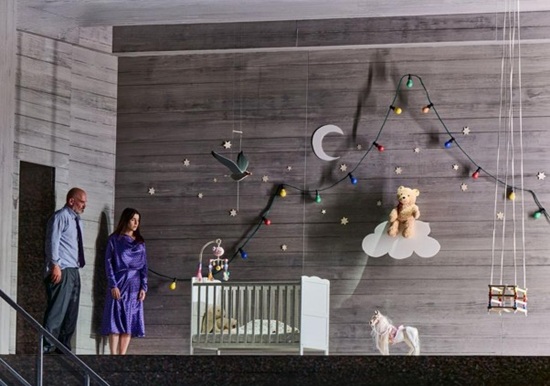
Through the successive doors Judith and Bluebeard face up to images and incidents in their life together, some making more sense than others. First Door (torture chamber) has swords appear through the sofa and projected in silhouette. Perhaps it references the weapon which killed the therapist as with the Second Door (armoury) there is shadow play of the murder. The Third Door (treasury) has Judith in her wedding dress (which we first saw in Florentine Tragedy) now complete with baby bump which soon reveals the couple lost a child. For the Fourth Door (fragrant garden) Judith put floral linen on the bed while a small tree suddenly catches light for some reason. A mirror shatters and Judith’s shattered image is projected across the stage for the Fifth Door (Bluebeard’s kingdom). Judith and Bluebeard battle on the stairs leading to an empty nursery behind the Sixth Door as the couple mourn their lost child. The increasingly distrustful Judith sings ‘Do you love me? … whom did you love before me?’ Judith throws down her rings, jewellery and clothes as Bluebeard reveals that behind the Seventh Door ‘All my former wives are there’. But the ‘former wives’ are represented by the dresses we have seen Bianca/Judith wear during the opera; blue, brown, blue-patterned and, of course, the wedding dress. So, it is Bianca whom Simone/Bluebeard has loved from the start (there are no ex-wives) and with the therapist’s corpse now consigned beneath the mattress Bianca remakes the bed and Simone joins her in it.
Christopher Maltman was Simone and since he withdrew from the next performance (which was the one originally scheduled to be broadcast live) he may not have been 100%. There was a certain gruffness which made his baritone voice sound at times darker (to me) than doppelgänger Florian Boesch in the bass-baritone role of Bluebeard/Simone. Maltman was initially obsequiously polite but as his jealousy brewed, he was more explosively declamatory. Despite doubts about his voice, Maltman’s was just one of a quartet of finely characterised portrayals. The role of Guido seems somewhat underwritten, but Dmitry Golovnin brought to it a soaring, impassioned lyricism which morphed into extreme desperation in his fight for his life. Florian Boesch was perhaps a little more grizzled than the suaver Maltman, but his Bluebeard moved darkly from guarded acceptance of Judith’s goading to – despite a momentary tragic grandeur – burgeoning dread, desperate emotional pain and ultimate resignation.
Towering above these fine performances was Asmik Grigorian’s Bianca/Judith. Bianca is underwritten too, but Grigorian is possibly this generation’s leading singing-actor because of her versatility; and she probably could make the smallest role the largest on the stage. Judith’s ennui, dislike of her husband, and fury at his antics, were plain to see; as was her somewhat understated seduction of Guido. As Judith she compellingly pleaded, cajoled, insisted, was awe-struck, became uneasy, and succumbed to the devastating reality. As ever, Grigorian’s range was impressive from a superb depth of tone in her lower voice to the cutting edge higher up.
Alain Altinoglu conducting the impeccable Vienna State Opera Orchestra clearly had a sound grasp of the dramatic structure of both works. In cranking up the pervading sense of unease in Bartók’s disconcerting orchestration he wrung out every last detail of the colourful score and the castle really did seem to live, bleed or weep. Earlier in Florentine Tragedy Altinoglu enhanced the emotional menace and turmoil in music which is so redolent of Richard Strauss and Gustav Mahler.
Jim Pritchard
Featured Image: Florian Boesch (Bluebeard) and Asmik Grigorian (Judith) in Duke Bluebeard’s Castle © WS/Marcel Urlaub
Creatives:
Production – Vasily Barkhatov
Set – Christian Schmidt
Costume – Stefanie Seitz
Lighting – Alexander Sivaev
Video – Roland Horvath
Casts:
Eine florentinische Tragödie (A Florentine Tragedy)
Guido Bardi – Dmitry Golovnin
Simone – Christopher Maltman
Bianca – Asmik Grigorian
Herzog Blaubarts Burg (Duke Bluebeard’s Castle)
Duke Bluebeard – Florian Boesch
Judith – Asmik Grigorian