 Germany Musikfest Bremen 2025 [2] – Ciao Napoli! Serenata Napoletana: Pene Pati (tenor), Il Pomo d’Oro. Die Glocke, Bremen, 4.9.2025. (DM-D)

When I told friends, back in 1994, that I was going to take up a job in Wales, they commented with some excitement about the beautiful landscapes, and even more so that Wales was known for its enjoyment of singing and many very well-known classical singers were from Wales. I was indeed struck by how many people I met there had had singing lessons and sang regularly in a range of contexts and venues. Even the local postmaster was a regular singer on Welsh TV. Sir Bryn Terfel is on record commenting on Wales as a very musical country.
Pene Pati, the tenor soloist in the Musikfest Bremen evening of Neapolitan songs, has also commented in print and on YouTube how his native Samoa is a very musical country too. Apparently, his father had left Samoa for New Zealand and found support in singing folk songs from his home country to maintain his connection to his roots and instilled this love for music in his family. The subject matter of those songs, Pati argues, is close to that of the Neapolitan songs that emerged and flourished in Italy from the end of the nineteenth century. That is why he was drawn to those songs – also because their music and their rhythms, too, offer themselves well to the particularly soft and gentle ways of singing he so loved from those Samoan folk songs.
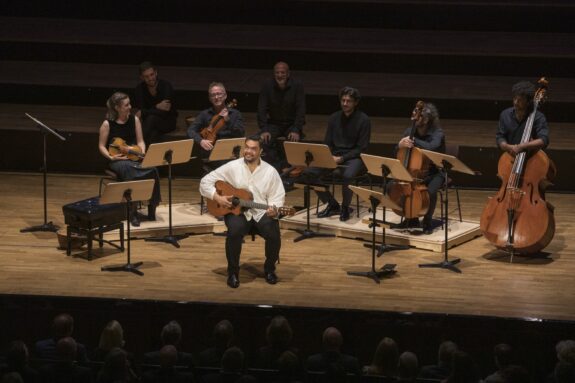
Pati chose specifically to perform them with the chamber ensemble ‘Il Pomo d’Oro’, consisting of guitar, two violins, viola/mandola, mandolin, cello and double bass. The collegial relationship between the ensemble and the tenor was very obvious – they made music together and enjoyed every moment of it. The small ensemble, compared with a full orchestra, allowed many more nuances of Pati’s voice to come through and shine. His voice became the eighth instrument. That voice was predominantly light yet full-bodied, with perfect intonation and a wide range of expressive nuances. In louder material it was unforced and like a clarion, and there were numerous shades of the softer, gentler passages. Every single sound was deliberately moulded in terms of the nuances of volume, in terms of where it was almost imperceptibly formed and then subtly developed in relation to the throat and mouth. The nuances extended to which resonators he used, and where he shifted, ever so gently, from mezza voce to falsetto. With all this, he captured the rhythms, and tunes and the emotions of the songs admirably.
The ever-popular O sole mio has become a frequent encore for tenor recitals. It featured here as an integral part of the programme, and Pati was not tempted to either wave a white handkerchief in Pavarotti-style or to belt the tune fortissimo from beginning to end. He stuck to his emphasis on rhythm, melody and piano – sung in that way the song was of utmost tenderness and very moving, indeed.
Interspersed with the songs, Il Pomo d’Oro presented a number of compositions by Antonello Paliotti, who throughout led the music from the guitar. During those pieces, Pati remained on the stage, sitting behind the musicians on a raised rostrum of stage floor, listening to their music intently and with a broad smile. For their last ensemble piece, Pati remained in their midst playing the castanets.
The final encore, in which he accompanied himself on Paliotti’s guitar, was a Samoan song, and it confirmed the influence of having grown up with them for Pati to have developed his love for Neapolitan songs.
A gem of an evening!
Daniel Meyer-Dinkgräfe
Featured Image: Musikfest Bremen – Tenor Pene Pati sings ‘Le manu tagi e’ © Nikolai Wolff/fotoetage
Canzoni di Notte
Raffaele Calace (1863-1934) – ‘Notturno, Cielo stellato’
Gaetano Lama (1886-1950) – ‘Silenzio cantatore’
Eduardo di Capua (1865-1916) & Alfredo Mazzucchi (1878-1972) – ‘Maria Marí’
Francesco Paolo Tosti (1846-1916) – ‘Inquietudine’; ‘Romance’
Francesco Buongiovanni (1872-1940) – ‘Palomma ‘e notte’; ‘Mandulinata a mare’
Mario Pasquale Costa (1858-1933) – ‘Napulitanata’; ‘Serenata napoletana’
Salvatore Gambardella (1871-1913) – ‘O marenariello’
Antonell0 Paliotti (b.1963) – ‘Variazioni sui basso di Tarantella’, Preludio – Tarantella
Enrico Cannio (1874-1949) – ‘O surdato ‘nnammurato’
Canzoni di Giorno
E.A. Mario (1884-1961) – ‘Canzone appassiunata’
Mario Pasquale Costa – ‘Era de maggio’
Francesco Paolo Tosti, -‘A vuccella’; ‘A Marechiaro’
Antonello Paliotti – ‘Fronna e ballo del Pomo d’oro’: Froona d’o Limone – Ballo; ‘Tarantella storta’
Gaetano Lama – ‘Reginella’
Eduardo di Capua & Alfredo Mazzucchi -‘O sole mio’
Luigi Denza – ‘Funiculì, funiculà’
Encores
Donizetti – ‘Com’è gentil’ (Don Pasquale)
Vincenzo Russo, Eduardo Di Capua und Alfredo Mazzucchi – ‘I te vurria vasa’
Samoan Song – ‘Le manu tagi e’