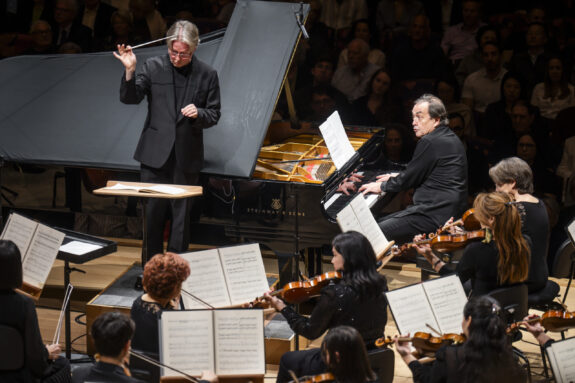
 United States Debussy, Boulez: Pierre-Laurent Aimard (piano), New York Philharmonic / Esa-Pekka Salonen (conductor). Wu Tsai Theater, David Geffen Hall, New York, 3.10.2025. (ES-S)

Boulez – Notations IV, VII, II for Solo Piano and for Orchestra
Debussy – Gigues and Rondes de printemps from Images pour orchestre; Fantaisie for Piano and Orchestra; La mer
For his first of two subscription weeks conducting the New York Philharmonic, Esa-Pekka Salonen proposed a Debussy-Boulez program. As Boulez observed in Orientations, ‘Debussy freed music from the tyranny of meter’ – a liberation that would later guide his own restructuring of musical time and color. With Pierre-Laurent Aimard, one of Boulez’s closest pianistic collaborators, as soloist, the evening became both tribute and exploration, while Salonen, a composer-conductor deeply shaped by Boulez’s influence, brought it into focus.
Strikingly classical in its symmetry for a modern-idiom program, the chosen structure for the first half set three of Boulez’s Notations – each first in its original piano form and then in its later orchestral transformation – in alternation with Debussy’s Gigues and Rondes de printemps. The sequence (Notation IV – Gigues – Notation VII – Rondes de printemps – Notation II) unfolded without cesurae or applause, as if conceived as a single five-part composition. The effect was one of contrast held in balance: Debussy’s fluid harmonies and shifting rhythms seeming to anticipate Boulez’s crystalline density and rhythmic volatility. Salonen shaped the transitions so that one sound world dissolved into the next, chronology yielding to seamless continuity.
Placed on one side of the large orchestra, next to the three harps and across from the nine double basses, Aimard opened the evening with the keyboard version of Notation IV, its tightly coiled brilliance articulated with tensile precision before the music erupted into the orchestral version – a vast amplification where fragments became masses and rhythm turned kinetic. Written in 1945 as a set of terse piano miniatures and reimagined decades later for orchestra – occasionally beyond easy recognition – Boulez’s Notations trace the composer’s fascination with transformation: of gesture, of density, of sound itself.
Salonen drew fierce precision from the Philharmonic: Notation IV incandescent and rhythmically charged, its angular propulsion at times recalling Stravinsky’s bite; Notation VII suspended in glacial stillness, its glinting sonorities momentarily suggesting the distant shimmer of gamelan textures that also impressed Debussy; Notation II volatile and centrifugal, propelled by the sharp, motoric interplay of percussion and brass filtered through Boulez’s own post-serial language. The alternation between Aimard’s distilled articulation and the orchestra’s unleashed grandeur made audible the journey from Boulez’s youthful abstraction to the monumental luminosity of his late style – an evolution Salonen shaped with a conductor’s precision and a composer’s insight.
If the selections from Notations laid bare the architecture of sound, those from Debussy’s Images dissolved it into shifting light and color. In the absence of Ibéria, the best known of Images’ components, Gigues and Rondes de printemps became complementary studies in motion and memory: Gigues unfolding through veiled textures and the wistful oboe refrain of a Northumbrian folk song, Rondes bursting with rhythmic vitality and spring brightness. Salonen favored momentum and focus over sensual excess, revealing how Debussy’s play of rhythm and timbre anticipates the modernism Boulez would later codify. Heard between and around Boulez’s transformations, Debussy’s soundworld felt prophetic – a reminder that the century’s revolutions in texture and form began not with rupture but with suggestion.
After the continuous first half, the Fantaisie for Piano and Orchestra brought a change in tone and proportion. Scored for a reduced orchestra, it remains a lesser-known member of the Debussy canon – a work the composer withheld from publication, uncertain of its hybrid form between concerto and symphonic poem. Aimard approached it with characteristic lucidity, emphasizing interplay: his phrasing often answered by figures in the woodwinds or mirrored by the strings’ delicate sheen. These exchanges, shaped with restraint and finely graded color, gave the performance its sense of inward calm. Salonen matched that perspective, keeping textures lucid and balances exact. The first movement traced a broad arc of reflection, the Lento con grazia glowed with gentle lyricism, and the finale gained rhythmic drive without ever hardening in tone. What emerged was not a virtuoso vehicle but Debussy in the process of redefining how piano and orchestra might breathe together – a soundworld already hinting at the flexible syntax of Pelléas and the refined textures of Images.
With La mer, Debussy’s most complete realization of orchestral metamorphosis, Salonen returned to the full ensemble. The opening, De l’aube à midi sur la mer, emerged with patient breadth: the initial low strings’ murmurs gradually gathering brightness until the brass entered in radiant equilibrium. In Jeux de vagues, rhythmic precision replaced impressionistic haze, the Philharmonic’s strings darting with mercurial agility while Robert Langevin’s flute traced quicksilver lines and guest oboist Nathan Hughes – principal of the Minnesota Orchestra – added a plaintive, vocal warmth. The harps, sharply profiled within the same texture, reinforced the movement’s restless motion – their crystalline articulation propelling the music forward with angular clarity and urgency. It was in keeping with Salonen’s view of La mer as rhythmically and structurally driven rather than ornamental – a conception that Boulez himself had long championed, insisting that ‘Debussy was not a colorist but an architect of color’. The final Dialogue du vent et de la mer grew in long, sweeping arcs rather than surging climaxes, its energy sustained by inner motion more than sheer force. Salonen emphasized proportion over spectacle, tracing the music’s ebb and flow with supple continuity and formal poise. Following the restraint of the Fantaisie, La mer offered both release and culmination, tracing Debussy’s and Boulez’s shared fascination with transformation, from musical gesture to color, from surface to structure.
Edward Sava-Segal
Featured Image: Esa-Pekka Salonen conducting pianist Pierre-Laurent Aimard and the NY Philharmonic © Chris Lee