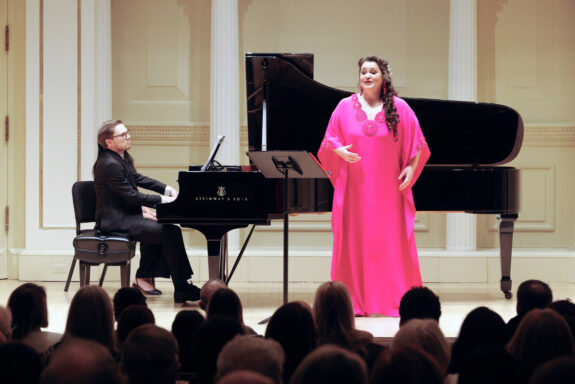
 United States Tchaikovsky, Mahler, Rachmaninoff: Olesya Petrova (mezzo-soprano), Francesco Barfoed (piano). Weill Recital Hall, Carnegie Hall, New York, 5.12.2025. (RP)
Olesya Petrova made her Metropolitan Opera debut as Madelon in Andrea Chénier in 2014, which she is reprising in the current run of Giordano’s opera. The old woman, who has already lost her son and a grandson in the war, offers her only remaining grandson as a soldier in the French Revolutionary Army in the moving ‘Son la vecchia Madelon’. The aria requires subtle, dramatic instincts to make its impact, which were on full display in Petrova’s Carnegie Hall debut recital.
One would expect no less from the Russian mezzo-soprano, who was a finalist in the 2011 BBC Cardiff Singer of the World competition. That, along with placing at the Paris Opera Competition and the International Tchaikovsky Competition, was the springboard for an international career. She has returned to the Met in the great Verdi roles – Ulrica in Un ballo in maschera, Azucena in Il trovatore and Amneris in Aida – where vocal heft and dramatic fire are needed.
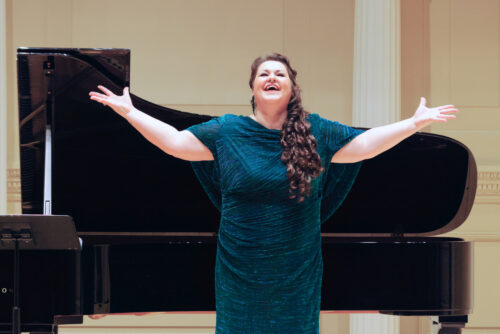
Petrova programmed songs by Tchaikovsky, Mahler and Rachmaninoff that require reserves of vocal beauty and expressiveness to plumb their emotional depths. She did so movingly and magnificently in her simple, natural approach to the songs (sung in their original languages) accompanied by the excellent pianist Francesco Barfoed. Passion was a constant, but power was used sparingly. Simplicity stopped with the music, as three different composers demanded three different gowns.
Tchaikovsky’s songs, like all his music, overflow with emotional intensity and melodic beauty. Petrova opened with one of the composer’s most famous songs, ‘No, Only He Who Knows’, more commonly known as ‘None, But the Lonely Heart’. After Barfoed’s expressive introduction, Petrova revealed one of her singular talents, the stunning naturalness and ease of her vocal production. There were no texts or translations provided, so all one could do was luxuriate in the beauty of her voice and her artistry.
In ‘To Forget So Soon’, Petrova let the musical lines unfold in a seamless parlando line, as if engaging in a conversation. ‘Reconciliation’ revealed the rich, plummy depths of her lower range, as well as eliciting exceptionally sensitive playing from Barfoed. Another of Tchaikovsky’s best-known songs, ‘Lullaby’, permitted Petrova to express softer sentiments in shimmering, floating tones that resonated with heartbreak as much as tenderness.
After the Tchaikovsky songs, Petrova’s Mahler came as a revelation. Although her German diction could be murky, the expansiveness of her voice and her ability to shape long narratives were exceptional. In ‘Erinnerung’, Petrova expressed the poet’s musings on the intertwining of love and song with intense longing and anguish. It is one of Mahler’s early songs but already expresses the themes of loss, ambiguity and the supernatural which haunt ‘Wo die schönen Trompeten blasen’. To Barfoed’s riveting playing of its brisk marches and achingly beautiful musical lines, Petrova sang the long narrative of a girl visited by her lover, or his spirit, on the eve of battle with clarity and directness. Her voice rose gloriously in the sweeping melody foretelling that they will only meet again in death when the beautiful trumpets sound. After that glorious swelling of sound, Petrova ended the song quietly, singing of the green turf that will be the soldier’s final resting place.
Petrova ended the first half of the recital with Mahler’s sublime ‘Ich bin der Welt abhanden gekommen’. She bathed Mahler’s music, which expresses an artist’s retreat from worldly concerns into a realm of love, solitude and music, with her luxurious sound. Her voice simmered with emotion and beauty when singing of finding solace ‘in heaven, in my love, in my song’, emotions that Barfoed expressed with equal eloquence in the song’s postlude.
The second half of the recital was a bouquet of Rachmaninoff songs, and it found Petrova at her most expansive emotionally and vocally. She crested the soaring lines of ‘In the Silence of the Secret Night’ with spinning, floating high notes. ‘Christ is Risen’ resounded with solemnity and grandeur in proclaiming the miracle of Easter. In ‘I Fell in Love to My Sorrow’, Petrova expressed the full emotional impact of young love in ecstatic outbursts, one of the rare instances when she unleashed her voice’s full power in the recital.
Barfoed set the mood for Petrova’s sinuous, spinning lines to express the sense of longing Rachmaninoff captured in ‘Oh, Never Sing to Me Again’. In ‘Lilacs’, Petrova floated above Barfoed’s delicate evocation of spring, capturing the gentle sentiments in equally lighter-than-air tones. She ended the recital with ‘I Am No Prophet’, lifting her voice to proclaim its noble acclamation that ‘I am a singer, not a prophet, soldier or teacher’.
An ebullient Petrova sang three encores. The first was a poignant expression of deep sorrow, loss and unfulfilled love in Tchaikovsky’s folk-inspired ‘Was I Not Like Grass in the Lea’? She risked the soprano key and triumphed after a false start in Rachmaninoff’s ‘How Beautiful it is Here’. The final encore was Rachmaninoff’s ‘Spring Waters’ which was as thrilling for Barfoed’s torrents of arpeggios and sweeping playing as for the joy of hearing Petrova’s voice throbbing with passion and beauty.
Rick Perdian
Featured Image: Olesya Petrova (mezzo-soprano) and Francesco Barfoed (piano) © Christian Miles
Tchaikovsky – ‘No, Only He Who Knows’, Op.6 No.6; ‘To Forget So Soon’ (1870); ‘Reconciliation’, Op.25 No.1; ‘Serenade: O Child! Beneath Your Window’, Op.63 No.6; ‘Lullaby’, Op.16 No.1; ‘Not a Word, O My Friend’, Op.6 No.2
Mahler – ‘Erinnerung’ (Lieder und Gesänge aus der Jugendzeit); ‘Wo die schönen Trompeten blasen’ (Des Knaben Wunderhorn); ‘Ich bin der Welt abhanden gekommen’ (Rückert-Lieder)
Rachmaninoff – ‘In the Silence of the Secret Night’, Op.4 No.3; ‘A Dream’, Op.8 No.5; ‘O, Do Not Grieve’, Op.14 No.8; ‘Christ is Risen’, Op.26 No.6; ‘I Fell in Love to My Sorrow’, Op.8 No.4; ‘How Painful for Me’, Op.21 No.12; ‘Oh, Never Sing to Me Again’, Op.4 No.4; ‘Lilacs’, Op.21 No.5; ‘I Await You’, Op. 14 No.1; ‘I Am No Prophet’, Op.21 No.11