 United States ‘20 Years of Los Angeles Ballet’: Dancers of Los Angeles Ballet. The Wallis Annenberg Center for the Performing Arts, Beverly Hills, 29.1.2026. (JRo)
Inspired by a visit to Van Cleef and Arpels, George Balanchine created Jewels, a three-act ballet inspired by the glitter of emeralds, rubies and diamonds. The significance of the ballet lies elsewhere, however, with each section referring to a style of dance. Emeralds harkens to the romance of nineteenth-century France (music by Gabriel Fauré), Rubies reflects the American spirit with Stravinsky’s jazzy Capriccio for Piano and Orchestra and Diamonds exemplifies the grandeur of Russian ballet (Tchaikovsky).
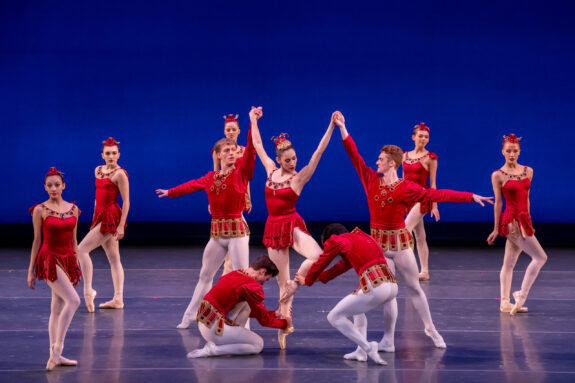
Each section can stand alone, and Los Angeles Ballet performed Rubies (all music was recorded) in their recent appearance at the Wallis. Hollywood film star glamour permeates the ballet, which is also imbued with Balanchine’s admiration for the athleticism of American dancers – there is a hint of the all-American cheerleader in much of the dancing. The complexity of the neoclassical choreography with its intricate footwork, sharp attack and bold extensions of the leg is no easy task for a dancer.
Julianne Kinasiewicz as the ‘Tall Girl,’ was excellent. Whether leading the female corps or dancing with four male corps members, Kinasiewicz and her secure technique brought just the right blend of arrogance mingled with joy to the role. A highlight of the choreography is when the ‘Tall Girl’ moves from an exaggerated second position and summons the four males. They manipulate her legs stretching one in a developpé then moving her into arabesque. All the while, she retains her power over them like Athena doling out favors.
The central pas de deux to Stravinsky’s vivacious music is marked by razor sharp precision, syncopated movement, playfulness and surprise. Kate Inoue and Marcos Ramirez danced the lead couple. They were working a bit too hard to express what should have been the devil-may-care glee of a flirtatious pair, and each seemed more confident when dancing alone rather than in partnership. In those moments, Inoue had a charming delicacy and Ramirez infectious enthusiasm.
Costumes by the famed Karinska evoked the 1920’s flapper girl and the stage was handsomely lit by Nathan W. Scheuer.
It was fitting that Hans van Manen’s ballet, Frank Bridge Variations, was programmed after Rubies. The Dutch choreographer, who died this past December at the age of 93, cited Balanchine as his greatest influence. Like Balanchine, he was enamored of the dancers Fred Astaire and Gene Kelly, along with the doyenne of modern dance, Martha Graham.
Benjamin Britten was a student of composer Frank Bridge and the music consists of ten variations on a theme by Bridge. It explores a variety of moods and styles: adagio, march, romance, bourrée, waltz and more. Van Manen’s choreography reflects the individual variations with movements that feature extended arms gesturing like questions in the air whether in a sharp overhead ‘V’ or parallel to the floor with palms up and hands cupped. Britten’s composition is a powerful one, simultaneously dissonant and lyrical, and Van Manen’s choreography corresponds to this dichotomy.
In ‘Bourrée Classique’, a delightful variation, three couples take the stage to a riot of strings. Dancing separately from their partners, arms scoop the air and hands beat against thighs. Much time is spent engaged in traveling steps across the floor, but when the couples do meet, their parings have an edge of competition. The LAB dancers were wonderfully at home here as they were in all the variations. Dancing the two principal couples, Brigitte Edwards and Marco Biella and Lilly Fife and John Dekle were noteworthy. The unconventional ‘Weiner waltzer’, marked by lifts as the ballerina’s neck swivels in gentle circles, is perhaps the most joyous of the variations. Elsewhere, a somber note creeps in with the ‘Funeral march’ as the company starkly walks into what I can only interpret as an unforeseeable future. Britten finished composing the piece in 1937, and the war wasn’t far away.
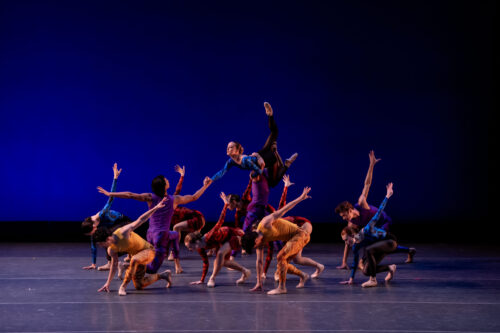
Concluding the program was Melissa Barak’s premiere of Wavelength, with an intriguing score by David Lawrence. Rhythms evoked moving trains and ticking clocks and offered the choreographer and dancers music for fleet footwork and dramatic lifts. Using the vocabulary of ballet’s aerial lightness, Barak contrasted upward movement with modern dance’s sense of gravity’s pull. Crouches alternated with leaps, ballerinas were held by their partners as they arched backwards dramatically or were pulled across the floor with one leg extended and the other pointed foot hugging the floor. In an exuberant section, Marcos Ramirez and Jacob Soltero dazzled like a pair of sprightly Mercutios from Kenneth MacMillan’s Romeo and Juliet. The backdrop’s lighting scheme moved from burnished gold to copper and to purple, reflecting ETRO’s costume design of similar colors. It was a handsome affair, brought off with joy by LAB’s dancers.
Jane Rosenberg
Featured Image: Los Angeles Ballet (centre, Julianne Kinasiewicz) in George Balanchine’s Rubies © Cheryl Mann
Rubies
Choreography – George Balanchine
Music – Igor Stravinsky, Capriccio for Piano and Orchestra
Costumes – Karinska (provided by Ballet Arizona)
Lighting – Nathan W. Scheuer
Frank Bridge Variations
Choreography – Hans van Manen (staged by Marluca do Amaral)
Music – Benjamin Britten, Variations on a Theme of Frank Bridge
Set and Costumes – Kesso Dekker
Lighting – Bert Dalhuijsen (recreated by Nathan W. Scheuer)
Wavelength
Choreography – Melissa Barak
Music – David Lawrence
Costumes – Chloee O’Hayon-Crosby and ETRO by Marco De Vincenzo
Lighting – Nathan W. Scheuer
Dancers: Kate Inoue, Marcos Ramirez, Julianne Kinasiewicz, Marco Biella, Bryce Broedell, Jacob Soltero, Theo Swank, Natalia Burns, Cassidy Cocke, Poppy Coleman, Abigail Gross, Taylor Hugens, Anna Jacobs, Cleo Taneja, Brigitte Edwards, Lilly Fife, John Dekle, Felipe Zapiola, Nick Sedano, Paige Wilkey, Sarah-Ashley Chicola, Evan Gorbell, Rony Baseman, Lilly Leech, Chloe Oronoz