
 United Kingdom Ustvolskaya, Beethoven, Shostakovich: Yuriy Yurchuk (baritone), Benjamin Grosvenor (piano) Royal Philharmonic Orchestra / Vasily Petrenko (conductor), Royal Festival Hall, London, 3.2.2026. (JR)
Ustvolskaya – The Dream of Stepan Razin
Beethoven – Piano Concerto No.1, Op.15
Shostakovich – Symphony No.10, Op. 93
Galina Ustvolskaya may not have been known to many non-Russians before this concert. Vasily Petrenko, in an eloquent address before the concert commenced, gave us an insight into this Soviet composer (1919-2006), a pupil of Shostakovich. She was heavily censored by the Stalin regime and allowed her music (outwardly, at least) to meet the regime’s propagandist requirements. Her tone poem for baritone and orchestra The Dream of Stepan Razin, composed in 1949 falls into that period (if you are interested to hear her ‘true’ style, full of extreme dynamics, austere harmonies and brutal, relentless repetition try listening to her Second Symphony, ‘True and Eternal Bliss’). British-Ukrainian baritone Yuriy Yurchuk was the soloist in this performance and we revelled in his glorious, rich, dark tones and the delivery of the Russian language. The work itself is based on a folksong and was a hit with the authorities; but I suspect, found it hard – despite some soaring melodies and folk themes – to make a lasting impression on what was a principally British audience in the Royal Festival Hall.
Given the weight of the symphony in the second half of this concert, it was a wise choice to throw in a lightweight, early Beethoven piano concerto, his First (actually his Third), composed by Beethoven in his twenties. Although it harks back to Mozart and Haydn, it breaks tradition by exploring new ideas and employing more daring harmonies. Benjamin Grosvenor was the soloist for this performance, a favourite with British audiences. He brought out all the playful wit in the outer movements, scampering joyously across the keyboard. Whilst the serene Largo, a pause for quiet reflection, is a hard movement in which some may succumb to slumber, Petrenko ensured the mischievous Rondo caught our attention and drew the concerto to a vigorous conclusion, the final attacca being particularly well executed. Grosvenor delighted us with his cross-hand technique in his encore, a charming Étude by German composer Moritz Moszkowski.
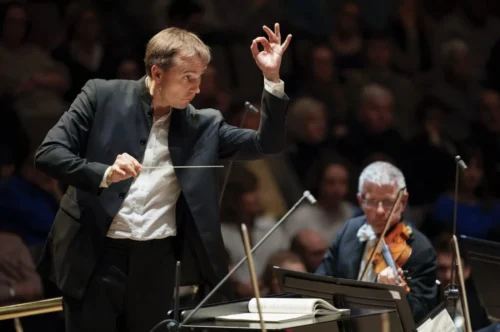
It is hard to beat a Russian conductor performing Shostakovich and Vasily Petrenko was in full command of every nuance in the score. The orchestra were on top form, I highlight the woodwind: Sonia Sielaff (clarinet), Richard Ion (bassoon), Patrick Flanaghan (cor anglais) and Diomedes Demetriades (piccolo) in particular. Duncan Riddell was an outstanding Leader, his instrument deliciously honeyed when muted for his solo passage.
In the opening first movement, Moderato, I was much taken by Petrenko’s use of his left arm, swirling to interweave the melodic line as it changed sinuously between the string sections. The fearsome second movement scherzo (Allegro) was particularly brutal, ‘butchery, blood and guts’ as Petrenko put it expressively in his pre-concert address. Petrenko explained the story behind the DSCH and EAEDA (E-La-Mi-Re-A = Elmira) monogram themes in his talk and they came over, courtesy of the principal horn) in the third movement loud and clear. An exciting final movement, with its thundering DSCH hammered out on the timpani, brought this shattering symphony to its close.
A standing ovation for a well-constructed and excellent concert.
John Rhodes