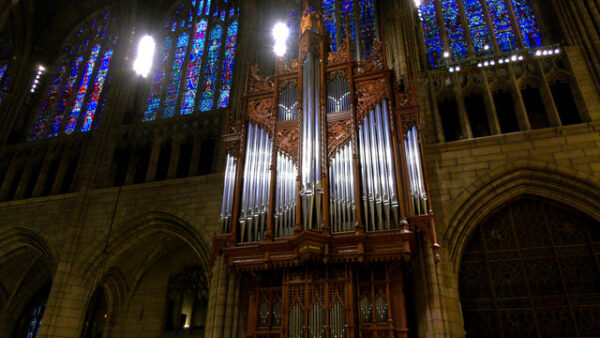
 United States Various: The Choir of New College Oxford, Hugh Rowlands (assistant organist), March McDevitt & Joseph Hyam (organ scholars) / Robert Quinney (conductor). Saint Thomas Church Fifth Avenue, New York, 27.3.2026. (RP)
Opera and ballet were Timothée Chalamet’s prime targets, but wouldn’t the English cathedral choir tradition, assuming he knows of it, be on his list too? The American actor deemed them cultural relics that few people care for, except for a few diehards who maintain them on life support.
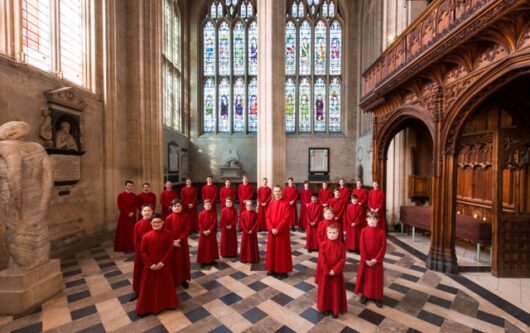
English church choirs may seem to fit the mold, but they are not on the endangered list. They are remarkable, ever-evolving institutions, as evidenced by The Choir of New College Oxford’s concert at Saint Thomas Church Fifth Avenue. Through works spanning centuries, the choir proved that the tradition remains remarkably vital, achieving not only its intended musical ends but also its spiritual and educational ones. In fact, with half the choir being boys and the other musicians mostly in the bloom of young adulthood, the future seems rosy.
The Oxford choir’s visit to St. Thomas Fifth Avenue linked two of the Anglican church’s bastions of the English boy chorister model, which traces its beginning to the establishment of a school for choristers at St. Paul’s Cathedral in 604. Since New College’s founding in 1379, the school has always maintained a boys’ choir. Its model of furnishing an education to boys, combined with their daily participation in chapel services, became the prototype for all others.
The Saint Thomas Choir School is an heir to that tradition. The boys choir school was founded by Dr. T. Tertius Noble, who served as the church’s organist and choirmaster from 1913 until his retirement at 75 in 1947. He agreed to leave York Minster in England on the condition that Saint Thomas establish a choir school, which it did in 1919. There are still 20 Anglican cathedral schools in Great Britain with choirs that include boys, but only Westminster Abbey has an all-boarding, all-boys school. The Saint Thomas Choir School is the last in the US.
Robert Quinney, the Director of the Choir of New College Oxford, began his musical life as a chorister, initially in Dundee Cathedral Choir. He read music at King’s College, Cambridge, where he was Organ Scholar. Before coming to Oxford in 2014, Quinney held posts at Westminster Cathedral, Westminster Abbey and Peterborough Cathedral. He played the organ at the wedding of Prince William, Duke of Cambridge, and Catherine Middleton in Westminster Abbey on 29 April 2011, which was viewed by an estimated 2 billion people worldwide.
Quinney led the New College choir in a program that underscored its dual roles as caretaker of the tradition’s past and champion for its future. The concert began with a pristine performance of Palestrina’s setting of ‘Laudate pueri Dominum’ for two choirs. Quinney achieved a remarkable level of transparency and clarity in its glorious but tricky eight-part counterpoint, clearly delineating the piece’s structural complexity.
William Byrd and Orlando Gibbons are two of the pillars of English choral music, spanning the late Renaissance to the early Baroque. Some 40 years older than Gibbons, Byrd died just two years before him at the age of 83. The elder composer lived in an age of conflict between Catholics and Protestants in London, while Gibbons wrote sacred music entirely within the established Church of England.
Although a Catholic, Byrd’s ‘O Lord, make thy servant’ illustrates his artistic and political dexterity. It is a prayer for Queen Elizabeth I, perhaps in honor of her ascension to the throne, which the Choir of New College sang with the appropriate reverence and elegance. Two anthems by Gibbons, both appropriate for Lent, were also performed, ‘O Lord, in thy wrath’ and ‘Hosanna to the Son of David’. In the latter, the choir perfectly delineated Gibbons’s complex transitions between polyphony and homophony. Quinney and his singers were equally attuned to the emotion that Gibbons instilled in the piece, joyfully proclaiming Christ’s triumphant entry into Jerusalem on Palm Sunday.
Except for two works by Benjamin Britten, his ‘Festival Te Deum’ and ‘Jubilate in E flat’, the second half of the program was devoted to composers active today, beginning with Matthew Martin’s anthem, ‘I saw the Lord’, a setting of selections from the prophecy of Isaiah. Quinney emphasized the work’s dramatic intensity in this riveting performance, especially through the sounds he drew from the choir in Martin’s expansive and emotive choral writing. Tenor Michael Alchin’s and organist Hugh Rowlands’s performances also added to the drama of the piece.
American composer Nico Muhly was raised in Providence, Rhode Island, where he sang in the choir of Grace Episcopal Church. He has made significant contributions to the canon of sacred choral music, including his setting of John Donne’s ‘To shutt up this circle’, which he composed for The Choir of New College at Quinney’s request in 2025. Its most striking moment came when a treble soloist sang with tonal brilliance and extraordinary clarity the words ‘where we shall have continuall rest’ as the choir repeated the word ‘rest’ in contrasting musical permutations.
Kerensa Briggs was born into the English choir school tradition and embraced it. Her father is organist David Briggs, who is currently Artist in Residence at the Cathedral of St. John the Divine in New York. She sang with ensembles including the Gloucester Cathedral Youth Choir and the Choir of King’s College London and specializes in choral music as a composer. Quinney led the choir in a luminous reading of her moving setting of ‘O nata lux’, notable for how subtly he shaped its flowing musical lines and the subtle dynamic shifts he coaxed from the singers.
The singing concluded with Rhian Samuel’s a cappella setting of George Herbert’s ‘Love bade me welcome’. The Welsh composer wrote the piece when she lived in America earlier in her career. Quinney’s sensitive approach to text and mood permitted Samuel’s setting of the spiritual dialogue to unfold naturally, alternating between crystalline singing from the trebles and rich choral passages. A resonant unison marked the supplicant’s final acceptance of Love’s invitation.
St. Thomas Fifth Avenue has two great organs, the Miller-Scott Organ in the chancel, installed in 2018 by Dobson Pipe Organ Builders, and the Loening-Hancock Gallery Organ installed by Taylor & Boody in 1996. Hugh Rowlands, Assistant Organist at New College, played works on both instruments that demonstrated their unique tonal qualities.
In the first half, Rowlands performed Bach’s Concerto in D minor, an organ transcription of Vivaldi’s Concerto for Two Violins on the gallery organ. It provided the opportunity for Rowlands to not only demonstrate his technical virtuosity but also his refined taste, drawing color from the organ, especially from the instrument’s string stops. These traits were on equal display in Matthew Martin’s Prelude and Fugue. Rowlands brought brilliance, lightness and transparency to the Prelude, and released the full power of the organ in all its magnificence in the Fugue’s thrilling climax.
For an encore, the choir performed Imogen Holst’s setting of John Donne’s ‘A Hymne to Christ’. Donne wrote the poem when traveling to Germany in 1619 as a prayer for love and protection. Holst, the daughter of the composer Gustav Holst, composed her setting in 1940 in the early days of World War II. The Choir of New College captured the musical delicacy of Holst’s setting and movingly expressed the comfort that faith lends in uncertain times, of which Donne wrote.
Rick Perdian
Featured Image: The Miller-Scott Organ at Saint Thomas Fifth Avenue © Saint Thomas
Palestrina – ‘Laudate pueri Dominum’
Byrd – ‘O Lord, make thy servant’
Gibbons – ‘O Lord, in thy wrath’, ‘Hosanna to the Son of David’
Bach – Concerto in D minor, BWV596; ‘Komm, Jesus, Komm’, BWV229
Schutz – ‘Herr, wenn ich nur dich habe’
Matthew Martin – ‘I saw the Lord’; Prelude and Fugue
Kerensa Briggs – ‘O nata lux’
Nico Muhly – ‘To shutt up this circle’
Rhian Samuel – ‘Love bade me welcome’
Britten – ‘Festival Te Deum’, ‘Jubilate in E flat’
Encore: Imogen Holst – Setting of John Donne’s ‘A Hymne to Christ’