 United States ‘Parisian Voices’ – Various: Erika Baikoff (soprano), Ken Noda, Orion Weiss (piano), Lun Li (violin), Matthew Lipman (viola), David Requiro (cello), Sooyun Kim (flute), Chamber Music Society of Lincoln Center. Alice Tully Hall, New York, 12.4.2026. (RP)
Saint-Saëns – Trio No.1 in F major for piano, violin & cello, Op.18
Duparc – L’Invitation au voyage
Ravel – Shéhérazade for voice, flute & piano
Fauré – Quartet No.1 in C minor for piano, violin, viola & cello, Op.15
If April in Paris wasn’t in the cards for you, then the Chamber Music Society of Lincoln Center’s ‘Parisian Voices’ was just the ticket. The audience that filled Alice Tully Hall on a sunny though brisk Sunday afternoon was rewarded with captivating and fresh performances of French Romantic and modernist musical gems.
A change of scenery was the catalyst for Saint-Saëns’s Piano Trio No.1 in F major. Composed while he was on holiday in the Pyrenees, it brims with Saint-Saëns’s ability to express in music the joy and serenity of the natural world. The buoyant mood is also perhaps attributable to a brief break from his mother, with whom he lived and had a particularly intense relationship. Violinist Lun Li, violist Matthew Lipman and cellist David Requiro captured that joie de vivre in their winning performance which, for all the detail they brought to the music, remained open and spontaneous.
In the Allegro vivace, a lively melody was tossed from violin to viola, finally landing in the cello, as lightly as a kite floating in the wind. In the second movement, Li’s silvery, emotion-laden tone made its pianissimo melody bloom gently. In the Scherzo, Li and Requiro plucked perfect pizzicatos, and Weiss flung dazzling arpeggios. There was drama too in the movement but leavened with a touch of humor. Weiss propelled the finale with a sweeping melody, which led to a final sweet tune that Li played to perfection. Weiss brought it home with cascades of sparkling piano arpeggios.
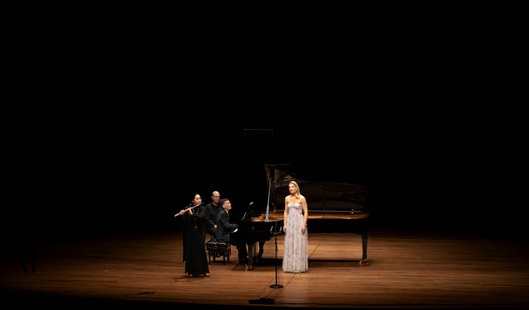
Erika Baikoff’s singing in Duparc’s L’Invitation au voyage was an alluring invitation to a far-off land of calm, beauty and love. She was a breath of spring incarnate in her simple white dress with a delicate lilac-colored floral pattern. Reality was swept away, as Baikoff’s lustrous soprano floated like a gently passing, scented cloud above the scintillating, intoxicating sounds that Ken Noda drew from the piano.
Flutist Sooyun Kim joined Baikoff and Noda in Ravel’s Shéhérazade, which was inspired by the romanticized Middle East of One Thousand and One Nights. In ‘Asie’, Baikoff spun a narrative that captured the fabled lands in a voice glistening with wonder and excitement. Her tone grew darker and more dramatic as she described the horror of lives dispensed with by whim. Noda summoned a rueful sense of mystery, as Baikoff sang the final lines in haunted tones that suggested the pipe the narrator smoked contained something more potent than tobacco.
Baikoff aroused longing and sensuality in ‘La flûte enchantée’, singing of a slave girl listening to her lover play a flute from outside while her master sleeps. Kim strolled onto the stage playing the dreamy, languorous melody in dialogue with Baikoff’s description of the emotion it evoked in the girl. With the sounds of her flute lingering in the air as Kim walked off the stage, Baikoff was left alone to muse that each note had been like a kiss.
In the final song, ‘L’Indifférent’, Baikoff displayed all of the artistic gifts that made her singing so magical. She related the dreamlike tale of a handsome stranger who ignores the narrator’s invitation with extraordinary naturalness, ease and a gossamer legato. Noda was her equal in capturing the fleeting moods and colors that course through all three songs.
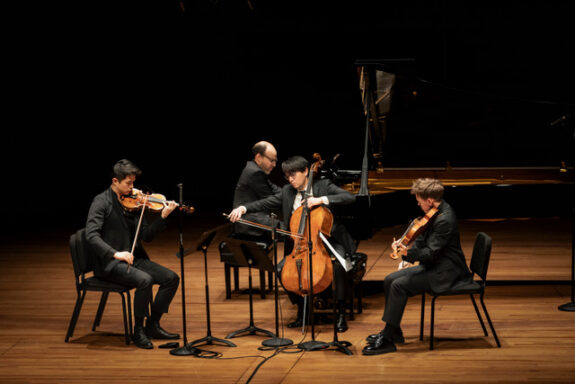
Fauré combined classical elegance and romantic passion with harmonies that bent towards the future in his First Piano Quartet. The piece has been described as ‘the pure happiness of a carefree mind’, perhaps reflecting the composer’s relief after ending a tumultuous romance. The performance of violinist Lun Li, violist Matthew Lipman, cellist David Requiro and pianist Orion Weiss was rich in lyrical warmth and brimmed with high spirits, although drama was ever-present.
In the first movement, the strings played the opening theme with excitement and urgency, yielding to more graceful, lighter playing in the piano. Scintillating cascades of melodies streamed in succession from the strings. String pizzicatos made the Scherzo bristle with excitement, which didn’t fade with the suave musical dialogue that followed.
Contrast was provided by Requiro’s rich tone in the Adagio’s mournful melody, the impact of which was heightened with Weiss’s equally emotive playing. The beginning of the finale was marked by constant rhythmic drive and the interplay between Li and Lipman over Weiss’s shimmering triplets in the piano. Li’s playing evolved from luminescence to radiance in the extended solos. With Weiss tearing up the keyboard, the three strings surged forward to the triumphant, resounding chords that brought this splendid French sojourn to a close.
Rick Perdian
Featured Image: Lun Li (violin), Matthew Lipman (viola), David Requiro (cello) and Orion Weiss (piano) in Fauré’s Quartet No.1 in C minor © Paul Mardy