
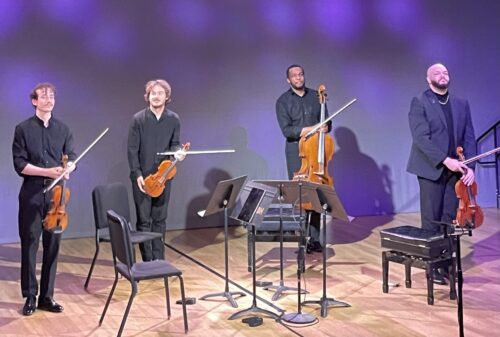
 United States Haydn, Childs, Brahms: Isidore String Quartet (Phoenix Avalon, Adrian Steele [violins], Devin Moore [viola], Joshua McClendon [cello]). 92nd Street Y, New York, 2.5.2026. (DS)
Haydn – String Quartet in B-flat major, Op.76, No.4, ‘Sunrise’
Billy Childs – String Quartet No.4, ‘American Mosaic’ (NY premiere)
Brahms – String Quartet No.3 in B-flat major, Op.67
After the Isidore String Quartet opened with a colorfully pliable rendition of Haydn’s ‘Sunrise’ Quartet, classical and jazz composer Billy Childs introduced his Fourth String Quartet, ‘American Mosaic’, to the audience at the 92nd Street Y.
It is ‘for ears, hearts and minds’, he told us. The three-movement quartet depicting the past and present state of race relations in the United States was also written to relay a personal desire, as Childs explained, ‘of where I want race relations to go’. Composed for the Isidore String Quartet, it made for a deeply gratifying listen on the heels of the US Supreme Court’s decision to dismantle the last vestiges of the Voting Rights Act – especially detrimental to Black political representation in the American South. The timing was not lost on the audience who murmured in agreement as Childs described his musical purpose.
It would be remiss not to mention that the piece is also very much for the eyes. The members of the Isidore String Quartet portray an equality rarely seen on a classical performance stage – two white musicians (Phoenix Avalon and Adrian Steele on violin) and two Black musicians (cellist Joshua McClendon and violist Devin Moore). Childs has had a strong partnership with the quartet since their founding at Juilliard in 2019 (the Isidore has performed his previous quartets), and he was well positioned to bring attention to their balanced racial identity by writing the parts to match accordingly. The Black American voice in the work is channeled through McClendon and Moore in the lower string registers while the white experience came from the violins.
In the first movement, ‘Separate but Equal’, duets push back against each other between the higher register strings and the lower. The violins open with fast, strident material while the contrasting responses from cello and viola pull more questioning, beautifully mellow tones. Tensions rise between the two groups with an urgency that all four players harnessed with evocative flair. Childs proves a master of texture in his use of trills, pizzicato, straining squeaks from the E strings or drones from the cello’s C string. While the movement sounded classical in style, his jazz background undoubtedly drove this fantastic balance in artistry.
In ‘The Coexistence Struggle’ – the second movement – the Isidore ushered in a sense of emotional trepidation at the outset with a delicate yet tenuous harmony. It lasted briefly before they burst into a veritable chase between voices. Violist Moore and violinist Steele eventually landed in passages that link complex passagework while McClendon and Moore compete in lush melodic material. The Isidore’s perceptive interpretation fleshed out the French Impressionist and German Modernist stylistic influences that informed this movement’s more dissonant material – both in harmony and structure. This modernist aesthetic symbolized well the depth of racial struggle still prevalent today.
The final movement is entitled ‘Lift Every Voice’, after the Black national anthem. Beginning with a poetic cello solo played with gleaming clarity by McClendon, a new sonic space is established. Letting go of the modernist tonal clashes of the second movement, folklike melodic styles harness the voices. All four instruments begin to close phrases together, allowing quietness to exist between each phrase. Eventually, over a cello drone, a more improvisational and informal style of playing emerges. The ensemble united around material evoking peaceful American modal harmonies, hymn tunes, folk dance rhythms and an undeniable sense of place. Proud passages mixed with gentle melodies – neither overpowering the other. The work ends with a moving quietude, anchored in a soft major cadence. The Isidore, with their unquestionable talent at igniting fresh meaning in the repertoire, played ‘American Mosaic’ with a solemnity that paired gracefully with hints of optimistic energy.
The evening closed with an articulate performance of Brahms’s String Quartet No.3. Leaning into harmonies, their tight teamwork left one breathless. The Andante, in particular, reached a high point of spirituality that triggered sighs from the audience. Violist Moore led the unfolding third movement with a luster so blithe that the four fell into enrapturing symbiosis. Glimpses of Childs’s captivating use of quiet, simple melody reverberated in Brahms’s final movement.
The graceful arc of interpretive clarity that the Isidore brought to the entire evening made it easy to listen with open ears, hearts and minds.
Daniele Sahr