 United Kingdom Longborough Festival Opera 2026 [2] – Wagner, Tristan und Isolde: Soloists, Longborough Festival Opera Chorus and Orchestra / Antony Negus (conductor). Longborough, Gloucestershire, 20.6.2026. (CP)
With the dream husband and wife team of conductor Antony Negus and director, Carmen Jakobi, this long-awaited revival of Longborough’s 2017 production of Tristan und Isolde more than lives up to expectations. For many years, the Negus musical journey at Longborough with Martin and Lizzie Graham did in his own words ‘provided a marvellous opportunity to build an ensemble of singers and mould a fine group of players into a cohesive and responsive orchestra on our continuing Wagner journey’. Now this continues, with Polly Graham as Artistic Director. With a first attempt at Die Meistersinger von Nürnberg next year, this is a golden age for Wagner-lovers at Longborough. It is trite to suggest Longborough is the UK’s Bayreuth, just accept that this location, this team and its supporters have built a venue and its reputation. As for Negus he has now had a long overdue and much-deserved CBE and is relinquishing his role as Music Director this year, Christopher Ward takes over in 2027 when Negus becomes Conductor Laureate.
Opening night on Saturday, thankfully before an anticipated heatwave, was a glorious event, many in the audience standing to applaud the remarkable staying-power of Negus. He knows exactly when to power up the orchestra and when the subtler moments are needed; his charges in the pit responded wonderfully. All now have a short break until 2 June when a run of just five performances begins. Do find a ticket if you can, this is one of the finest Jacobi/Negus collaborations since 2017. The fateful course of events that leads to the climactic moment and tragic end of the opera must count as one of the most bizarre in either historical or fictional stories. The Jacobi direction ensures total focus on those final words ‘… unbewusst, – höchste Lust!’ which translates to ‘oblivion, the greatest pleasure’ or ‘supreme bliss, highest joy’. Negus held the orchestra in suspension for those final chords before the audience’s appreciative eruption. In his contribution to the excellent programme notes, the late Michael Tanner described the work as ‘No wonder Wagner has been so often called a magician, for his music in Tristan bewitches us while the action, the text, show that love is not the beautiful dream but the most exquisite illusion’. This performance was one of those magical occasions!
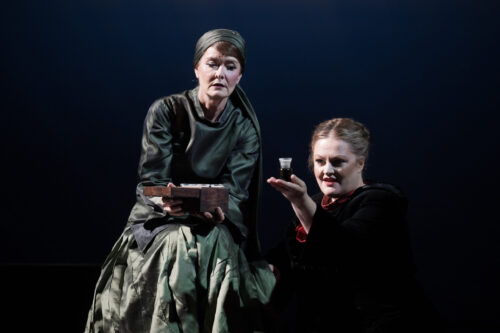
Peter Wedd (Tristan) returns to repeat his success of 2017; Catherine Carby (Brangäne) repeats her success of 2015; her mezzo-soprano voice is so convincing as she actively supports Isolde; both have lost not one ounce of their energy in the last decade. They know their roles intimately; they are the foundation on which this production builds. Catharine Woodward uses her recent experience of Bayreuth (Gerhilde) and earlier concert productions of the second acts of Tristan and Parsifal to create a most convincing Isolde, one which is believable and full of emotion, most especially in the last act with her singing of the Liebestod when she finally recognises Tristan was indeed mortally wounded. Wedd’s energy can only be described as him having an inexhaustible reservoir of stamina; he commanded the stage, his performance at times electrifying. Having sung the title role in Peter Grimes he fully understands the importance of the role in depicting Tristan as an authoritative individual. Woodward claims she adores the role of Isolde and her Longborough debut is one with which she can be extremely pleased. Her soprano voice has blossomed into a fine Wagnerian one and she is already in demand at the Royal Opera House and Regents Opera in Wagner roles.
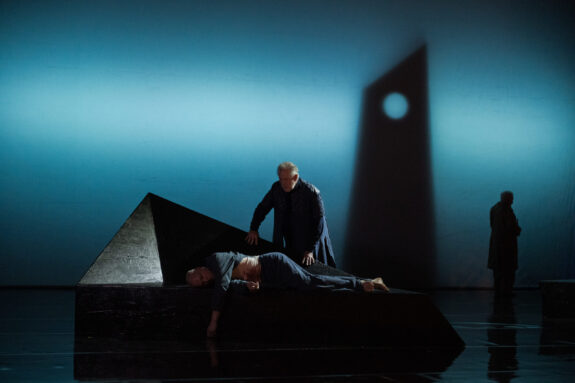
Set designs can be very complicated and physically challenging for those on the stage. Director Carmen Jacobi and designer Kimie Nakano brings a very fresh approach to this 2026 production. Gone are her somewhat controversial dancers of the 2015 production. This year, the sets are refreshingly simple, a plinth on which much of the action takes place, a seascape with one sail as a backdrop and a woodland scene with one large tree trunk. New this time is the use of the prelude, a sort of musical summary of the entire work, during which Tristan and Isolde stumble to the ground having drunk a potion. They face each other as they will do again at the end of the five-hour love song. Nakano deserves much credit for these simple sets as she clearly understands audiences for Wagner at Longborough are there to especially hear the orchestra and the singers. Another asset at Longborough is Ben Ormerod’s lighting plot with one spot on the plinth in Act I and very subtle changes in light levels with some added colour maintaining the simplicity theme.
Many audience members have enjoyed the Negus excellence in other productions, not least the widely admired sold-out Longborough Ring cycles. It is quite exhausting to watch – on one of the monitors positioned in the rafters – Negus conduct as he winds up the orchestra!
High levels of competence throughout the company make this all compelling watching and listening. Robert Hayward (Kurwenal) is Tristan’s determined minder, not always a man of integrity. Alistair Miles (King Marke) performs well as a troubled man, with Brian Smith Walters (Melot), Peter Bronder (Shepherd) and Tobias Campos (Sailor) contributing much to the overall success. All are supported by the remarkable Longborough Festival Opera Orchestra led by Barbara O’Reilly. Horns and the wind section were superb. The trumpets playing from side boxes, welcoming the arrival of the King, were stupendous and those strings sustained the magic of Wagner’s score throughout.
Clive Peacock
Featured Image: Peter Wedd (Tristan) and Robert Hayward (Kurwenal) © Matthew Williams-Ellis
Production:
Design – Kimie Nakano
Lighting designer – Ben Ormerod
Chorus master – Kelvin Lim
Cast:
Tristan – Peter Wedd
Isolde – Catharine Woodward
Marke – Alistair Miles
Brangäne – Catherine Carby
Kurwenal – Robert Hayward
Shepherd – Peter Bronder
Sailor – Tobias Campos (emerging artist)