 United States Caramoor Festival [3] – Marc-Antoine Charpentier: Soloists from Le Jardin des Voix, Les Arts Florissants / William Christie (conductor). Venetian Theater, Caramoor Center for Music and the Arts, Katonah, 17.7.2026. (ES-S)
Charpentier – Les Arts florissants, H.487; La Descente d’Orphée aux enfers, H.488
Nearly half a century after William Christie named his ensemble after Marc-Antoine Charpentier’s Les Arts florissants, the composer’s oeuvre remains a testing ground for the group’s interpretive and theatrical ideas. In its early years, Christie and his musicians used this repertory to forge their distinctive approach to French Baroque performance: alertness to language, flexibility of phrasing and ornamentation, and a conviction that historical awareness need not result in museum-piece theatre. Presented at Caramoor largely by the young singers of Le Jardin des Voix, this touring production of Charpentier’s Les Arts florissants and La Descente d’Orphée aux enfers followed that approach while opening it to further experiment.
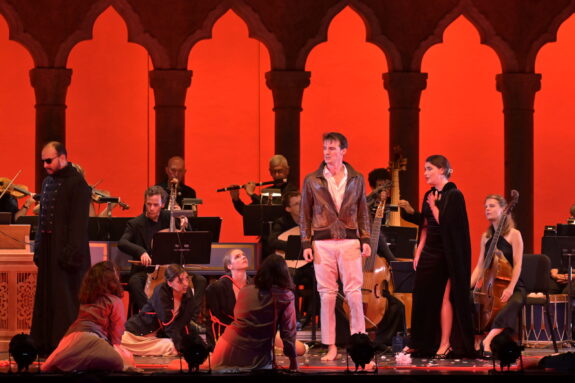
Marie Lambert-Le Bihan and Stéphane Facco linked the two works by allowing the social gathering of the first to evolve into the wedding celebration of the second. Recurring visual motifs and relationships between characters reinforced that continuity while Martin Chaix’s choreography gave singers and dancers a shared physical language. The action began almost imperceptibly, with performers appearing casually around the stage and gradually drawing the audience’s attention. It was an enticing opening that made effective use of the Venetian Theater’s openness to its natural surroundings.
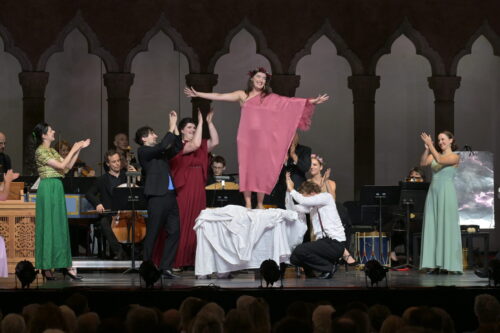
Charpentier described Les Arts florissants as an idylle en musique. It is also a panegyric to Louis XIV: Music, Poetry, Painting and Architecture celebrate their flourishing under a monarch portrayed as the guarantor of peace, only for Discord to intrude and provoke conflict before order is restored. The allegorical dramaturgy can seem schematic, and the contemporary garden-party setting did not sufficiently overcome that limitation. The ceaseless movement nevertheless gave the work theatrical vitality: the singers negotiated coordinated gestures, intricate footwork and rapidly changing formations, while the four professional dancers elaborated the same vocabulary with greater athletic freedom. The result was an unusually seamless integration of singing and dance.
Musically, Les Arts florissants took an uncharacteristic few moments to settle. With the singers moving in front of the conductor and instrumentalists, the opening choral entrances were not entirely together. The ensemble quickly found its footing and no comparable coordination problems followed. Christie directed from the harpsichord with characteristic economy, relying on sparing but precise gestures and on the musicians’ long familiarity with his methods.
After the interval, La Descente d’Orphée aux enfers brought the evening into sharper dramatic and emotional focus. The surviving score leaves the myth suspended before Orphée’s fatal backward glance, ending instead with the promise of Euridice’s return. The production accepted this open conclusion on its own terms, rather than supplying the familiar tragic ending.
Chaix’s choreography made no attempt to reconstruct Baroque dance. Its vocabulary was openly contemporary although it retained traces of Baroque symmetry, posture and rhetorical gesture. Energetic and visually engaging in Les Arts florissants, the movement became more restrained and dramatically purposeful in La Descente d’Orphée aux enfers. Red ropes evoked both the barriers of the Underworld and the chains of its tormented inhabitants while white sheets became Eurydice’s shroud. These simple devices created forceful stage images without seeming intrusive.
Drawn from the current cohort of Le Jardin des Voix, the young cast brought a striking combination of musical assurance and theatrical commitment. As he has throughout his work with young singers, Christie gave them a clear stylistic framework without limiting their individuality. Richard Pittsinger emerged as the evening’s central presence in the title role of La Descente d’Orphée aux enfers. Supported by the two violas da gamba that served as Orphée’s lyre, he combined the luminosity and poise associated with the French Baroque haute-contre voice with an emotional directness that made the poet’s power of persuasion entirely credible. Camille Chopin brought a clear, flexible soprano and an unaffected freshness to Euridice, qualities that also made her an apt embodiment of La Musique in Les Arts florissants. Colombian bass Kevin Arboleda-Oquendo gave Pluton a resounding voice and an imposing physical presence, embodying an authority not easily swayed. Sarah Fleiss, La Poésie in Les Arts florissants, brought warmth, alertness and persuasive compassion to Proserpine in the second work. Josipa Bilić made a particularly strong impression as La Paix in Les Arts florissants and in her brief appearance as Daphné in La Descente, singing with poise and natural radiance.
The wisdom of pairing the two works became increasingly evident as the evening unfolded, with the inventive staging revealing the breadth of Charpentier’s theatrical imagination.
Edward Sava-Segal
Featured Image: Scene from La Descente d’Orphée aux enfers © Gabe Palacio
Les Arts Florissants
Music director, Harpsichord and Organ – William Christie
Semi-staging – Marie Lambert & Stéphane Facco
Choreographer – Martin Chaix
Soloists from Le Jardin des Voix
Josipa Bilić, soprano (La Paix, Daphné)
Camille Chopin, soprano (La Musique, Euridice)
Sarah Fleiss, soprano (La Poésie, Proserpine)
Tanaquil Ollivier, soprano (Œnone)
Sydney Frodsham, contralto (L’Architecture, Aréthuse)
Bastien Rimondi, high tenor (La Peinture, Ixion)
Richard Pittsinger, high tenor (Orphée)
Attila Varga-Tóth, tenor (Tantale)
Olivier Bergeron, bass baritone (La Discorde, Apollon, Titye)
Kevin Arboleda-Oquendo, bass (Un Guerrier, Pluton)
Dancers – Tom Godefroid, Andrea Scarfi, Claire Graham, Zarina Stahnke