
 United Kingdom Finnis, Bruckner: Sheku Kanneh-Mason (cello), London Symphony Orchestra / Sir Antonio Pappano (conductor). Barbican Hall, London. 25.10.2026. (AV-E)
Edmund Finnis — Cello Concerto (LSO co-commission)
Bruckner — Symphony No.9 in D minor (Urtext Edition, ed. Benjamin-Gunnar Cohrs)
Co-commissioned by the Los Angeles Philharmonic, the London Symphony Orchestra, the Melbourne Symphony Orchestra and the Dresden Philharmonic, Edmund Finnis’s Cello Concerto was written for Sheku Kanneh-Mason, whose instrument becomes a solitary voice emerging from its subterranean sound world.
The virtuoso Finnis makes a virtue out of apparent contradiction: for the sound is weightlessly substantial, its translucent calm threaded and unthreaded by restless energy. Mutating motifs recur in shape-shifting, formless forms, gathering force before dissolving solidified into a crystalline haze.
In Radiant, the orchestra created a panoramic, shimmering space across which the cello traced long, florid lines. Finnis’s colliding orchestral colours had a delicately rough, finely grained surface, their translucent calm threaded with restless energy. The solar sonority felt tangible yet elusive, buoyant yet unsettled, at once immediately present whilst strangely otherworldly.
The central Lamentoso drew the music into a nocturnal-noon, the cello’s yearning line darkly luminous, its deep, resonant tones expanding and contracting like slow breaths. Kanneh-Mason’s somatostatin-sound had a warmly chilling quality, intimate yet corporeally spectral as it merged and submerged with the orchestra. The languid lament remained restrainedly raw, never sentimental, its grief surfacing from within the music rather than imposed upon it. As the textures thinned, faint string overtones cast a vanishingly present pale glow over the final descent.
In Fast, flowing, the music gathered a restlessly fluid propulsion. The cello glided above the orchestra’s iterative patterns, then absorbed their motion into its own singing line. Kanneh-Mason brought a fiercely gossamer delicacy to the solo part, sustaining its lyrical freedom as the surrounding textures grew denser and more radiant. The result was exultantly weightless, ecstatic without bombast, its brilliance never blunt or overbearing. The concerto’s conclusion felt less like a conventional virtuoso triumph than an illumination from within: the music grew more urgent even as its luminous sound remained blindingly radiant.
Antonio Pappano drew scintillating playing from the London Symphony Orchestra, whose impeccable precision and stylish finesse balanced Finnis’s shifting orchestral colours while allowing Kanneh-Mason’s unusually distinctive cello sound to emerge clearly from the orchestral texture.
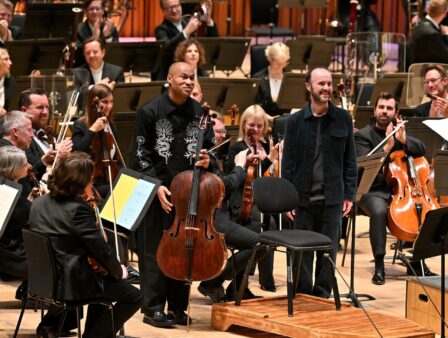
This was a remarkably compelling cello concerto — by far the most original I have heard so far this century. Finnis revealed himself as a composer of the first rank. Kanneh-Mason’s embrace with Finnis on stage after the performance movingly acknowledged the affinity between them.
Just before the second half began, I encountered Finnis as he returned to his seat. I shook his hand and said, ‘Very good,’ to which he replied, ‘Thank you.’
Bruckner’s Ninth Symphony began with a sense of darkly germinating expectancy. In Feierlich, misterioso, the tremulous strings established a barely voiced foundation, above which hesitant wind chords and gleaming horn calls emerged from a primordial, shadow-laden space. Pappano resisted hurrying this emergence: the wind chords and horn calls gradually intensified the tension until the full orchestra unleashed the monumental first theme. The effect was a terrifyingly elemental release, the theme crystallising out of the opening’s tremulous strings, wind chords and horn calls.
The LSO’s playing was immaculate: the brass gave the first subject granite-like authority and burnished brilliance, while the strings sustained the restless inner movement beneath Bruckner’s vast paragraphs. After the opening eruption, pizzicato strings exposed the transition to the second subject, whose broader, more lyrical melody offered provisional consolation. The cellos and violins warmed the line without dispelling its unease. The woodwind-led third thematic group unsettled the atmosphere once more, its shifting colours increasingly poised-yet-foreboding as tension mounted.
What impressed most was Pappano’s control of the movement’s immense proportions. The development was not a succession of disconnected climaxes; earlier ideas returned in altered, more angular forms, the symphonic argument tightening towards passages of almost unbearable intensity. The great orchestral outbursts had a savagely disciplined force, heightened by Pappano’s shaping of the silences and retreats that followed. As the recapitulation gave way to the coda, the tension continued to mount, the underlying harmony retaining its deeply disquieting edge.
For the critical timpani part at the movement’s absolute climax, Pappano permitted a blurred, rumbling effect that was almost buried beneath the massive wall of brass. The shattering conclusion sounds far more potent when the notation is given sharp rhythmic clarity instead. Rather than a sustained roll, executing Bruckner’s written triplet rhythm as isolated, separate timpani blows creates a physical, hammering cadence. Delivering the part as a series of heavy, repeated pounding thuds – precisely timed to match each of the brass section’s terrifying block chords — allows the listener to actually hear the timpani rhythm punch through the dense orchestral texture. This was the legendary, bone-rattling approach pioneered by Bernard Haitink and his principal timpanist, Jan Labordus, at their unforgettable 1983 Concertgebouw BBC Prom. By hammering out individual, hard-accented timpani blows instead of a blurred roll, they kept the foundational pulse entirely clear. Without this repeated rhythmic precision to punctuate the brass chords, the final eruption lacked the pounding force that this colossal climax demands.
Bruckner’s schizoid Scherzo surged with demonic energy, its jagged, hard-edged rhythms making it less a peasant dance than a darkly ritualistic procession. Pappano kept the momentum taut, allowing the razor-edged accents and dissonant clashes to bite without dissolving into orchestral tumult. The LSO’s precision gave the music a macabre exhilaration, at once rigorously controlled and perilously wild.
The Trio, marked Schnell, offered a fleeting contrast, its lighter textures elusive but still touched by nervous energy. When the Scherzo returned, its obsessive rhythmic force seemed all the more unsettling. Pappano and the LSO brought the movement to a close with discipline and delirium held in precarious balance.
The Adagio brought the symphony to a deeply moving culmination, Pappano sustaining an unhurried span in which grief and radiance seemed inseparable. The opening violin melody rose with almost unbearably exposed poignancy, its searching intervals unfolding above a hushed orchestral foundation. Pappano gave the musical line room to breathe without losing its inner concentration. The LSO’s playing was finely wrought, the strings infusing the melody with warmth of expression and quiet yearning, while the brass chorales emerged with grave, burnished solemnity. Bruckner’s harmonic world remained poised between longing and desolation, its moments of consolation never quite dispelling the shadow beneath them.
Pappano shaped the great crescendos with admirable patience, so that the climactic dissonances arrived not as isolated shocks but as the fulfilment of everything that had preceded them. The orchestral sound became almost physically overwhelming, yet Pappano retained control of the movement’s immense architecture. After the great eruption, the retreat into stillness was all the more affecting: the music seemed to look back upon its own devastation, searching for a final, fragile serenity.
Particularly striking was the repeated figure in the first flute near the close (bars 219–224). In Klemperer’s 1970 recording, its isolated, pointed flute notes have a distinctly Morse-code quality, as though bleeping into infinity. Such details can easily be blurred in the larger flow of the music, but Pappano allowed the repeated notes to register with remarkable clarity, making them an arresting feature of the fading solarscape. The final pages receded into a sombre, melancholic withdrawal, the music gradually relinquishing its hold without consolation or resolution.
After the last lingering notes faded, the symphony felt utterly complete, in no need of a fourth movement. Had the Good Lord wanted Bruckner to complete the symphony, He would surely have given him the time to do so. It was all part of God’s plan.
The audience also shared this feeling of finality, waiting respectfully for a few seconds of silence before breaking into exultantly exuberant applause.
Alexander Verney-Elliott