
 United States Berlioz: Benjamin Bernheim (tenor), Orchestra of St. Luke’s / Louis Langrée (conductor). Carnegie Hall, New York, 5.11.2026. (RP)
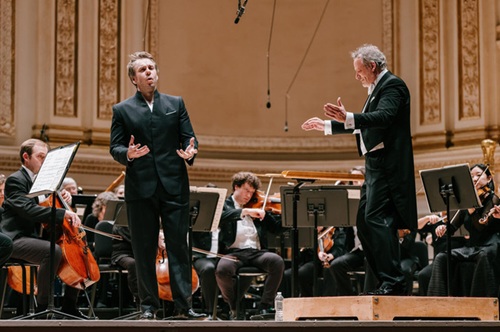
Berlioz – Overture to Les francs-juges, Op.3; Les nuits d’été, Op.7; Symphonie fantastique, Op.14
Encore: Massenet – Werther: ‘Pourquoi me réveiller’
Louis Langrée led the Orchestra of St. Luke’s in an exciting all-Berlioz program to open their Carnegie Hall season. It featured the revolutionary French composer at his most romantic in the song cycle Les nuits d’été and at his most wildly inventive in Symphonie fantastique. The splendid tenor Benjamin Bernheim, featured in the song cycle, added even more luster to the concert.
Berlioz completed three surviving operas. Two others remained unfinished, and he contemplated numerous others that never got off the ground. He did manage to complete Estelle et Némorin, although he destroyed the score. He abandoned his next opera, Les Francs-juges, of which only fragments survive. Fortunately, the Overture was one of them and, popular from the start, it is a fantastic curtain-raiser.
The drama was immediate, with the low strings establishing an evocative mood. A passage for cello and harp was particularly appealing, followed by a graceful violin melody. Flutes and clarinets introduced another lyrical theme over string tremolos that cast a mysterious spell. The emotional twists and turns led to a thrilling race to the finish, a riotous romp that owed more than a passing debt to Rossini.
In Les nuits d’été, Berlioz lavished rich melodies and a sumptuous array of instrumental colors on his settings of six poems from Théophile Gautier’s La Comédie de la mort. The poems explore expectation, love and longing which Berlioz expressed in music of unsurpassed delicacy and expressive richness.
The opening measures of ‘Villanelle’ summoned spring with lightness and sparkle. Bernheim’s expressive delivery heightened the joy contained in the text which celebrates the bliss of everlasting love. Langrée began ‘Le spectre de la rose’ with even greater delicacy, but the music soon blossomed into dazzling depths and arrays of colors. Bernheim embodied the rose, whose brief existence found its fulfillment in adorning the alabaster bosom of a woman at a ball. The tenor moved through a range of hot-house emotions, culminating in floating tones as he sang of the soft fragrance that embodied the rose’s soul. His delivery had an impish quality. His smile seemed a wink as he sang of the rose’s hope that its epitaph would proclaim it the envy of kings.
Despair replaced rapture in ‘Sur les lagunes’, with Bernheim declaring that his beloved was dead, and the plaintive cellos and horns amplified the agony. The tenor gave the song a more narrative shape than a vocal showpiece, allowing its emotions to unfold naturally before a final expression of loss, etched in pain.
In ‘Absence’, Bernheim pleaded for his beloved to return with the utmost simplicity. The final, softly sustained phrases of loss were ravishing. That longing darkened in ‘Au cimetière’ where the agony in Bernheim’s voice found an echo in the brass. With the final song, ‘L’île inconnue’, the tenor’s voice opened into full-throated ebullience. His demeanor was relaxed and insouciant, and his soaring lines and expressive freedom lent the music a rare, exhilarating sense of abandon.
The performances were beautifully controlled, but that control came at the expense of spontaneity. Bernheim and Langrée were reluctant to surrender to the music’s emotional extremes. Precision and attention to detail did not always translate into expressive freedom. Berlioz took enormous risks in his music, and a little more abandon from the performers would have elevated this performance from excellent to sublime.
Bernheim dispensed with that restraint in his sole encore, ‘Pourquoi me réveiller’ from Massenet’s Werther. The sound was glorious and the outpouring of regret devastating.
Inspired by unrequited love and opium-induced dreams, Symphonie fantastique transforms obsession, passion, despair and hallucination into an extraordinary orchestral drama. Langrée and the LSO delivered that full spectrum, from the tender reveries of the opening movements to the sinister bells and demonic frenzy of the finale.
The second movement’s swirling waltz was especially graceful, with the harps adding an alluring shimmer. Even more evocative was the dialogue between the solo English horn and offstage oboe amid the pastoral atmosphere of ‘Scène aux champs’. The shepherd’s final call went unanswered but the timpani’s foreboding rumble indicated the horrors to come.
Langrée’s command of the score was particularly evident in the horrifying ‘March to the Scaffold’ and the ‘Witches’ Sabbath’. The clanging bells were chilling, as were the low brass and winds intoning the Dies irae. In the final measures, the chant and the witches’ dance converged in a cacophonous collision of the sacred and the profane, bringing this musical nightmare to a thunderous close.
Rick Perdian