
 United States ‘Graphic Content Festival – Feldman and Brown at 100’: Maya Bennardo (violin), Lauren Conroy (violin), Hannah Levinson (viola), Matt Schultheis (piano), Drew Wesely (guitar), Eli Wallace (piano), James Ilgenfritz (bass). St. Michael’s Church, New York, 7.11.2026. (DS)
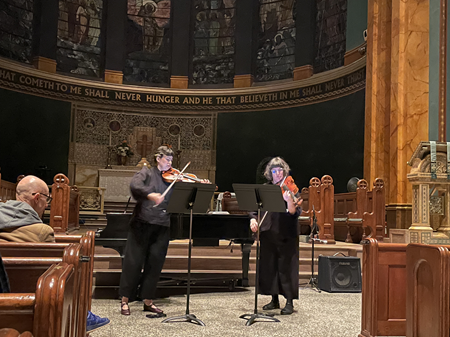
Christian Wolff – 3 Pieces for Violin and Viola
Steven Swartz – merger
Morton Feldman – Spring of Chosroes
Earle Brown – Selections from Folio and Four Systems
Over the past two months, the quiet, sparse aesthetic and stretched pacing of musical narrative created by New York School composers has found an unexpected home in the blue-and-gold, ornately painted interior of St. Michael’s Church on the Upper West Side. The stained-glass windows of the chancel were crafted with Tiffany glass in the image of saints and angels.
The producers of the Graphic Content Festival (a play on words referencing the New York School’s experimental form of compositional notation from the 1950s) may not have initially realized how this setting would offer the possibility of new perspectives for the pitches and textures meant to align with formal abstraction and usually associated with a sparse, art-gallery environment.
Take, for instance, Morton Feldman’s Spring of Chosroes. The title refers to ancient Persian king Khosrow I’s elaborate brocaded carpet. Doubtless, it was a loud, brilliant-colored and bejeweled textile wonder and hardly what comes to mind when thinking of the delicate, nearly non-existent surface textures in Feldman’s compositions. Nevertheless, performed in St. Michael’s by Magpie Duo (Matt Schultheis on piano and Lauren Conroy on violin), the ornate developments of this pixilated, floating work for piano and violin glimmered despite the quiet dynamics in which its world of dark textures emerged.
The duo andPlay (Hannah Levinson on viola and Maya Bennardo on violin) performed Christian Wolff’s Three Pieces for Violin and Viola, which carried fractured sounds and samplings of Americana tunes suited well to a colorful stained-glass environment – except Wolff’s shards of sound broke apart familiar musical narratives instead of piecing them together into a recognizable form. This avant-garde act of dismemberment was in no way reminiscent of violent institutional destruction but sounded more like a playful re-working of the traditional, replete with irony and unhindered in stretching the limits of the concept of tunefulness.
The newest work on the program was by Steven Swartz, a student of Morton Feldman and an invaluable ambassador of the New York School’s legacy. His recent piece, merger, performed by andPlay, is an exploration of the shifting boundaries of sound in chamber music. Crafted around steadier forward movement than in work by his mentor, it called upon a geometric play between violin and viola: the sounds move not in time but rather in space, architecturally. Viola and violin strokes, harmonics and even vocal humming required of both players evoke lines, planes and points that meet, cross or pass untouched. There is a play between the horizontal and vertical in merger that blended perfectly with the soaring columns and crossing rafters aligning the nave.
The evening closed on six pieces by Earle Brown from Folio and Four Systems that define the concept of New York avant-garde. Brown builds short sonic portraits from plucks, strums, reverberations, whisps of sound or knocks on the instrument body, and any kind of tapping and ticking imaginable. Some of these works have been set to dance, like Four Systems which was used for Merce Cunningham’s 1956 Galaxy, and they sound ideal for directing sudden bodily movements. The concentration required by Wesely, Wallace and Ilgenfritz to realize these short but dense works was verging on the holy. With a candle shimmering on the altar behind them, they performed the ground-breaking music with a sense of mystery – appropriate to a space meant to stimulate contemplation and leave questions open for interpretation.
The Graphic Content Festival is not over yet. On 21 November, they will close with a performance of Feldman’s six-hour String Quartet No.2 performed by the FLUX Quartet. Listeners (who are allowed to arrive at any time) are encouraged to bring yoga mats or blankets, to lie down and experience some of New York’s best avant-garde music while gazing at the city’s choicest Tiffany stained-glass.
Daniele Sahr