
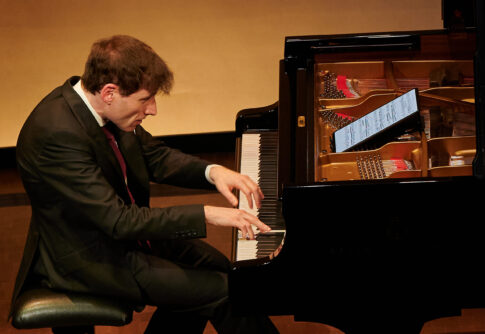
 United States Various: Boris Giltburg (piano). Stephen A. Schwarzman Auditorium, Frick Collection, New York, 18.1.2026. (ES-S)
Rachmaninov – Ten Preludes, Op.23
Chopin – Ballade No.4 In F minor, Op.52
Liszt – Piano Sonata in B minor, S178
Encore: Robert Schumann – Arabeske, Op.18
In keeping with its tradition of presenting important musical voices only rarely heard in New York, the Frick Collection hosted a return recital by the Moscow-born Israeli pianist Boris Giltburg, this time in the new Schwarzman Auditorium.
The recital opened with the late Romantic idiom of Sergei Rachmaninov’s Ten Preludes, Op.23, a set that has long raised the question of whether it sustains the same level of interest across its full span as it does in excerpt. In Giltburg’s hands, the sequence immediately established the character of the entire performance. He allowed the cycle to unfold as a continuous progression, with close attention to the accumulation of sonority, tempo and harmonic tension from one piece to the next. The extroverted preludes benefited from this sense of momentum, their climaxes patiently prepared, while inner voices were carefully weighted to prevent density from turning opaque, as in the sunny, driven B-flat major Prelude No.2, where propulsion never came at the expense of clarity.
In some of the slower numbers, this restraint risked muting the music’s hidden volatility. In the F-sharp minor Prelude No.1, a hushed touch emphasized line and balance, holding emotion in suspension and limiting the capacity of the carefully calibrated dissonances to press forward. By contrast, the broad Prelude No.10 in G-flat major benefited from Giltburg’s emphasis on voicing and long-breathed phrasing, its expansive cantabile line carrying weight without heaviness and recalling a Robert Schumannesque inwardness beneath the surface grandeur. As the set progressed, Giltburg’s strengths came increasingly into view in the more driven preludes, such as the whirlwind No.7 in C minor, where clarity of voicing and a firm sense of hierarchy kept the music’s relentless motion sharply focused.
After the interval, Chopin’s Ballade No.4 in F minor shifted the focus from cumulative breadth to formal concentration. Where Rachmaninov’s Op.23 preludes invite listening across a sequence of contrasting miniatures, fashioned by loose recurrence, Chopin’s final ballade compresses an entire dramatic trajectory into a single, tightly argued span. Giltburg avoided any sense of grandiosity, allowing the opening to emerge quietly, with an inner focus that kept narrative impulse in check. The opening thematic material returned in subtly altered balance; its repetitions gently inflected without being underlined as moments of transformation. As the piece unfolded, Giltburg clarified Chopin’s intricate contrapuntal writing through careful voicing and a flexible sense of pulse; inner lines remained audible even as textures grew denser and harmonic pressure intensified.
In the final pages, where Chopin’s writing turns volatile and highly charged, Giltburg maintained control without smoothing the music’s edges. The coda’s turbulence registered as the release of energy held in reserve throughout the work. With its competing impulses of lyric introspection and kinetic release, the Ballade emerged as a work of poise and tension, defined by its refusal to settle into a single expressive or formal resolution: thematic return, harmonic tension and rhythmic drive continue to coexist without one decisively subsuming the others.
After a moment of respite, Giltburg began Liszt’s Piano Sonata in B minor, the most substantial work on the program and one that stands at a junction of the Romantic paths traced over the course of the afternoon.
What distinguished this reading was the seriousness with which Liszt’s sonata was treated as a work of thought as much as of virtuosity. The opening octave Gs, gently weighted and free of emphasis, suggested a genuine search for direction; the final gestures were suspended between release and renunciation, the music breathing out as it came to rest. Between these extremes, Giltburg shaped an expressive arc of remarkable coherence with a clear sense of large-scale pacing and shifts of mood registering as transformations rather than interruptions. As earlier in Rachmaninov, Giltburg emphasized continuity over contrast, process over effect.
Throughout the sonata, Liszt’s themes were approached as mutable characters, defined by contour and weight instead of surface brilliance. The descending chromatic line retained a smoky ambiguity; the repeated-note motif acquired a brittle edge; the grand, hymn-like theme unfolded broadly, without triumphal excess. In the closing pages, where the opening material returns largely stripped of menace, the earlier tension dissolved into something quieter and more equivocal. If some clarity of detail was occasionally sacrificed, at times owing to overgenerous pedaling, the larger narrative remained intact. Transitions were carefully proportioned, and climaxes arrived through gradual accumulation, even when tempi pressed forward with urgency. Trusting the work’s internal logic above surface drama, Giltburg avoided pressing for a final verdict, allowing the sonata’s ambiguities to remain intact.
Boris Giltburg offered a single encore, Robert Schumann’s early Arabeske, his flowing phrasing and subtle rhythmic elasticity highlighting the work’s blend of surface grace and underlying emotional vulnerability. One of the high points of the afternoon, it proved an ideal fit for a recital conceived to crisscross different strands of Romantic expression.
Edward Sava-Segal