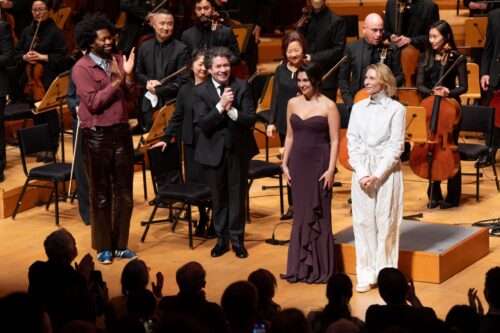
 United States Lorenz, R. Schumann, Beethoven: Cate Blanchett (narrator), Elena Villalón (soprano), Yunchan Lim (piano), Los Angeles Philharmonic / Gustavo Dudamel (conductor). Walt Disney Concert Hall, Los Angeles, 14.2.2026. (LV)
Ricardo Lorenz – Humboldt’s Nature
Robert Schumann – Piano Concerto in A minor, Op.54
Beethoven – Egmont (incidental music)
Gustavo Dudamel led his LA Phil troops into the first of four weekends devoted to Beethoven – music that has special personal meaning for him – with an adaptation that did for Goethe today what Beethoven had done in 1810: made this play about the 16th-century Dutch rebel Egmont speak urgently to the danger of our time.
The danger to Beethoven’s world in 1810 was Napoleon, and it was intense and violent. The danger to our world in 2026 was seen by Dudamel’s creative team as similarly urgent, and they produced a brilliant script featuring Cate Blanchett narrating a rabble-rousing adaptation of the original narration spoken by Egmont. It was a pièce de résistance in every sense of the word. The applause was warm, sustained and deserved, and only a handful of people walked out muttering under their breath.
The reimagining of Goethe’s narration was shaped ingeniously by Jeremy O. Harris, and just when you thought the target was contemporary and perilous – Minneapolis or Tehran – it pivoted back into history, to Brussels under Spanish rule. The effect was to collapse past and present into a single charged space in which tyranny is never safely distant. In either case, it was Beethoven infusing Goethe’s language: ‘Protect our land…You are not alone.” Dudamel has said he long wanted to explore Egmont in a new way: here, the desire was to bring it fully into the present.
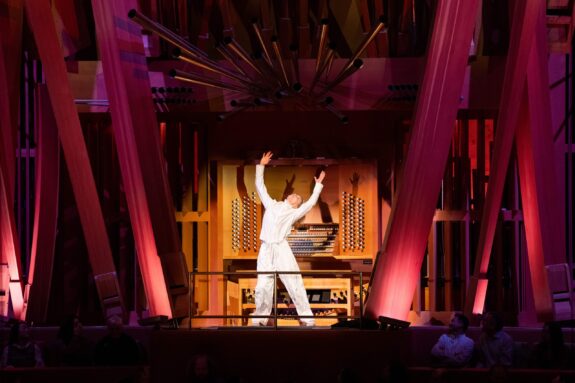
Although the bass thumps in the Overture lacked weight, and the initially distant drums at the end before Alva’s fanfares announcing Egmont’s death were not initially distant, the play quickly took over the music. Elena Villalón sang Klara’s two songs with radiant beauty, and the orchestra played its most movingly in Klara’s death. It was Blanchett who stole the show, ranging and raging around the stage, at first between the timpani and the winds, and then sitting on the apron and carrying on a dialogue with the audience about the need to fight tyranny, just as Goethe’s Egmont had done. ‘They do everything so that you do nothing!’ she cried. ‘You must wake up!…Dance free of fear, with dignity’. At the end, she spoke from the organ loft, like the castle ramparts, lit like a figure in a German Expressionist movie.
The evening opened with the world premiere of Ricardo Lorenz’s Humboldt’s Nature, an LA Phil commission. Lorenz framed his 25-minute symphonic fantasy around Alexander von Humboldt’s late-18th-century journey through what is now Venezuela, the composer’s country of birth. Humboldt’s holistic worldview – nature and humanity inextricably interwoven – and his outrage at slavery, particularly the so-called ‘Cuatro Consuelos’ in Cuba, form the narrative arc. A recurring piano idée fixe represents Humboldt himself, transformed by tropical landscape, colonial collision and human injustice. As a richly detailed tone poem, Humboldt’s Nature might have revealed its full imaginative scope even more vividly had listeners been able to follow Lorenz’s evocative program note while the music unfolded.
In the middle of this curious program was a perfectly irresistible Robert Schumann Piano Concerto from Yunchan Lim that was long on dashing love and poetry, even if it never quite dared attempt the quiet intimacy that causes the heart almost to stop before it sings. The balance that Lim, Dudamel and the orchestra achieved in the first movement was at times hypnotic, and he finished off the cadenza with a thrilling, once-in-a-lifetime trill. In the second movement, his tone became more wonderfully liquid. The third-movement, though exhilarating, was short on mystery.
Laurence Vittes
Featured Image: Cate Blanchett in the LA Phil’s Egmont © Elizabeth Asher/LA Phil
Wish I could have been there!
I was there opening night. The Lorenz was a formless, overly long hot mess. If a composer needs his liner notes for the audience to understand his music – he’s failed. Lim, the Phil and Dudamel did Robert Schumann proud. And the Egmont was stirring and brilliant.