 United States Puts, Emily – No Prisoner Be: Joyce DiDonato (mezzo-soprano), Time for Three (Ranaan Meyer [double bass, vocals], Nicolas Kendall [violin, viola, vocals], Charles Yang [violin, vocals]). Co-commissioned and presented by Cal Performances, University of California Berkeley, 7.2.2026. (HS)
Creatives:
Director – Andrew Staples
Stage manager – Lars Braun
Lighting – William Reynolds
Sound – Colin Egam
Joyce DiDonato’s newest modernized recital fuses music with theater, breathing life and depth into an enchanting and soulful new song cycle by Kevin Puts based on poems by Emily Dickinson. Emily – No Prisoner Be builds its heart-tugging magic out of the mezzo-soprano’s arresting and oh-so-human stage presence as well as her plangent voice. Creative and effective use of lighting and sound amplification add to the effect, avoiding the sort of overdoing that has hobbled other recent concerts.
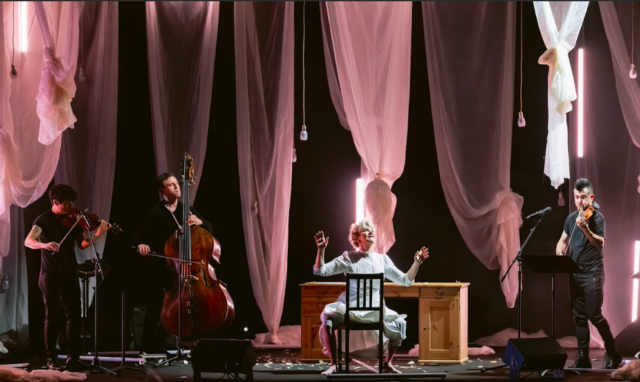
On Saturday evening while the audience was settling in at Zellerbach Hall, DiDonato could be seen pacing behind the set, a raised platform depicting the attic room where the 19th-century American poet produced most of her works. Sheer draperies with bits of her poems projected onto them were knotted at the bottom, echoing the bunched skirt of DiDonato’s all-white gown. Throughout, the words of the poems were projected onto the facing below the platform, and lighting reflected each verse’s mood.
DiDonato’s pre-show pacing circled the platform, gesturing to suggest Dickinson’s mind seeking the right words as, emerging through the sound system, were a foghorn in the distance and whispered (pre-recorded) phrases. Eventually DiDonato settled in a chair before a modest desk and raised her feet onto the desk as stage fog played against side-stage lights
Only then did the string players of Time for Three dig into the first slashing measures of the music. Conservatory-trained and impeccable in execution, the string and vocal trio added juice to their performance with free-wheeling elements that suggest a rock-genre energy. That set the stage for the first poem of the nearly two dozen jewels from Dickinson’s oeuvre. ‘They shut me up’, an angry plaint (‘They put me in a closet because they liked me “still”’), launched a first set of poems outlining her limited place in early-19th-century America, when women were not expected to create art or have something important to say.
The vexation expressed in the first poem didn’t last long. The next one, ‘The Soul selects her own Society’, moved to Puts’s lyrical side, with a more regretful, bittersweet turn to the music. ‘Again, his voice is at the door’ reached a level of fluency and harmonic richness, the contrast establishing this cycle as something special. Puts has the ability to set words to musical phrasing that follows the rhythms and shapes of the language yet introduces unexpected turns and occasional tangy dissonances which stamp the music as contemporary.
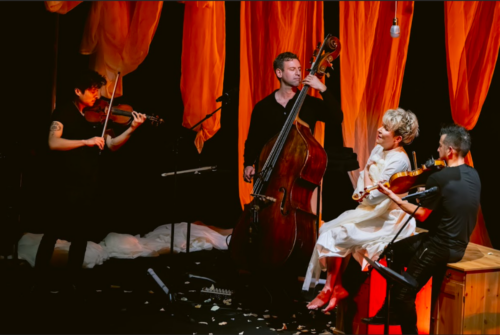
The musicians of Time for Three contributed to the visual impact by roaming the stage, interacting with DiDonato and often singing in harmony to enrich the textures. They played their instruments standing up (not just double bassist Ranaan Meyer), almost entirely from memory. This created a more natural flow for the songs as they unfolded. DiDonato delivered each song from a different position, sometimes sitting primly at her desk, at other times scrunched into a ball on the chair, lying on top of the desk or walking around her ‘room’. A polished acting ability made it all effortless and natural.
Instrumental interludes provided lively transitions between the groups of songs. Three of these were scherzos inspired by ‘bee’ poems (which were included in the printed libretto although not actually sung). Each bee scherzo found an inventive way to portray aspects of the insect and inject some welcome humor without any specific references to ‘Flight of the Bumblebee’. These miniatures would make a superb suite for chamber music groups.
One of the loveliest songs came after the first bee scherzo. ‘A little Snow’, and the one that followed, ‘“Hope” is the thing’, painted detailed images and surged with emotional weight. Another beauty came after the second scherzo: ‘Her face’. It began with velvety vocal harmonies against a walking rhythm, the men in falsetto echoing in counterpoint with the mezzo-soprano’s liquid lines.
The final sequence was the most positive, with two songs embracing the audience in a warm hug of vocal elegance. In ‘If I can stop one heart from breaking’, DiDonato weaved and floated the melody against high chords from the men, through to the final line, ‘I shall not live in vain’.
The finale, as gorgeous as anything Puts wrote in The Hours for DiDonato, Renée Fleming and Kelli O’Hara at the Metropolitan Opera, picked up the tempo just enough to make it into a sort of mini anthem. ‘No Prisoner be’ changed the last words to the feminine gender – ’where Liberty [Her]self abide with Thee’ – emphasizing that we are hearing a point of view from a woman of artistic greatness.
The music drew a strong audience response for the performance. For an encore, DiDonato started singing the opening line’s theme, gesturing to the men one by one to join in, then gesturing toward sections of the audience. The higher voices in attendance picked up on the idea immediately. With DiDonato conducting, they repeated the theme a few times. The musicians on the stage waved goodbye and walked off, and the refrain in the audience continued until the lights dimmed.
It was a thrilling moment and an appropriate coda to a memorable 90 minutes. Credit for the staging does to director Andrew Staples, the English tenor who has sung Tamino at Covent Garden and directed a film of Stravinsky’s The Firebird for ARTE during the pandemic. He put together a particularly effective staging – both visually and for amplified sound. In an age when more performances are amplified, often poorly, this should stand as an example of what is possible.
Harvey Steiman
Featured Image: Violinist Chares Yang, bassist Ranaan Meyer, mezzo-soprano Jyce DiDonato and violinist Nicolas Kendall © Kristen Loken