 Spain Ponchielli, La Gioconda: Soloists, Children’s Choir of the Orfeó Català, Chorus and Symphony Orchestra of the Liceu / Daniel Oren (conductor). Gran Teatre del Liceu, Barcelona, 17 & 19.2.2026. (JMI)
This rarely performed opera was last staged at the Liceu seven years ago. Although it is not unknown to opera lovers, performances of the opera are remarkably infrequent. After attending two performances, I still consider it not to be a masterpiece but rather an opera of uneven quality. It has some excellent numbers – ‘O monumento’, ‘Cielo è Mar’, ‘Suicidio!’ and the ballet ‘Dance of the Hours’, but the pieces interspersed among them are noticeably lower in quality.
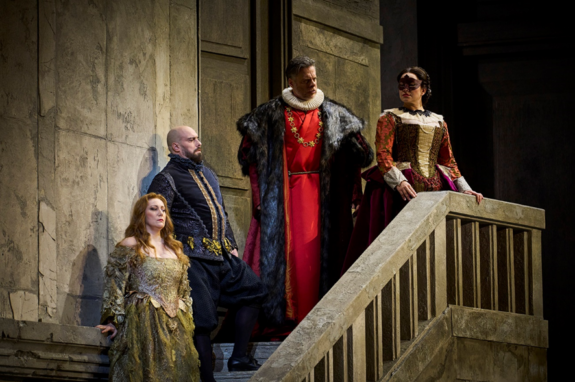
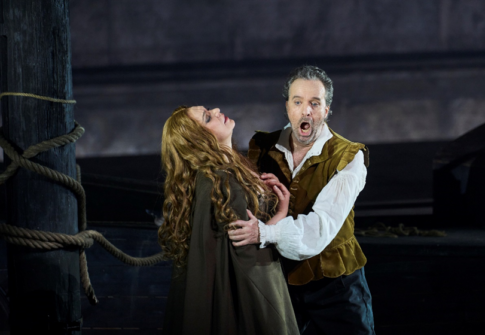
This production is a collaboration between the Liceu and the Teatro San Carlo in Naples, with stage direction by Romain Gilbert. There is basically one set for the opera’s four acts: an open space in the center of the stage surrounded by palaces and temples. In Act II, a large boat is added while in the third act, the square is once again left open for the ballet. The set is darkened and showing signs of destruction in Act IV which depicts the death of Gioconda and the final escape of Laura and Enzo Grimaldo. With costumes by Christian Lacroix it is a production that narrates the story effectively, although the stage direction is not particularly noteworthy, neither in the direction of the actors nor in the movement of the crowds.
Maestro Daniel Oren offered a fine though somewhat uneven interpretation. He conducted the opera with a firm and confident hand and took good care of the singers’ voices. The performances of the Symphony Orchestra and Chorus of the Gran Teatre del Liceu were good, as was the Children’s Choir of the Orfeó Català in their brief appearance.
The title role in the first cast was sung by Madrid-born soprano Saioa Hernández who was the star of the evening. Her voice is perfectly suited to the demands of the character: she is a spinto soprano with an admirable voice who sings with taste and expressiveness. Her high point was the performance of the aria ‘Suicidio!’ where she deservedly earned the biggest ovation of the night.
The second Gioconda was mezzo-soprano Ekaterina Semenchuk who occasionally takes on soprano roles. I found her to be more of a soprano than usual here, and she gave a remarkable performance. She is a good singer for whom the tessitura posed no problems.
The first Enzo Grimaldo was sung by tenor Michael Fabiano whom we have frequently seen in Spain, most recently two months ago at Teatro Real as Don José. The beginning of his performance was promising; he sang with gusto and projected his voice well, but everything changed in the aria ‘Cielo è Mar’ where he had evident problems at the end. From then on, he reverted to open sounds and showed some difficulty with the higher notes.
Tenor Martin Muehle was Grimaldo in the second cast, and he once again offered his beautiful voice with no difficulty in the upper register. For me, he was clearly better in the second part of the opera; in the first part, he had some trouble projecting his voice clearly. Nor was I convinced by his interpretation of ‘Cielo è mar’ which lacked expressiveness.
The villainous Barnaba was sung by baritone Gabriele Viviani who has an adequate stage presence, but he falls short as a singer. He is not a Verdi baritone, which is what this role demands – a close cousin of Iago in Verdi’s Otello. His biggest problem lies in the lower notes, and his vocal volume is not extraordinary either. Àngel Òdena was Barnaba in the second cast and was adequate in the role, although I do not think it is one that is particularly suited to his voice.
Mezzo-soprano Ksenia Dudnikova, with her ample, high-quality voice, was remarkable as Laura Adorno. She is a sure bet in every sense. Laura Adorno in the second cast was mezzo-soprano Varduhi Abrahamyan who has a beautiful voice and sang with gusto.
In the first cast, Alvise was sung by bass John Relyea who was paasable in the part. His voice is not extraordinary, and his projection leaves something to be desired – it is one of those voices that has trouble projecting from the stage. In the second cast we had bass Alexander Köpeczi whom I was seeing for the first time. He too had problems with projection which sometimes prevented his voice from reaching the audience clearly.
Finally, La Cieca, Gioconda’s mother, was sung by Violeta Urmana who is well-known to all opera aficionados – she has been a leading soprano for many years. Here she tackled a contralto role, but her voice is more suited to a mezzo-soprano. She performed well, but there is a wide vibrato that was not present before. I was also hearing contralto Anna Kissjudit in the second cast for the first time, and she made a wonderful impression on me. Her interpretation of La Cieca was noteworthy, with a truly authentic contralto voice, a rare breed these days. She could be a superb Erda in Wagner’s Ring.
In the supporting roles, Guillem Batllori did well as Zuane and Roberto Covatta as Isepo. The ballet performance in ‘The Dance of the Hours’ was excellent.
José M. Irurzun
Featured Image: [l-r] Saioa Hernández (La Gioconda), Gabriele Viviani (Barnaba), John Relyea (Alvise) and Ksenia Dudnikova {Laura} © D. Ruano
Production:
Director – Romain Gilbert
Sets – Etienne Pluss
Costumes – Christian Lacroix
Lighting – Valerio Tiberi
Choreography – Vincent Chaillet
Chorus master – Pablo Assante
Casts:
La Gioconda – Saioa Hernández / Ekaterina Semenchuk
Enzo Grimaldo – Michael Fabiano / Martin Muehle
Barnaba – Gabriele Viviani / Àngel Òdena
Laura – Ksenia Dudnikova / Varduhi Abrahamyan
Alvise – John Relyea / Alexander Köpeczi
La Cieca – Violeta Urmana / Anna Kissjudit
Zuane – Guillem Batllori
Isepo – Roberto Covatta
Mimo – Maxim Nourissat