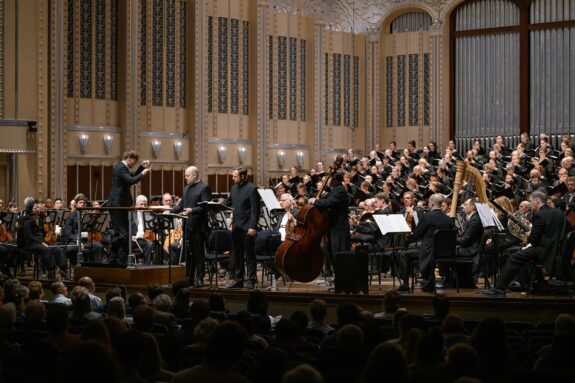
 United States Britten, War Requiem: Tamara Wilson (soprano), Andrew Staples (tenor), Ludwig Mittelhammer (baritone), Cleveland Orchestra Chorus (director: Lisa Wong), Cleveland Orchestra Children’s Chorus (director: Jennifer Rozsa), Cleveland Orchestra / Klaus Mäkelä (conductor). Mandel Concert Hall at Severance Music Center, Cleveland, 23.4.2026. (MSJ)
When conductor Daniel Harding became indisposed for family reasons just a couple of weeks before this concert, Klaus Mäkelä stepped in on short notice to take over. He showed no sign of unfamiliarity with the piece and, indeed, adds this to his track record of great performances of English works in Cleveland, following his presentation of Walton’s Belshazzar’s Feast last season. He commandingly steered the layers of harmonically tricky activity ranging from orchestra to sub-divided chamber ensemble to chorus to children’s chorus to soloists, allowing Benjamin Britten’s concentrated War Requiem to unfold in a single breath. In reality, it was an unforgettable eighty-minute encounter with a harrowing masterpiece.
The piece was commissioned for the re-opening of Coventry Cathedral in 1962, in a new building adjacent to the preserved ruins of the original structure which was bombed during World War II. With a long history of standing behind his beliefs as a conscientious objector, Britten was not about to offer jingoistic nationalism nor bland consolation. By interleaving the Latin text of the Mass for the Dead with poems by Wilfred Owen – who died just before the armistice that closed World War I – Britten created a powerful and awe-striking antiwar statement. And it is one that seems to have made a profound impact on Russian composer Dmitri Shostakovich, whose Symphony No.14, dedicated to Britten, is cut from similar cloth.
Any performance of the War Requiem soars or slumps on the strength of its choral singing. Fortunately, Lisa Wong has been honing the Cleveland Orchestra Chorus for many seasons now, and she has them singing at a level of tremendous and articulate poise. The War Requiem offers particular challenges to singers (and, for that matter, players) with its heavy use of conflicting layers of harmony, often dominated by that most unstable of intervals, the tritone. But the chorus sang the work’s most jagged and treacherous passages with great assurance. Conversely, they weren’t excessively ironed out from rehearsal, and the singing maintained a sense of emotion and even wonder.
Those harmonic pitfalls are there too for the children’s chorus, and director Jennifer Rozsa had prepared the children in a way that gave them the confidence to sail through the tricky passages. They were positioned in the upper lobby outside the balcony seats and were cued by Mäkelä through a video monitor. The location of the children was difficult to pinpoint at first, adding to the ethereal, hallucinatory feel of those passages. Because of their placement at the far end of Mandel Hall from the stage, they came to the doors at the rear of the balcony, with balcony houselights brought up, to acknowledge their contribution though many in the crowd missed it.
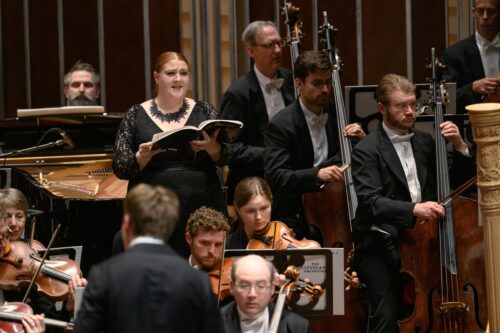
The soloists were ideally chosen. Tamara Wilson, in keeping with her deployment with the main chorus in the Latin passages, was stationed deep in the stage near the orchestral piano. It is an unusual position for a soloist, and it took some time to find her there, but that only contributed to the often-disorienting blaze of the piece. Wilson had the steel in her voice to cut through that blaze like a battlefield Valkyrie where required, but she could also scale it back for the vulnerability of the Lacrimosa, where the soprano sings a falling line that mirrors the upward question of the work’s opening phrase in the violins. Andrew Staples and Ludwig Mittelhammer were well-matched as the soloists in the interpolated Wilfred Owen poems, Staples expressing empathy and fear with his luminous tenor while Mittelhammer brought a world-weary heft with his tawny baritone. When the two harmonized together in the Offertorium, their blend was gorgeously poised, each singer taking care not to overwhelm the other. This gave Owen’s devastating version of the Biblical Abraham and Isaac story a disturbing sweetness, embittered further by the subsequent entry of the children’s chorus singing with pure innocence.
The Wilfred Owen sections of the work were accompanied by the score’s designated chamber ensemble, made up of section leaders. They were deployed in the front, house-right corner of the stage, near the two male singers. Their poise, combined with the placement, allowed their passages to be heard with spectacular clarity. When they all finally, near the end, joined together with the rest of the orchestra and chorus, the effect was profoundly moving. After the uneasy release into peace following the final ‘Amen’, Mäkelä held the silence for what felt like a full minute before releasing the audience to applaud and warmly cheer an outstanding performance.
It was left for audience members to discover afterwards that, once night fell, Severance Hall had been illuminated with red lights. Certainly, that can be taken as a reference to the tradition of honoring the war dead with red poppies. But just as the flowers symbolize the loss of blood, the gut reaction to the concert hall colored blood-red was visceral.
Mark Sebastian Jordan
Featured Image: Klaus Mäkelä conducts the soloists, Cleveland Chorus and Orchestra © Yevhen Gulenko/TCO
Wonderful performance and a thoughtful and excellent review. We are honored to have witnessed this performance and appreciate all of the work that went into providing this emotional experience to an appreciative audience.