
 United Kingdom Grace Pervades: Theatre Royal Haymarket, Haymarket, London, 30.4.2026. (BF) *****
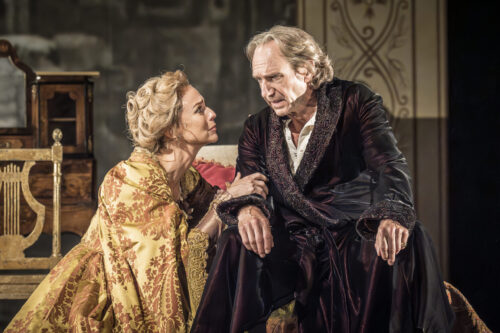
Actor-manager Henry Irving and actress Ellen Terry were two giants of Victorian theatre. Idolised by the public, and specialising in Shakespeare, they made the theatre respectable again. In 1878, Irving took over and managed the Lyceum Theatre, engaging Terry as his leading lady, an arrangement which lasted nearly thirty years to tremendous acclaim. He was the first actor to be knighted, and she the second actress to be made a dame.
Both charismatic, they were in many ways a contrast to each other both on and off the stage: he was intense, lean and melancholy and given to silent brooding, while she was noted for her charm, sweetness and joy. Ralph Fiennes as Irving and Miranda Raison as Terry bring this out in a simply delightful double act, both naturals for their roles. Fiennes is dark and saturnine, full of buttoned-up intensity, while Raison is fair and warm, with a rich well-modulated voice.
There is a lovely and well-written scene where he asks for her (theatrical) support as he is aware his performance is too artificial and even over-intense and she responds gently with some practical tips. She suggests that he should wait in his dressing-room until called to come on stage rather than in the wings where he becomes too keyed-up, and also that it might be good if he were to look at the actor to whom he is speaking. He accepts the advice humbly, basking in her charm and warmth. According to biographies of the two, this is based on fact – Hare has done his research – and it demonstrates their collaboration and mutual respect.
They were clearly very close and affectionate, but it is not known whether they had a physical relationship, and Hare wisely leaves the issue open. Terry certainly had a somewhat racy life, including two divorces (one from famous painter G F Watts, whom she married aged 16 when he was 46) and living with a married man by whom she had two children. Astonishingly, given the prudery of the era, she managed largely to escape opprobrium. (Though perhaps not entirely – the title of this work comes from contemporary novelist Charles Reade’s comment on Terry: ‘Grace pervades the hussy.’). Irving, on the other hand, though he abandoned his incompatible wife early on, is not recorded as ever living with anyone else.
Hare uses Terry’s two children to frame the piece: they introduce the play, comment on the action at intervals and provide more binaries or contrasts: old and new, stasis and change. Both children were distinguished members of the theatrical Terry family; they were troubled but brilliant and made a profound contribution to the development of British theatre.
Edith Craig (Ruby Ashbourne Serkis) became a theatre director and producer and a feminist activist, living for many years in a ménage à trois with two other women, played by Maggie Service (Chris) and Katherine Wilder (Tony). A nice touch is Chris’s complaint that Vita (we understand it must be Sackville-West) has dumped her after sleeping with her – a reminder of the social landscape of the period.
Edith’s brother Edward Gordon Craig (Jordan Metcalfe) became a famous dramatic theorist while flitting from woman to woman. These included Isadora Duncan (Saskia Strallen), which gives Hare the dramatic opportunity to have her dance and underline the modernity of Gordon Craig’s theories. Another memorable scene has Gordon Craig producing and directing Hamlet in Moscow in Russian in stripped-back scenery, the cast (and the audience) struggling to understand what is wanted of them. Jordan Metcalfe is masterly in his portrait of a rather nasty, but highly talented man.
Gordon Craig’s theories are still to this day very influential, though fortunately Hare has not put into practice his dictum that plays would be much improved by the absence of words. But one must admit, Grace Pervades does appeal to the senses. It is beautiful to look at. Bob Crowley’s lush sets and Fotini Dimou’s sumptuous fabrics, set off by generous lighting and sound, are a pleasure to look at.
Another contrast of old and new: Hare has Terry after some years seek to persuade Irving to get out of his rut by putting on plays by more modern playwrights such as Shaw, plays of ideas. Irving resists, too stuffy to take the chance; he claims audiences won’t like them. She also wants him to give her better roles, in particular Rosalind, but he just stalls her as he doesn’t want to put on As You Like It.
But the greatest pleasure simply comes from the interaction of the two main characters, so beautifully and subtly portraying two other actors. There is something interestingly ‘meta’ about considering the performance of an actor playing another actor playing a role. I couldn’t tell if Raison’s performance as Terry’s Lady Macbeth or Fiennes’s as Irving’s Hamlet were accurate – but I certainly enjoyed them.
This is the West End transfer of a production premiered at the Theatre Royal Bath last summer as part of the Ralph Fiennes/Theatre Royal Bath Season. Grace Pervades is presented in the West End by Theatre Royal Bath Productions, Sir Leonard Blavatnik and Danny Cohen for Access Entertainment and Second Half Productions. Performances until 11 July 2026.
For more about Grace Pervades, see here.
Barbara Ford
Featured Image: Edward Gordon Craig (Jordan Metcalfe) struggles with Hamlet © Marc Brenner
Cast:
Ralph Fiennes – Henry Irving
Miranda Raison – Ellen Terry
Jordan Metcalfe – Edward Gordon Craig
Ruby Ashbourne Serkis – Edith Craig
Kathryn Wilder – Kate Terry / Tony Atwood
nMaggie Service – Christabel / Christopher St John
Saskia Strallen – Isadora Duncan
Harriet Leitch – Maid / Moscow Stage Manager
Giulia Innocenti – Gertrude
Tom Kanji – Loveday / Hamlet / Waiter
Guy Paul – Claudius (Lyceum) / Stanislavski
Chris Porter – Claudius (Moscow)
Youness Bouzinab – Leopold ‘Suler’ Sulerzhitsky
Creatives:
Writer – David Hare
Director – Jeremy Herrin
Set design – Bob Crowley
Costume design – Fotini Dimou
Lighting design – Peter Mumford
Sound design – Elizabeth Purnell
Video design – Akhila Krishnan
Wig, Hair and Make-up design – Susanna Peretz
Composer – Paul Englishby
Movement director – Lucy Cullingford