 United States Wildmann, Mendelssohn: Cleveland Orchestra / Jörg Widmann (conductor). Mandel Concert Hall at Severance Music Center, Cleveland, 30.4.2026. (MSJ)
Widmann – Fanfare for Ten Brass Instruments; Con brio; Danse macabre
Mendelssohn – Symphony No.5 in D minor, Op.107, ‘Reformation’
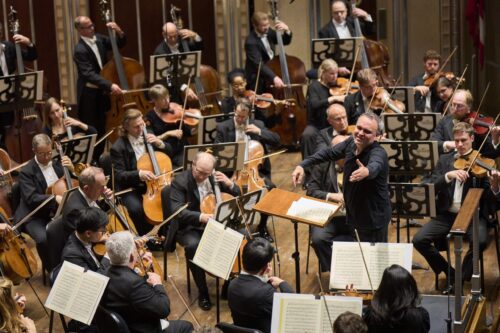
Jörg Widmann served as the Cleveland Orchestra’s Daniel R. Lewis Composing Fellow from 2009 to 2011, and he has remained connected as an often-featured modern composer. This occasion marked his debut as conductor with the orchestra, and the results were highly effective, albeit in the distinctive manner often associated with composers who branch out into conducting. Widmann doesn’t have a polished, conventional technique, and he can be a bit tricky to follow at times because he doesn’t always remember to give clear upbeats to set tempos. But what he lacks in polish is more than made up for by a passion for music making, whether he is bringing his own works to teeming life or giving a neglected Mendelssohn symphony new vitality.
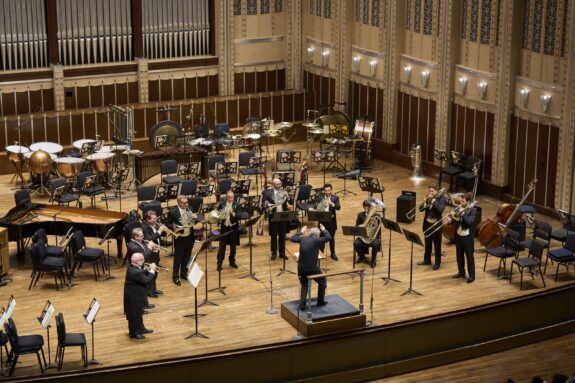
The concert opened with Widmann’s Fanfare for Ten Brass Instruments. It served as a showpiece for the Cleveland Orchestra’s brass which is at the strongest it has been in the forty years I have been listening to this orchestra. While titled ‘Fanfare,’ this five-minute piece might be better thought of as a toccata as it largely steers clear of the repeated-note bugling of traditional fanfares and explores a wide range of textures. The first section of the alternately atonal and pantonal piece is based on a questioning, upward-moving gesture that soon yields to a tart snarl of intertwining lines. The players, including the section principals, brought the music to vivid life, and Widmann effectively led the piece, occasionally adding an unintentional percussive element with his leaps and stomps on the podium.
More tonal but even more unpredictable was Con brio, a piece commissioned by Mariss Jansons and the Bavarian Radio Symphony in 2008. The idea was for the work to be programmed with performances of Beethoven’s Symphonies No.7 and No.8, and Widmann made use of Beethovenian accents and gestures without actually quoting much Beethoven. He certainly draws those Beethovenian gestures into his own soundworld. Or, perhaps, a better image might be that he hops into a time machine built of his own music and wildly crashes it into a Beethoven concert of the early 1800s. The effect is both entertaining and exhilarating, giving tonal anchor points for his music which at times veers toward the squeak-bloop-crash school of modern composition.
There was no shortage of experimental techniques, including string players using the frog of the bow to tap on chinrests, winds using the flat of the hand to make a popping sound against the bell of the instrument, or even whispering like wind through the instruments or playing the edge of timpani with sticks. The players took on the challenges without hesitation no matter how much they were used (and in places such techniques were relied on a little too heavily). The Clevelanders had to watch Widmann like a hawk in the work’s many tempo changes, for his manner of indicating a new tempo often consisted less of an upbeat in a new tempo and more of a sudden slowing of gestures which the orchestra deftly matched. To be sure, a less polished ensemble might struggle with that, but the Cleveland Orchestra has a long history of deciphering the gestures of conductors like Vladimir Ashkenazy and Thomas Adès and they know how to make it work. Widmann’s passion is more important than his technique.
The best of the three Widmann pieces was also the most recent: Danse macabre, written in 2022 and receiving its US premiere. A fifteen-minute fantasy, the piece moved from abstract mystery to fragments of demented dance that became more and more delirious as the piece progressed. Feverish dances moved through and collided with modernist textures in a modern La valse. While Widmann encouraged the ensemble to play with full volume and color, he did save enough firepower to make the climax of the piece visceral. It was warmly received by the audience.
I have to say that three Widmann pieces back-to-back, all of them featuring some degree of wild, dissonant activity, is a lot. Were the events more spread out in his music it would be a little less overwhelming, but hardly a minute passes without a tempo change or an eruption of some new texture including sometimes unconventional techniques. But his pieces are more than just a catalog of experimental techniques: they bring real musical storytelling to the front and are absolutely worth hearing. It would be delightful to see them continue to show up in context with more traditional ones, as previously heard in Trauermarsch (in 2017, featuring Yefim Bronfman) and in the gloriously theatrical Viola Concerto (in 2022, featuring Antoine Tamestit).
Mendelssohn’s ‘Reformation’ Symphony might seem an odd traditional piece to set alongside Widmann’s own works, but he has a genuine enthusiasm for it which showed here. This is arguably one of the more difficult Mendelssohn compositions to bring to life: it was a made-to-order piece that Mendelssohn himself apparently had no intention of including in his official list of symphonies although posterity decided otherwise. To be sure, the characteristic touches that Mendelssohn shows in this work appear more vividly in several of his other works but that made no difference to Widmann. He inhabited every phrase of the symphony and led it in a personally-inflected manner, bringing passages to life that most performances let tick by on autopilot. What can come across as piecework in lesser performances kept it absorbing and interesting in Widmann’s hands, a welcome perspective on a work too often straight jacketed by metronomic tempos and impersonal gestures.
Mark Sebastian Jordan
Featured Image: Jörg Widmann conducts the Cleveland Orchestra in ‘Fanfare for Ten Brass Instruments’ © Roger Mastroianni/TCO