 United Kingdom Various, Inferno: The Inferno Singers, The Choir of Merton College, BBC Concert Orchestra / Jérôme Kuhn (conductor). Queen Elizabeth Hall, London, 29.4.2026. (AV-E)
Hildegard – Oh how wonderful it is
Couperin – The nightingale in love from
Messiaen – The greater short-toed lark
Liszt – Dante Symphony, S.109
Fiona Brice – My Precious Fool
Titled Inferno and part of the Southbank Centre’s Multitudes festival, this was poignantly prophetic programming, rendered all the more potent by its interval-free momentum; after all, a true inferno rarely permits a pause for breath.
The evening’s descent began with the distinctless dissonance of the foggy foyer — a premonition of the Inferno awaiting us within. Marooned on plinths, musicians performed Fiona Brice’s Visions of Dante: Liszt Remixed (world premiere), dissolved by the distorted sound system din. Leaving the audience to meander about, bored and bewildered; this dragged on for what felt like an eternity in hell before we had even entered the hell in the hall to come.
The architectural peculiarities of the Queen Elizabeth Hall allowed the orchestra to perform behind a haze of their own making; in this case, a gauze rear-projection screen. Yet this silk-net-like veil did not render the musicians as secondary, since their sound shone through the silver-screen with a radiant, piercing clarity.
The timeless solemnity of Hildegard of Bingen’s O quam mirabilis est held an attentive auditorium in a trip-like-trance; the voices vortexed in an unmoored unison — a vocal shroud hovering above the low, tectonic pulse of a cello pedal. This was accompanied by a slightly re-edited version of Collishaw’s Eidolon (2023), the unfolding blue iris-in-flames perfectly matching the monastic, moribund mood.
From this seamless-stillness, Couperin’s Le Rossignol en Amour emerged endearingly, Ileana Ruhemann’s flute taking flight with a sprightly, frantic whimsy exquisitely equated to the projected imagery of finches splashing in rain puddles.
Mishka Rushdie Momen provided a skeletal harpsichord accompaniment before transitioning to the piano for Messiaen’s L’alouette Calandrelle, trading metallic snap for a fluid, avian virtuosity. Even in the cavernous QEH, these moments maintained a spellbinding, microscopic intimacy that felt entirely featherly.
Franz Liszt’s Dante Symphony is a brazen and bombastic work of unadulterated excess which is why it is so wonderful. Of course, critics castigate it as crude, vulgar, and meretricious; and yet it is precisely this that gives this mutant music its enduring edge of going ‘over the top’.
When Liszt premiered his Dante Symphony in 1857, it was intended as an impaling-immersion — a sensational ‘spectacle’ involving an experimental wind machine and projections of lanternslides depicting scenes by the painter Bonaventura Genelli. Due to logistical and financial constraints, these ambitious plans for a multi-media experience were never realised during his lifetime. This 19th-century vision finally found its full, devastating expression through a contemporary digital lens.
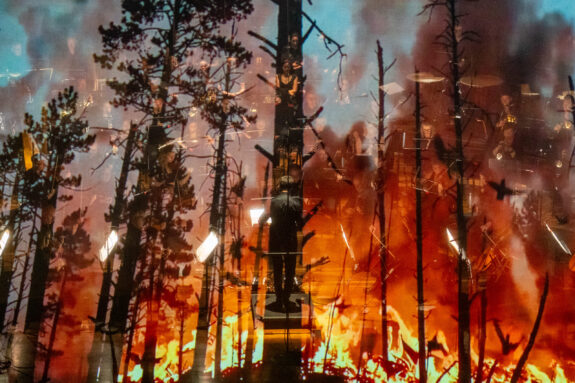
The Dante Symphony became the sonic-scape for the radical film director, Mat Collishaw, to initiate and instigate imploding imagery of a worn-out-world-in-wreck-and-ruin.
As these desolate visions of devastation and destruction blossomed forth, the phrase ‘a terrible beauty’ — as evoked by the painter Francis Bacon — became bluntly evident. Wittingly or unwittingly, consummate Collishaw revealed the true beauty of the real ugly. This vision transforms image into ab-image, where a ‘common-sense’ view of the world transmutates into a ‘rare-sense’ of the world — a puzzling place-out-of-place where the familiar becomes the unfamiliar. When watching, I pondered:
Who would have thought pollution could be so polished?
Who would have thought extinction could be so exquisite?
Who would have thought sludge could be so silken?
Who would have thought debris could be so debonair?
Who would have thought contamination could be so contagious?
Who would have thought catastrophe could be so captivating?
Who would have thought pollution could be so pollinating?
Who would have thought devastation could be so decorous?
Who would have thought ruins could be so ruminating?
I felt a calm-anxiety of uncomfortable-pleasure watching asylum seekers marooned in a dinghy — for there was a cool calm serenity about the distilled-scene. Why do such peril, pathos, plight and despair suddenly become beautiful?
Through this alchemic juxtaposition of image and music, the dreadful transmutates into the delightful; for this image-to-music procuring-process transforms our perception, reception and conception of the world around as if experiencing everything afresh and anew for the first time; which here, is for the last time.
Also, at times, the conductor and orchestra appeared through the screen in puddles that reflected them as phantoms amidst the ruined buildings; and a shuddering sensation of seeing them often going up in flames!
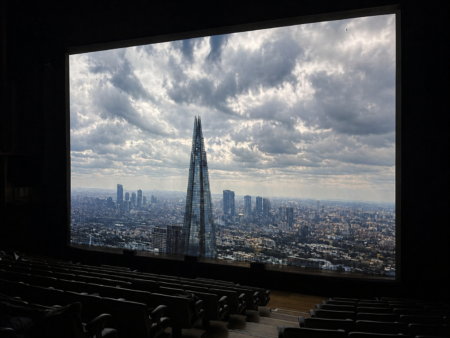
The closing sequence ascended to the pinnacle of The Shard that was standing in ruins; yet with two storks nesting at its peak, high above its skeletal splinters. In fact, it looked better this way — possessing an ‘anciently-modern’ beauty that the functional structure lacks. Perhaps it should have been designed-in-ruins from the start, a pre-packaged realism for our inevitable end.
It all looked so real that I wondered if colliquate Collishaw had filmed all of this in the future and teleported it back for us to witness. This tour de force of ‘visumusic’ left me feeling simultaneously sad yet glad, ruined yet restored, polluted yet purified, devastated yet delighted, elevated yet exhausted. We were transfixed by this sensory-alchemy — a total transmutation of emotion into sensation and sensation back into emotion. This is what great art does.
Where Liszt’s monumental journey through the afterlife concludes on a note of celestial transcendence, this immersive experience demanded a more visceral endgame. Closing with a compact coda by Fiona Brice, the world premiere of My Precious Fool acted as a potent, post-romantic strike — a nightmarish re-working of the morbid motifs that had come before, synchronised seamlessly with the symphony via a relentless, driving beat and the devilish delivery of TaliaBle, whose ‘dysfunctional’ punk-rap transformed the hallowed-hall into a harrowing-house of searing storytelling. TaliaBle’s protesting-poetics read like a bruised breakup song; a chronicle of love and care betrayed, exploited, and ultimately abused. My Precious Fool was the definitive post-endtime punctuation mark for the end of all nights — an unapologetic collaboration that provided the high-drama closure many claim Liszt’s original symphony lacks.
The colossal Collishaw has curated and directed a vivacious visceral violation, severing our ‘over-sensitive’ senses from our security-blanket comfort-zones.
Stumbling up the stairs of the QEH, I felt fully sober with a hangover: grounded but disoriented, settled but unhinged, coherently-confused — a spectral survivor returning from a future that had already happened.
Aided and abetted by the incisive and intuitive conducting of Jérôme Kuhn, the BBC Concert Orchestra growled and gleamed through the silk-net-like veil with a grainy, muscular intensity; their playing possessing a weighty, brooding, metallic melancholy that was the sonic equivalent of the textural grit on screen. This was a visceral, integrated collaboration, where the orchestra’s expressive, sinewy power proved they were no mere ‘background’ accompaniment, but the very enduring-engine of this environmental-endgame.
My recommended Recordings of Liszt Dante Symphony are Gerd Albrecht with the Czech Philharmonic Orchestra (Supraphon) and Giuseppe Sinopoli with the Staatskapelle Dresden (DG).
Alexander Verney-Elliott
Featured Image: Inferno © Pete Woodhead
Errr…. wow! Thank you, I’m reeling from that review. Particularly with the knowledge that you grew up in an environment where this very practise of marrying sound and vision was highly significant.
The challenges of climate change are so complex and seemingly insurmountable that I naturally gravitated toward Burke’s concept of The Sublime.
I very much doubt that lecturing people on the subject is helpful; I thought it might be better to be thrilled by this truly vast and awesome challenge we all face. Then engagement becomes more compelling.
Anyhow thanks you very much, your response makes all the hard work worthwhile.
Best wishes, Mat