 United States Rossini, Il Turco in Italia: Soloists, Chorus and Orchestra of Teatro Nuovo. Rose Theater, Jazz at Lincoln Center, New York, 16.7.2026. (ES-S)
Teatro Nuovo marked the bicentennial of Italian opera in America by revisiting two works associated with Manuel García’s pioneering 1825–26 New York season. Rossini’s Il Turco in Italia was paired with Il Don Giovanni, based on the revised libretto Lorenzo Da Ponte prepared for the opera’s New York premiere. Seldom performed in the city, Il Turco nonetheless fell squarely within Teatro Nuovo’s customary repertory and interpretive approach: historically informed, musically scrupulous and theatrically direct.
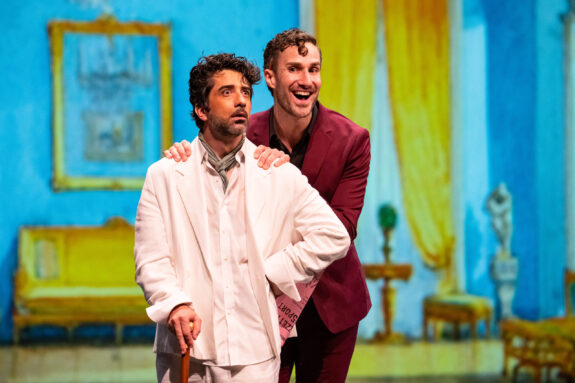
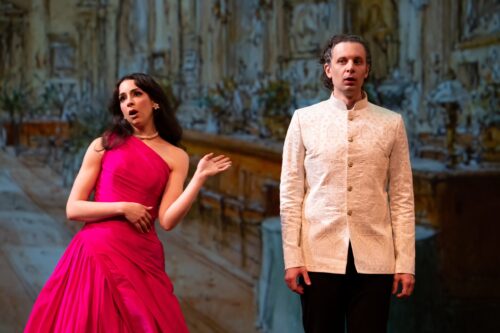
As in previous Teatro Nuovo productions, the staging here was spare but highly effective. Adam J. Thompson’s sequence of drawing-like projections established the changing settings, with the English supertitles incorporated into the images. Using few props and no cumbersome scenery, the production kept the action clear and the focus on Rossini’s music and Felice Romani’s ingenious play-within-a-play libretto in which the poet Prosdocimo shapes the entanglements unfolding around him into the opera buffa we are watching.
The orchestra sat fully exposed in a broad curve. The violins faced the stage while the woodwinds, with their backs to it, turned toward Elisa Citterio, the Primo Violino e Capo d’Orchestra. Derrick Goff, seated at the keyboard as Maestro al Cembalo, worked in tandem with Citterio to coordinate the singers and orchestra. Modeled on early nineteenth-century Italian practice, this divided leadership yielded remarkably unified results. Rhythmic precision was one of the evening’s most striking qualities: ensembles gathered momentum without blurring and Rossini’s characteristic crescendos unfolded with finely judged control.
The period instruments gave the score unusual transparency and pungency, with woodwind lines emerging as individual voices and the brass acquiring a vivid, less homogenized character. Less mechanically forgiving than their modern descendants, the horns were occasionally imprecise in the overture but settled as the performance progressed.
From its first entrance in ‘Nostra patria è il mondo intero’, the chorus, prepared by Teatro Nuovo’s General and Artistic Director Will Crutchfield, impressed with its discipline and energy. Clarity of diction characterized the singing throughout. The predominantly young cast brought an enthusiasm that animated Rossini’s comedy, with Kresley Figueroa, Mattia Venni and Hans Tashjian standing out for the specificity of their characterizations.
Although Il Turco in Italia is a true ensemble opera, Fiorilla remains its dramatic and vocal center. Kresley Figueroa began ‘Non si dà follia maggiore’ a touch tentatively but soon gained confidence and went on to deliver a consistently impressive performance. She negotiated Rossini’s ornamentation with increasing fluency and conveyed Fiorilla’s vanity, capriciousness and appetite for adventure without turning her into a conventional coquette. By her final aria, ‘Squallida veste e bruna’, she was excellent, revealing the insecurity beneath the character’s bravado and bringing genuine pathos to her moment of abandonment.
Mattia Venni offered one of the evening’s most complete performances as Don Geronio. Vocally solid from beginning to end, he dispatched Rossini’s rapid-fire passages with ease and displayed an instinctive command of buffo timing. Yet he never treated Geronio as merely a ridiculous, cuckolded husband. In ‘Vado in traccia d’una zingara’ and the increasingly heated exchanges with Fiorilla and Selim, Venni revealed the wounded dignity beneath the character’s bluster, making him both comic and unexpectedly sympathetic.
As Don Narciso, Fiorilla’s lover, Max Alexander Cook sang with notable steadiness. His clear, focused tenor and poised delivery suited the character’s old-fashioned gallantry, while ‘Tu seconda il mio disegno’ demonstrated his command of Rossini’s coloratura and exposed upper register.
Vincent Graña brought an appropriately confident bearing to Selim, the Turkish prince whose arrival sets the action in motion. His voice was neither especially brilliant nor distinctive in color and ‘Bella Italia, alfin ti miro’ could have made a stronger initial impact. Still, his alert responses to Fiorilla and Geronio allowed him to contribute effectively to the opera’s intricate comic interplay.
Hans Tashjian made a stronger impression through his vivid portrayal of the poet Prosdocimo than vocally. He moved deftly among the roles of spectator, commentator and discreet instigator. Amid the libretto’s shifting amorous intrigues and lively exchanges, Prosdocimo alone can step outside the action, repeatedly redirecting attention from the characters’ confusion to the theatrical artifice taking shape around them. Like Don Alfonso in Così fan tutte, he observes and nudges events, though his purpose is not to test a theory of fidelity but to find material for a new comedy.
Sabatina Mauro brought a solid, penetrating voice to Zaida, though her instrument sometimes lacked the flexibility ideally suited to Rossini’s quicksilver writing. Her more restrained characterization provided an effective contrast to Fiorilla’s volatility and she contributed strongly to the opera’s increasingly intricate ensembles. As Zaida’s loyal friend, tenor David Freides made an unexpectedly strong impression in the small role of Albazar, singing ‘Ah, sarebbe troppo dolce’ with fluency and style.
Through Prosdocimo’s continual revisions and interventions, Il Turco in Italia becomes something of an art poétique of opera buffa, exposing the careful architecture beneath its seemingly spontaneous confusion. Under Citterio and Goff’s firm musical leadership, Teatro Nuovo’s orchestra, excellent chorus and well-matched ensemble of soloists made Rossini’s rigorously constructed chaos genuinely exhilarating.
Edward Sava-Segal
Featured Image: Mattia Venni (Don Geronio) and Hans Tashjian (Prosdocimo) © Steven Pisano
Il Turco in Italia
Primo Violino e Capo d’Orchestra – Elisa Citterio
Maestro al Cembalo – Derrick Goff
Cast:
Selim – Vincent Graña
Doña Fiorilla – Kresley Figueroa
Don Geronio – Mattia Venni
Don Narciso – Mark Alexander Cook
Prosdocimo – Hans Tashjian
Zaida – Sabatina Mauro
Albazar – David Freides