
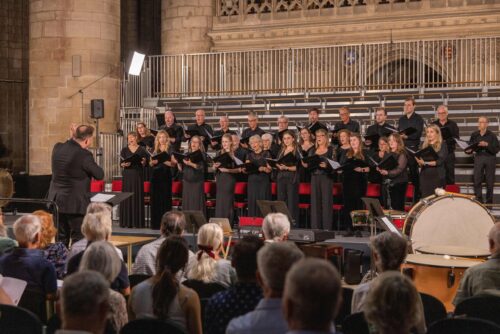
 United Kingdom Three Choirs Festival 2026 [9] – Venables, Bernstein, Cox: Tom Lilburn (countertenor), Piers Maxim (organ), Cecily Beer (harp), Jack Redman (piano), Diggory Seacome, Anna Newman (percussion), Saint Cecilia Singers / Jonathan Hope (conductor). Gloucester Cathedral, 30.7.2026. (JQ)
Ian Venables – God be merciful, Op.51
Bernstein – Chichester Psalms
Neil Cox – Requiem Canticles
It is a measure of the richness and variety of this year’s Three Choirs Festival that just in one day I have been able to attend three mouthwatering concerts. This morning, I heard a phenomenal recital by the French organist Thomas Ospital (review here); less than two hours later, I attended a searingly intense performance of Winterreise by Mark Padmore and Christopher Glynn (review here). Late in the evening, I was back in Gloucester Cathedral for this enticing programme given by the Saint Cecilia Singers and their conductor, Jonathan Hope.
Two of the three pieces were included in a 2024 concert by the same ensemble, which I attended (review here). New to tonight’s programme, though, was Ian Venables’s anthem God be merciful (2020), which I have previously heard on CD (review here) but never in live performance. I admire this composer’s music greatly, so I was very pleased to have the chance to hear this piece. Furthermore, I have recently experienced Jonathan Hope conducting Venables’ masterly Requiem, so I know he is very well attuned to this composer’s idiom. In a programme note, the composer explained that the anthem, which sets verses from Psalm 67, was written as a direct response to the Covid 19 restrictions which we all endured for so many months. He selected the text because it is ‘a plea to God for the return of health to the Nations’. Originally conceived for choir and organ, on the CD which I have heard the accompaniment is for string orchestra and organ; tonight we heard a version for organ and harp, which I believe the composer made specifically for this concert and which I thought worked extremely well. I have liked the anthem very much ever since I first heard it; the music is most expressive and here it received an excellent performance. In some passages, the work reminds me of the Venables Requiem – and it is none the worse for that.
Bernstein’s Chichester Psalms followed. This was yet another commission instigated by that indefatigable patron of the arts, Rev. Walter Hussey, while he was Dean of Chichester Cathedral. On this occasion we heard it in the composer’s own reduced scoring for organ, harp and percussion. This is a work I like very much. Not only is it colourful and highly appealing, it is also very sincere. I thought that in the first of the three movements, where words from Psalms 108 and 100 are set, the performance didn’t quite catch fire; the fast music, in 7/4 time, seemed a bit sluggish. Maybe that came about because the cathedral acoustic is so resonant. The second movement, a setting of Psalm 23 with some verses from Psalm 2 interpolated, introduced countertenor Tom Lilburn. His tone was pure and clear; his voice had a haunting quality to it, which was ideally suited to Bernstein’s music. Lilburn’s plangent, expressive singing was excellent, though even now I wasn’t quite convinced by the choir’s delivery of their jagged music; ideally, it should have been more incisive but in the resonant acoustic some edge seemed to be missing. In the final movement I felt the performance came to life; perhaps everyone was lifted by Bernstein’s long, flowing main melody. Hereabouts, the combination of harp and organ worked really well. The short solo lines from within the choir were well taken. The hushed choral singing in the final pages came off very successfully.
In the 2024 concert, the Saint Cecilia Singers gave the world premiere of Neil Cox’s Requiem Canticles. I greatly admired the piece on a first hearing and was delighted to have an opportunity to experience it once more. The work, which tonight played for 37 minutes, is cast in eight short movements, and sets texts from a variety of sources. In his programme note Jonathan Hope quoted the composer as saying that the composition ‘gave me the opportunity to revisit some of my work from the past, to incorporate it into a bigger work alongside new movements, and to build the structure anew’. In my review of the premiere, I said this: ‘if the composer’s remark suggests a patchwork score, I can only say that, though the movements were differentiated from each other, I found on a first hearing that the score had a cohesive unity’. For this second one, I thought the work was even more cohesive than I had first thought. The singers are accompanied by a small ensemble consisting of harp, percussion (2 players), keyboard and organ. In addition, in the first and last movements Cox has included the sound of recorded church bells. These are the bells of Speyer Cathedral which he heard when visiting the German city a few years ago. He thought the peal of bells was ‘all-encompassing’, so much so that he immediately recorded them on his iPad and it is that recording which he incorporated into Requiem Canticles.
The opening ‘Kyrie’ had a powerful, dark atmosphere to which the bells, harp and tam-tam contributed significantly. Jonathan Hope drove the following setting of a few verses from the ‘Dies Irae’ in a dramatic, exciting fashion. The choir’s singing had discipline and good attack, although it’s passages such as this which make me curious to hear what a larger choir might achieve. There follows a setting of the poem ‘Imagined Voices’ by the Greek poet Constantine Cavafy (1863-1933). This is sung by the countertenor and I thought that Tom Lilburn was marvellous. He communicated Cox’s haunting music in a most expressive way. The choir sings ‘The Lord is my Shepherd’ to music that is, for the most part, warm and reassuring; they made a very good job of this. The Sanctus includes a short, triumphant solo for the organ; Piers Maxim really grasped this opportunity. Subsequently, I learned that Cox had revised the movement to include this passage in order to showcase the new cathedral organ; it was highly effective.
The next movement is a setting of Psalm 121, but not in any of the familiar English translations. Instead, Cox went back to the 1640 Bay Psalter from Cambridge, Massachusetts; this text begins ‘I to the hills lift up my eyes’. Cox’s setting, introduced by the soloist, is mainly subdued and I think it is very effective. There follows St Paul’s well-known passage from Corinthians 1 (‘Though I speak with the voice of angels…’). Initially, the words are sung by the soloist with the choir providing a wordless background. Late on in the setting (‘Three things will last for ever…’) the choir takes the lead, bringing the movement to a big, optimistic climax, before the soloist returns to bring the section to a tranquil close. This is a most affecting movement. The final section follows without a break. First, the choir sings the Resurrection Prayer of St Augustine of Hippo; their music is very lovely and unaccompanied until the radiant ‘Amen’. Then, like Bernstein in his Chichester Psalms, Cox reprises the opening ‘Requiem aeternam’, bringing his work full circle and achieving a beautiful conclusion which is both emotionally and musically satisfying.
Requiem Canticles again impressed me on a second hearing. It is a profound, eloquent and very beautiful composition which deserves to be widely known. Jonathan Hope and the Saint Cecilia Singers rose to the occasion and gave it a very fine performance indeed. Tom Lilburn was an outstanding soloist and the instrumentalists contributed incisively. The composer, who was present, was clearly delighted by what he heard. I was pleasantly surprised that, even though the concert began at 10.15 pm, the cathedral nave was very full. The audience gave the work, its composer and the performers a very warm reception. Afterwards, I heard someone say words to the effect that they suspected that many in the audience came to hear Chichester Psalms but came away with Requiem Canticles as their dominant memory. Much though I admire Bernstein’s piece, that was my reaction too.
John Quinn