 Spain Bizet, Carmen: Soloists, Escola Coral Veus Juntes (chorus mistresses – Marta Mármol, Roser Gabaldó), Escolania de la Mare de Déu dels Desemparats (chorus master – Luis Garrido), Cor de la Generalitat Valenciana (chorus master – Jordi Blanch), Orquestra de la Comunitat Valenciana / Michele Spotti (conductor). Palau de Les Arts, Valencia, 7.10.2026. (JMI)
The Palau de Les Arts opened the 2026–2027 opera season with a performance of this magnificent opera by Georges Bizet, a work not seen here since 2010 when Zubin Mehta delighted us from the pit while conducting a trio of outstanding lead singers: Elīna Garanča, Marcelo Álvarez and Marina Rebeka. The 2026 performance of Carmen fell far short of the standard achieved sixteen years ago. One might be tempted to say that ‘the past was always better’, at least as far as I am concerned.
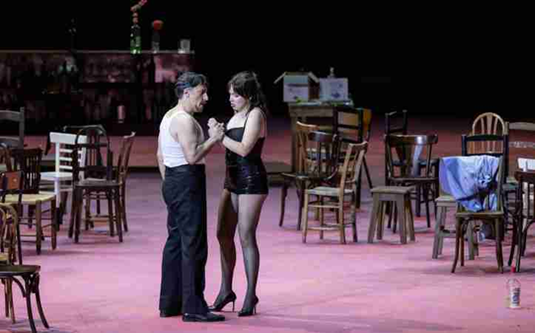
This coproduction with the Grand Théâtre de Genève is not to my liking – it is the first time I have seen an opera done without sets. The stage offers nothing but an empty space with a raised platform in the center that is occasionally filled with chairs. Perhaps the production is paving the way for a new trend of set-less stagings. While this undoubtedly lowers what it costs, I doubt those savings are passed on to the ticket prices. The program credits Nadja Sofie Elle for this absence of sets: perhaps she is already thinking about what else can be stripped away from a production.
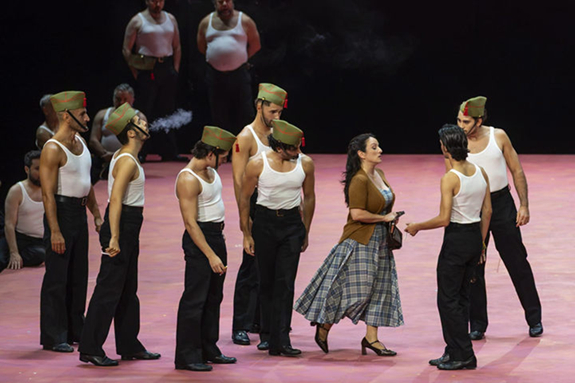
If the set design is conspicuous by its absence, the same applies to the costumes. In the first act, both the soldiers and the cigarette girls wear white tank tops; the soldiers’ uniform is completed by the addition of a military cap. This serves as a prime example of the stagings’s cost-cutting measures. I believe director Ted Huffman made a ‘mistake’ by presenting Escamillo as a bullfighter in full traje de luces (suit of lights)! As for the rest, the ‘innovative’ stage direction involves chairs everywhere, including in a zapateado dance sequence at the start of Act III. I conclude by noting that, from time to time, a brief explanation of the upcoming scene is provided: a new step towards eliminating printed programs and saving even more money.
While the staging leaves much to be desired, the musical direction by Michele Spotti was outstanding: at just 33, he has truly come into his own. It is not by chance that he was recently appointed music director of the Deutsche Oper Berlin, succeeding Sir Donald Runnicles. Spotti was highly attentive to the singers and led the superb Orquesta de la Comunitat Valenciana with great care, as well as the Coro de la Generalitat Valenciana and the children’s choirs.
Carmen was sung by Russian mezzo-soprano Vasilisa Berzhanskaya who made her Spanish debut a few months ago at Barcelona’s Liceu in a magnificent Semiramide. Her portrayal of Carmen, however, left me only partially convinced. There is no doubt that she is a fine singer, but I found myself wishing for a lower voice – she certainly has the notes but her actual sound is unconvincing for this character. She is more a soprano than a mezzo-soprano and has recently been singing soprano roles: she did La traviata at the Arena di Verona this summer and is scheduled to perform the title role in Anna Bolena at La Scala in Milan.
Don José was American tenor Charles Castronovo, whom we have seen often in Spanish theaters. He delivered a solid performance but without anything extraordinary in terms of either voice or singing.
Micaëla was portrayed by Aragonese soprano Ruth Iniesta whose performance was somewhat uneven. She certainly excelled in her second aria in Act III, singing it with great taste. In my opinion, however, the same could not be said for her aria in the opening act where her singing came across as rather bland.
The role of Escamillo was sung by Italian baritone Davide Luciano who has performed at Palau de les Arts on previous occasions. His voice has evolved: he is no longer the light lyric baritone he once was but now has a more dramatic quality: a full lyric or even spinto sound. Luciano’s voice has lost some quality though he sings with taste and delivers a solid performance. I was surprised by his decision to omit the high note at the end of Act III; a note traditionally sung.
José M. Irurzun
Featured Image: Ruth Iniesta (Micaela) and the soldiers © M. Lorenzo y M. Ponce
Production:
Director – Ted Huffman
Sets – Nadja Sofie Elle
Costumes – Astrid Klein
Lighting – Urs Schönebaum
Cast:
Carmen – Vasilisa Berzhanskaya
Don Jose – Charles Castronovo
Micaëla – Ruth Iniesta
Escamillo – Davide Luciano
Le Dancaïre – Cristófol Romaguera
Remendado – Matías Sebastián Herrera
Morales – Isaac Galán
Zúñiga – Manuel Fuentes
Frasquita – Aitana Sanz
Mercedes – Lora Grigorieva