 Netherlands Wagner, Tristan und Isolde: Soloists and Chorus of the Dutch National Opera, Rotterdam Philharmonic Orchestra / Tarmo Peltokoski (conductor), Amsterdam, 17.2.2026. (DM-D)
Pierre Audi’s production of Tristan und Isolde was premiered at the Dutch National Opera in 2018. It was revived for its 2026 run by Lisenka Heijboer Castañón, assisted by Frans Willem de Haas. The revival was intended as a return by Audi to the opera house he led from 1988 to 2018. Audi sadly passed away in 2025, and thus this production was a memorial rather than a return.
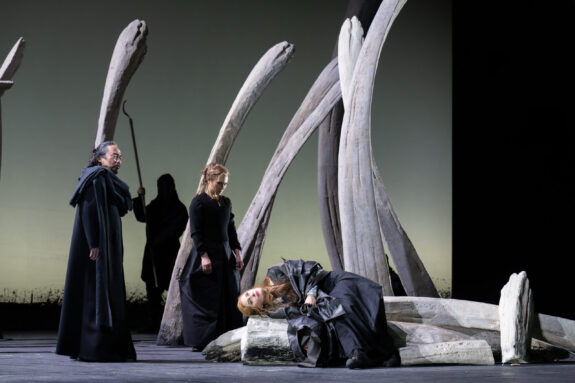
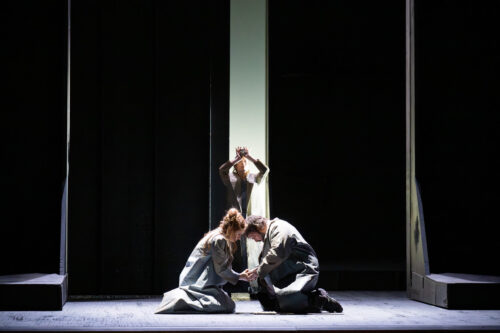
The set showed a stark landscape, with a central image for each of the three acts. For Act I, it was a set of four stage-high walls, which shifted position (frequently and quietly) to create different sub-spaces on the stage for the characters to interact with and within. For Act II, the stage was covered with stationary, barren structures that some have described as leaf-like, while I associated them with the individual bones of a large rib cage. For Act III, there was a rather barren tree on the left, a frame in the middle and a scaffold to the right with a ladder leading to the upper level, with a bundle, like a corpse, lying atop. The video was partly projected onto a screen that sometimes covered the middle frame. The lighting design further supported the overall impression of the stage’s textures as predominantly made of stone, or variations thereof; it also shifted the impressions of barrenness towards those of vast spaces, closed and claustrophobic spaces, or spaces emanating a calm, collected, focused, impressive but not overpowering sense of higher powers (of nature). The costumes added to the shades-of-grey theme of the set.
Within this visual context, Audi had been able to focus on character interaction. Movements were predominantly slow, majestic, making full use of the floor space available – after Tristan and Isolde took the love potion they were so overwhelmed by the experience that they both needed a moment of their own, which they were happy to give each other and equally happy to receive. They retreated from the middle of the stage to the side walls, leaning against them with palpable relief. A frequently used gesture of personal closeness consisted of the characters in question, Tristan and Isolde, but also Isolde and Brangäne, moving very slowly so as to allow their foreheads to (almost) touch.
The production was the occasion of Malin Byström’s much-awaited role debut as Isolde. She inhabited the part fully both in terms of acting and singing. Her Isolde was a highly emotional woman, her feeling shifting quickly and drastically at a consistently high level of intensity. She vividly recalled her love for Morold, her devastation at his death, her being torn by early feelings for Tristan, her current urge for revenge, and the feelings of love caused by the love potion. Byström was very comfortable as an actor within the barren environment of the set, giving appropriate and strong physical expression to her emotions. Her singing was above all an exercise in beauty. The lower register, so important for the role, was full of bloom and velvety rich, never difficult for her to reach or embellish, across the full range of volume. The lower register thus was powerful in its own right – and a great foundation for the upper range of the voice. Here, her intonation was precise, accurate, secure, assured and fully controlled at all times. It was a rare occasion when the rise to the top notes was gently sung and not vocally pushed with a great deal of audible effort.
Michael Weinius gave his debut as Tristan at Deutsche Oper am Rhein, Düsseldorf, in the 2020/21 season and has sung the role regularly since then in major opera houses across the world. He has a solidly strong voice with good baritonal foundation, which allowed him to sing with full voice from the start without the need to save energy for later. The voice was clear, open, not nasal nor narrowing uncomfortably at the top. He matched Byström’s vocal beauty in Act II. In the demanding scene in Act III he was able to sing melodiously throughout, without the need to resort to shouting or any other indication of vocal weakness.
As played and sung by Irene Roberts, Brangäne was a strong woman, more of a confidante to and friend of Isolde, although aware of the difference in social hierarchy between them. This Brangäne relished the idea of administering the love potion instead of the death potion in terms of the immediate excitement of the moment arising from playing a prank on Isolde, and realising only later, and very deeply, too, how foolish she had been considering the devastating consequences. She was later very much aware of her guilt, which underscored the intensity and urgency of her calls during Act II. Roberts sang with a vocal control and abandon that matched those of Byström and Weinius.
Jordan Shanahan played Kurwenal as an appropriately resolute, straight-forward and simple but well-meaning man; the epitome of a trusted and trustworthy servant-companion. In terms of voice, he conveyed his character’s strength through a very melodious and beautiful, controlled use of his voice. He has developed this aspect of the role further since his performance at the Bayreuth Festival in the summer of 2025. Liang Li’s perfect breath control allowed his huge voice to sound steady, even and beautiful across the music for King Marke. He was able to admirably mould his sonorous bass across a wide range of volume to express Marke’s deeply felt emotions fully and very movingly. Leon Kosavic played Melot as an old man, fragile, limping, always bent over and with a crutch fastened to one of his arms. He sang the role with a strong, robust voice. Linard Vrielink (Shepherd and Young Sailor) and Roger Smeets (Steersman) made the most of their smaller contributions.
The production also represented the debut of conductor Tarmo Peltokoski both with Dutch National Opera and conducting Tristan und Isolde. His was a very assured reading of the score, emphasising the emotional intensity. Some passages were infinitely tender, for others he unleashed the orchestra’s full force. In all of this, he took great care of the singers, signalling cues with precision and clarity and never drowning their voices. He placed much emphasis on bringing out the interplay of different instruments. For much of the music, the sound of the strings was dominant, overall – an impression probably enhanced by the arrangement of the orchestra in the pit: cellos and double basses were placed behind the first and second violins and violas, with woodwind and brass at the sides.
Daniel Meyer-Dinkgräfe
Featured Image: Liang Li (King Marke), Irene Roberts (Brangäne) and Malin Byström (Isolde) © Monika Rittershaus
Production:
Director – Pierre Audi
Revival director – Lisenka Heijboer Castañón
Associate Revival director – Frans Willem de Haas
Set and Costume design – Christof Hetzer
Lighting design – Jean Kalman
Video design – Anna Bertsch
Dramaturgy – Willem Bruls
Chorus director – Edward Ananian-Cooper
Cast:
Tristan – Michael Weinius
Isolde – Malin Byström
Kurwenal – Jordan Shanahan
King Marke – Liang Li
Brangäne – Irene Roberts
Melot – Leon Kosavic
Shepherd – Linard Vrielink
Steersman – Roger Smeets
Young Sailor – Linard Vrielink