
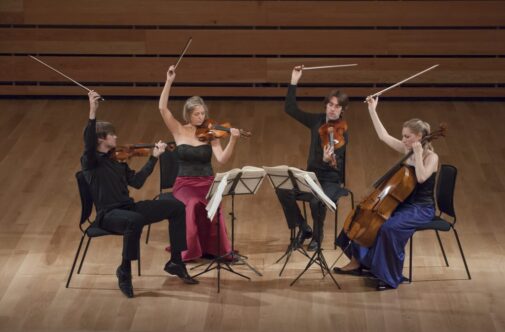
 United Kingdom Sacconi Quartet – 25th Anniversary Concert: Sacconi Quartet (Ben Hancox, Hannah Dawson [violins], Robin Ashwell [viola], Cara Berridge, [cello]). Wigmore Hall, London, 20.2.2026. (PC)
Haydn – String Quartet in C, Op.33 No.2 ‘The Bird’
Freya Waley-Cohen – Dances, Songs & Hymns for Friendship (world premiere)
Beethoven – String Quartet No.15 in A minor, Op.132
To celebrate 25 years of performing together, the Sacconi Quartet gave a wide-ranging and rewarding recital to a packed Wigmore Hall. Their carefully chosen programme consisted of two peaks of the mainstream repertoire and a substantial new work.
Haydn’s String Quartet in C, ‘The Bird’ (1781), was presented with refinement and wit. After a taut initial approach to the first movement’s enchanting, gently unfurling opening section, the performers eased into the repeat, creating time to further point up ornamental details the second time around. At the development section’s midpoint, a hushed, inward-looking sequence was especially affecting. The dark-hued, devotional Scherzo was atmospherically veiled and contrasted effectively with a central episode in which the violins showed a spirited lightness of touch in high register. All four players were poised throughout the slow movement, savouring its long-breathed, generous melodic lines. The music seemed to turn its face to the light when the returning main theme was laced by the first violin’s florid decoration. In the Presto finale, a tightness of ensemble ensured that the composer’s droll treatment of its vigorously exuberant folk-like tune was delivered with clarity as well as charm. The playful ending as the music casually evaporates drew appreciative chuckles from the audience.
Making its official concert debut, Freya Waley-Cohen’s Dances, Songs & Hymns for Friendship (2025) was written especially for the players on the occasion of their 25th anniversary. The piece had an aptly jubilant energy and affectionate warmth, which communicated directly to the audience. Lasting around 25 minutes, the work was cast in six separate movements, each of which captured a specific activity and mood. The opening movement, ‘Spin’ established the score’s open-air, folk-like qualities, with an inspiriting candour and richness of invention. The ensuing ‘Sing’ was gloriously lyrical, with closely imitative writing and idyllic, wistful dialogues between the musicians. ‘Play’ juxtaposed passages of airy euphoria featuring open harmonics with earthy, trenchant gestures, bows digging into strings. Folkish inflections persisted alongside the movement’s minimalist spirit. ‘Step’ was by powered by dynamic dance rhythms and evoked ‘The Dargason’ from Holst’s St Paul’s Suite in its irrepressible vigour. As the movement progressed, it expressed increasingly childlike high spirits and appeared to incorporate a time-honoured playground taunt in the closing moments. ‘Pray’ brought a complete change of tone. This searching, supplicatory music pulsed with a ‘breathing’ quality generated by inhaling and exhaling gestures recalling the regular rhythmic figures that open Britten’s Nocturne of 1958. The closing movement, ‘Be’ began and ended with eloquent cello phrases that seemed to capture the work’s prevailing tenderness and lucidity. This buoyant and engaging new work’s premiere performance was enthusiastically received.
After the interval, Beethoven’s String Quartet in A minor (1825) secured a compelling reading of great emotional intensity. At the heart of the work, and the thoroughly considered conception of it from the Sacconis, was the transcendent, supplicatory slow movement, which made a lasting impression in the players’ rapt, spaciously conceived account. Other interpretative highlights included the second movement’s naively arcadian trio and the improvisatory freshness of the fourth movement’s violin recitatives. A spirited closing rondo rounded off the work in glorious assertation, but the players’ fearlessly broad rendition of the central Adagio was the crowning glory of a commanding performance.
As light relief and by way of an encore, the Sacconi Quartet gave a hearty rendering of the folk tunes Old Molly Oxford/Christchurch Bells, in an arrangement for them made by Jon Boden. It set the seal on an evening of impressively versatile music making. Although the high level of performance was clearly the product of a longstanding artistic relationship, the players’ alert responsiveness ensured that their interpretations sounded newly minted.
Paul Conway