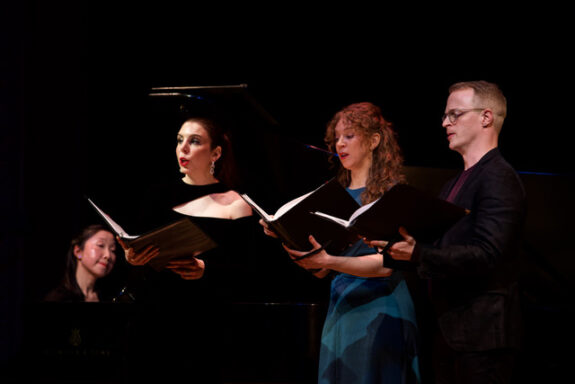
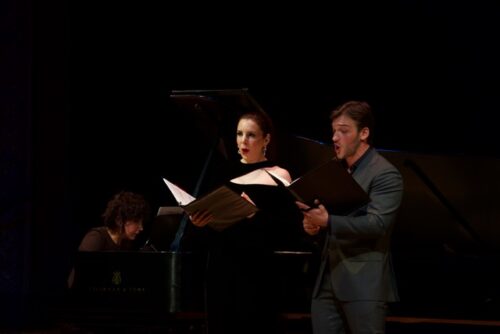
 United States Rorem, Evidence of Things Not Seen: Sara LeMesh (soprano), Anna Laurenzo (mezzo-soprano), Daniel McGrew (tenor), Nathaniel Sullivan (baritone), Mila Henry, Nana Shi, Miori Sugiyama (piano). Brooklyn Art Song Society, Roulette, Brooklyn, 8.3.2026. (RP)
‘I am a composer’, Ned Rorem once said, ‘who also writes, not a writer who also composes’. By the mid-1960s, Rorem was acclaimed as America’s foremost composer of art song. For those with more prurient interests, The Paris Diary, published in 1966, was a must-read. Rorem, unabashedly gay when that took extraordinary courage, not only laid bare his own youthful exploits in the book but named names. His thoughts on composers and their music also commanded attention.
In anticipation of his 75th birthday in 1998, Rorem composed a colossal song cycle, Evidence of Things Not Seen. Acclaimed as his crowning achievement in the genre, opportunities to hear Evidence of Things Not Seen in live performance are few and far between. Brooklyn Art Song Society stepped into the breach with a superb performance of the cycle featuring four exceptionally talented singers – soprano Sara LeMesh, mezzo-soprano Anna Laurenzo, tenor Daniel McGrew and baritone Nathaniel Sullivan – partnered by the equally compelling pianists Mila Henry, Nana Shi and Miori Sugiyama.
Through Evidence of Things Not Seen, Rorem sought to sum up his life in song, although he would live another 24 years, dying at 99 in 2022. Comprised of 36 songs with texts by 24 writers, the cycle is divided into three sections, aptly entitled ‘Beginnings’, ‘Middle’ and ‘End’. In addition to solo songs, the cycle contains duets, trios and quartets. Some of the latter display his knack for writing for multiple voices, a talent honed in the dozens of choral works that he composed.
Rorem had excellent, exacting and eclectic literary taste. Unsurprisingly, he set poems by Paul Goodman, whom he deemed his Goethe, and whose words inspired him throughout his career. Although an avowed atheist, he inherited Quaker sympathies from his parents. In Evidence of Things Not Seen, there are songs set to words by William Penn, an English Quaker and founder of Pennsylvania. There are also songs on Rorem’s own translations of Colette, the French writer, best known to English-speaking audiences as the author of the novella Gigi upon which the Hollywood film was based.
In ‘Their Lonely Betters’, a poem by W.H. Auden, soprano Sara LeMesh displayed her dramatic flair and transfixed the audience with the shimmering, sustained high note with which the song ended. At the opposite end of the emotional spectrum was the ferocity that LeMesh displayed in the setting of Goodman’s ‘Now is the Dreadful Midnight’, especially the final, piercing cry on the word ‘die’ which ended the song.
Mezzo-soprano Anna Laurenzo bubbled vocally and visually in a setting of Elizabeth Barrett Browning’s ‘How Do I Love Thee?’ Although composed in 1997, the song was quintessential Rorem, a composer who found his musical voice early, remained consistent and kept it ever fresh. In ‘The Sick Wife’, Laurenzo was tender and moving as she gave voice to Jane Kenyon’s poem about a woman not yet 50, unable to fasten a button and confined to the car while her husband ran errands. The sadness of the vignette was heightened by the naturalness and ease with which Laurenzo sang Rorem’s narrative-like setting of the poem.
With his fine lyric tenor and exceptional ability to project a text, tenor Daniel McGrew is one of the best song singers around. In another Goodman setting, ‘Boy with a Baseball Glove’, McGrew was wistful as he captured the effortless poise of youth at a golden moment. In Rorem’s setting of Rudyard Kipling’s ‘A Dead Statesman’, McGrew expressed a politician’s deception that led to the deaths of so many young men during World War I with a clear, forthright directness. That matter-of-fact approach underscored the sharp emotions of unrequited love, which Rorem captured so poignantly in his setting of Goodman’s ‘A Terrible Disaster’.
Rorem was noted for his baritone-friendly songs, and Nathaniel Sullivan found them congenial turf. He captured the electricity of a fleeting glance that portended romance in Rorem’s setting of Walt Whitman’s ‘A Glimpse’, and the unsettling despondency of an unsatisfactory sexual encounter in a public space as described by W. H. Auden. The final section of the cycle was Rorem’s response to the AIDS crisis. Sullivan plumbed the depths of despair and anger which Mark Doty wrote of in ‘Faith’ and which Rorem depicted in a frenetic setting that harkened stylistically to his song ‘Bedlam’, composed in 1950.
Rorem’s settings for multiple voices sparked moving experiences. LeMesh, McGrew and Sullivan brought clarity and warmth to William Wordsworth’s celebration of the joys of life in both youth and age in ‘The Rainbow’. ‘Hymn for Morning’ by 17th-century Anglican cleric and hymnodist Thomas Ken for vocal quartet was particularly beautiful, especially in the a cappella sections. LeMesh, Laurenzo and Sullivan offered simplicity and purity in Oscar Wilde’s ‘Requiescat’.
Evidence of Things Not Seen ends with all four voices singing another text by William Penn from which the cycle takes its name. It ends with words and music in which the writer and composer summoned the essence of human existence: ‘We cannot love to live, if we cannot bear to die’. The Brooklyn Art Song Society celebrated the life of a composer who embraced life to the fullest in the best way imaginable through sterling performances of his songs.
Rick Perdian
Featured Image: Anna Laurenzo (mezzo-soprano), Sara LeMesh (soprano), Nathaniel Sullivan (baritone) and Nana Shi (piano) © Catherine Hancock Photography
Enjoyed the vivid documentary portrait of Ned Rorem that screened before the concert, ‘The Artist Must Grow Every More Selfish’, that brought Rorem’s voice reading from his Paris Diary into the concert hall.
Thank you for this review; it’s got me listening to Rorem tonight!