 Germany Bizet, Carmen: Soloists, Semperoper Children’s Choir, Saxon State Opera Chorus and Orchestra / Lorenzo Passerini (conductor). Semperoper Dresden, 1.6.2026. (MC)
This new production of Bizet’s Carmen from stage director Nadja Loschky was her Semperoper Dresden debut. Introduced at Semperoper in May, it was the fourth performance which I attended. Advertised with the tag line ‘Between freedom and seduction’ Loschky’s staging is hailed in the programme notes as ‘a thrilling psychodrama that explores freedom, desire and social boundaries.’
This enduring masterpiece is in the top 5 most popular operas in the entire repertoire. Where one hit follows another it is hard to believe that Bizet’s Carmen had to wait 84 years to be staged by the foremost opera house in Paris. It was mainly the rigid rules against spoken dialogue that restricted Carmen to the Opéra-Comique receiving close to 3,000 performances there rather than the Palais Garnier, the elite venue of the company Opéra de Paris. To surmount this problem Bizet’s friend the composer Ernest Guiraud quickly provided a version that replaced the spoken dialogue with sung recitatives nevertheless it still wasn’t staged by the Opéra de Paris until 1959. Unbelievably, in 1875 Carmen’s première at the Opéra Comique was a failure. Poignantly Bizet died three months later without any conception that Carmen would achieve worldwide fame.
I have seen many Carmen productions and the last time at Dresden was Axel Kohler’s splendid 2016 staging that I described as a ‘colourful and satisfying production.’ Nonetheless a production that sticks firmly in my memory is the Bavarian State Opera’s 2014 revival of Lina Wertmüller’s much admired period staging at Munich. Wertmüller’s superb production transported me back to nineteenth-century Seville where the mighty iron gates of the distant cigarette factory at daybreak were dominated by a gradually brightening pale orange sky.
At some point in a popular opera’s lifetime, it is not uncommon for directors to make modifications to a traditional staging. Only last year at the Opera Festival in the English town of Buxton I attended La tragédie de Carmen a revival of Peter Brook’s 1981 reimagining of Carmen a scaled down version of music theatre that also utilised a narrator. Brook was controversial at the time but much less so now. Often these alterations don’t amount to much however a small number make significant changes, and I think this production by Nadja Loschky is one such example.
At Semperoper it felt as if Nadja Loschky and her design team had sucked the life out of the sets and in turn each character. A big disappointment was how stage designer Etienne Pluss eliminated all suggestion of the vista of a gradually brightening pale orange sky in Seville. Instead, the audience was greeted by a long expanse of high wooden panelling that made the dark and gloomy looking set look like one from say Verdi’s Ernani or Don Carlos rather than sun drenched Seville and feel claustrophobic by reducing the depth of the stage. I wouldn’t have thought it possible that Carmen’s seductive wiles would be reduced but they come across to me as rather nondescript. A mystery to me is why costume designer Irina Spreckelmeyer dressed the cast in such a gloomy and nondescript manner.
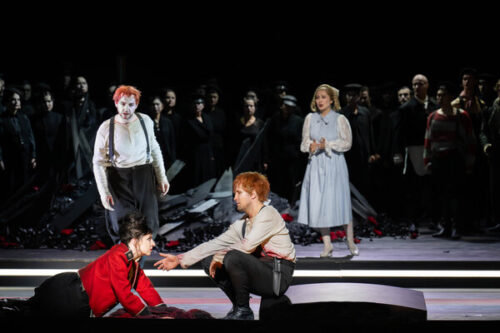
What rankled most was not these alterations but the addition of another character: an alter-ego for Don José, who was almost constantly on the stage beside him. From the libretto Loschky had eliminating the sung recitatives and connecting dialogue with the alter-ego providing a running commentary on José’s thoughts, adding unnecessary detail and overcomplicating an already familiar plot.
Loschky’s Carmen was a role taken by Geneva born mezzo-soprano Eve-Maud Hubeaux, the leading character who came across as belligerent rather than seductress. Spreckelmeyer had made some attempt to dress Carmen in Spanish themed clothing namely her long black fitted dress with a lengthy black mantilla. Her dress split revealed red tights, there were red evening gloves and matching red heels. On other occasions Carmen wore a red bullfighter’s flamenco jacket with gold braid and a red miliary style tunic both of which served to establish a traditional Spanish look. Across her range Hubeaux’s voice was in fine condition with an enviable smoothness and tonal security and I couldn’t help thinking how excellent her performance would be in the atmosphere of a more traditional production of Carmen which we have come to know and love.
Born in the German city of Ulm, lyric tenor Attilio Glaser sang the role of dragoon corporal Don José. It must have been tiresome to have to partner up on stage with his alter ego character. I am not sure where the idea for carrot-coloured wigs came from, it did make the wearers appearance easily identifiable in contrast to the white granddad vest and at the same time look ridiculous. Glaser came across as an engaged and dedicated singer using his top register especially effectively. Full credit was due to Hamburg born actor Lasse Myhr as José’s alter ego for his hard work with the spoken dialogue.
A character much loved for her sensitivity, the role of Micaëla, a visiting village girl delivering a message from José’s ailing mother, was made to look like a pathetic character who was all at sea. As Micaëla dressed in a plain white and light-blue dress Finnish soprano Marjukka Tepponen effectively managed her two marvellous contributions: the first-act duet with her beloved José and her signature Act III aria.
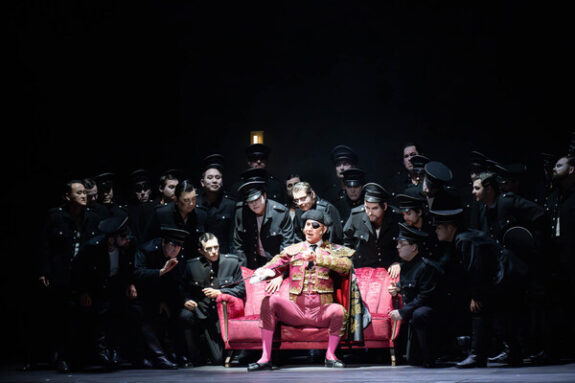
Polish bass Krzysztof Bączyk certainly looked the part of toreador Escamillo. The adored bullfighter had been kitted out convincingly by Irina Spreckelmeyer wearing a gold braided and pink costume with cloak, topped with a black montera, complete with eye patch. Parading around with virility, enjoying the adulation of his crowd the tall Bączyk had undoubted stage presence. His voice was effective too although the production didn’t allow too much impact for the much-loved Toreador Song.
Mainly seen in their long dark coloured army coats and so often positioned in draining dark lit surroundings the Semperoper chorus coped exceedingly well. Did we really need all those children choir members on the stage? I think not.
No matter how much life Nadja Loschky and her team drained from the traditional atmosphere of Carmen one saving grace was how the Staatskapelle Dresden under Lorenzo Passerini rose above it providing top-drawer playing. I understand the need for new productions of operas and the previous production of Carmen by Axel Kohler and designer Arne Walther wasn’t perfect but fared far better than this. Nadja Loschky’s Carmen disappointed me, and everything felt lifeless. Under those circumstances the soloists, chorus and orchestral players deserve much credit.
Michael Cookson
Featured Image: Krzysztof Bączyk (front, Escamillo) © SD/Monika Rittershaus
Production:
Stage direction – Nadja Loschky
Set design – Etienne Pluss
Costume design – Irina Spreckelmeyer
Lighting design – Fabio Antoci
Choreography – Thomas Wilhelm
State Opera Chorus direction – Jonathan Becker
Children’s Choir direction – Claudia Sebastian-Bertsch
Dramaturgy – Yvonne Gebauer, Benedikt Stampfli
Cast:
Carmen – Eve-Maud Hubeaux
Don José – Attilio Glaser
Micaëla – Marjukka Tepponen
Escamillo – Krzysztof Bączyk
Zuniga – Vladyslav Buialskyi
Moralès – Anton Beliaev
Frasquita – Magdalena Lucjan
Mercédès – Nicole Chirka
Dancaïro – Simeon Esper
Remendado – Mario Lerchenberger
Alter Ego of Don José – Lasse Myhr