
 United States Various, OSL Bach Festival [2]: Orchestra of St. Luke’s / Jean Rondeau (harpsichord and leader). Zankel Hall at Carnegie Hall, New York, 23.6.2026. (ES-S)
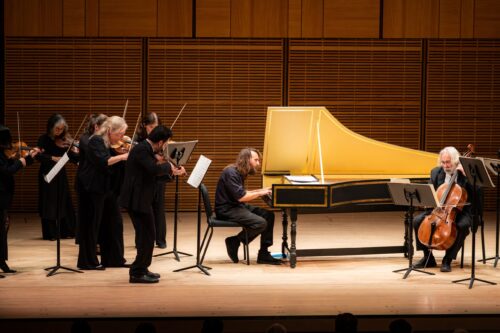
Johann Christph Bach – Wer Gott vertraut, hat wohl gebaut
Johann Christian Bach – Concerto No.6 in F minor, W.C73
Carl Philipp Emanuel Bach – Andante con tenerezza from Sonata in A major, Wq.65/32, H.135; Concerto in D minor, Wq.23, H.427
Johann Sebastian Bach – Harpsichord Concerto in D minor, BWV1052
Encore: Largo from J. S. Bach’s Harpsichord Concerto in F minor, BWV1056
A program entitled ‘The Bach Dynasty’ could easily have become a tidy genealogical exercise: fathers, sons, influence, evolution. In Zankel Hall, however, Jean Rondeau and the Orchestra of St. Luke’s turned it into something more searching and revealing. Proceeding attacca, the evening used continuity and contrast to suggest a family portrait assembled less through chronology than through temperament. It traced not just a family tree but a changing musical sensibility, moving through different understandings of the harpsichord: as a devotional voice, an elegant conversationalist, a medium of inward volatility and a source of concentrated dramatic force.
Rondeau set the sequence in motion with his adaptation of Johann Christoph Bach’s Wer Gott vertraut, hat wohl gebaut (Whoever trusts in God has built well), a quietly striking hymn by the Eisenach-based elder relative of Johann Sebastian. The performance seemed to reach toward the breadth and resonance of an organ while preserving the delicacy of chamber forces.
With the Keyboard Concerto in F minor by Johann Christian Bach, Johann Sebastian’s youngest son, the program approached the threshold of Classicism, placing the harpsichord in a more conversational role. Rondeau found a persuasive balance between galant ease and minor-key tension. His playing had a lightness that at moments sounded almost Mozartian in its grace, yet enough tension remained to prevent the music from becoming merely decorative. The elegance retained unease beneath the polish, and the ornamentation never overwhelmed but remained discreetly integrated into the musical discourse. The Orchestra of St. Luke’s matched him with transparent, stylish playing, and the basso continuo animated the texture from within instead of merely supporting the solo line.
C. P. E. Bach’s Harpsichord Concerto in D minor, the work of Johann Sebastian’s second surviving son, brought the program into more volatile territory. Rondeau allowed the music’s contrasts to register without exaggerating them; they felt dramatic but not mannered, shaped as turns of thought rather than imposed effects. The Orchestra of St. Luke’s responded with flexibility, as a genuine partner in the conversation. The slow movement balanced inwardness and lyrical poise, never becoming merely pretty or overburdened. In the finale, Rondeau gave the music welcome bite, its energy sharpened, not merely driven.
Rondeau’s solo performance of the Andante con tenerezza from one of C. P. E. Bach’s keyboard sonatas preceded the concerto, anticipating the latter’s Poco andante. Lithe and unsentimental, the rendition preserved the tenderness named in the title while shifting attention from virtuosic display and toward the harpsichord’s quieter expressive possibilities.
The evening’s most familiar work, J. S. Bach’s Harpsichord Concerto in D minor, brought the program to its most intense and tightly argued point. Rondeau avoided treating the harpsichord either as a fragile antique or as a purely percussive machine. It sounded, instead, vividly alive: quick in response, sharply articulated and harmonically alert. The tempos in the outer movements were thrilling but never careless, and the left hand carried real bite, grounding the music’s urgency in harmonic weight.
With Alex U Fortes as concertmaster for the occasion, the Orchestra of St. Luke’s matched Rondeau’s energy with precision and force, extending the convergence between soloist and ensemble that had marked the program from the start. In the Adagio, passages in which the string texture was reduced to a quintet allowed the harpsichord to emerge with undiminished clarity. The line remained fluent, spacious enough to breathe without losing direction. The finale, with its familiar sense of furious propulsion, was controlled and cleanly articulated. Its intensity never blurred; the music surged forward without losing discipline.
As an encore, the Largo from J. S. Bach’s Concerto in F minor, BWV1056, offered a final turn toward lyric simplicity, letting the evening settle after the D minor concerto’s controlled drive.
What made the final program in this edition of OSL’s Bach Festival compelling was that Rondeau and his musical partners did not present the Bach inheritance as a straight line from Baroque formal rigor to Classical elegance. Instead, they revealed a more complicated network of possible developments that, in the right hands, can still speak with immediacy.
Edward Sava-Segal