 United States Summers at Severance 2026 [2] – Various: Brian Wendel (trombone), The Cleveland Orchestra / Kazuki Yamada (conductor). Mandel Concert Hall at Severance Music Center, Cleveland, 30.7.2026. (MSJ)
Haydn – Symphony No.104 in D major, ‘London’
Rota – Concerto in C for Trombone and Orchestra
Saint-Saëns – Symphony No.3 in C minor, Op.78, ‘Organ’
Well, this complicates things.
Kazuki Yamada is a very busy conductor, with posts in Birmingham (City of Birmingham Symphony Orchestra) and Monte Carlo (Orchestre Philharmonique de Monte-Carlo), and with another post pending in Berlin (Deutsches Symphonie-Orchester Berlin). That’s a full dance card.
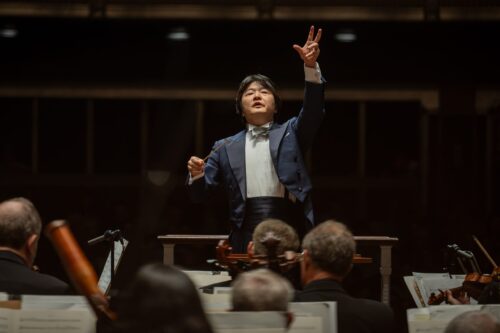
One can’t help but wonder if he’d consider dropping any of those activities if the Cleveland Orchestra were to show an interest in appointing him as music director to succeed Franz Welser-Möst who will depart at the end of the 2026/27 season after a twenty-five-year tenure. The musicians certainly made a powerful statement when, after an astonishingly fresh and vital performance of the Saint-Saëns ‘Organ’ Symphony, the players of the orchestra refused to take a bow during the final curtain call, forcing Yamada to take an extra bow himself. This is a rare salute from the ensemble, the last one I have seen being almost two years ago when they honored Esa-Pekka Salonen after a magisterial performance of Sibelius’s Fifth.
Yamada previously impressed here with a performance last year that clarified textures and brought out the singing voice in Elgar’s First Symphony. This concert’s encounter proved highly electrifying, particularly considering that it is for the first of two concerts Yamada will be conducting as part of the Cleveland Orchestra’s summer festivities, presumably on shorter rehearsal time than would be allowed for a main season subscription concert. It turned out that Yamada did not need additional time: he knew his scores, knew what he wanted and achieved that efficiently, something sure to win over an orchestra’s favor.
The opening of the concert came in a spacious yet vigorous performance of Haydn’s ‘London’ Symphony. Yamada chose a full complement of strings but balances proved not to be a concern for he knew just where to ensure woodwind, brass and timpani details cut through the textures. Moreover, he encouraged the strings to shape and energize their figurations so that textures never clogged. Yamada was particularly effective in subtly underlining the deeper shadows that color the first three movements, proving that Haydn has more to offer than just wit, delicious though that may be. And it was delicious when Yamada delivered the unanswered upbeats in the third movement Menuetto with perfect comic timing, making up for a somewhat stodgy, old-fashioned tempo. The Finale flew like the wind, bringing the performance home with high energy. Now, if we could just get quality performances of some of Haydn’s non-nicknamed symphonies, like Nos.39, 58, 88 or – my favorite – No.102.
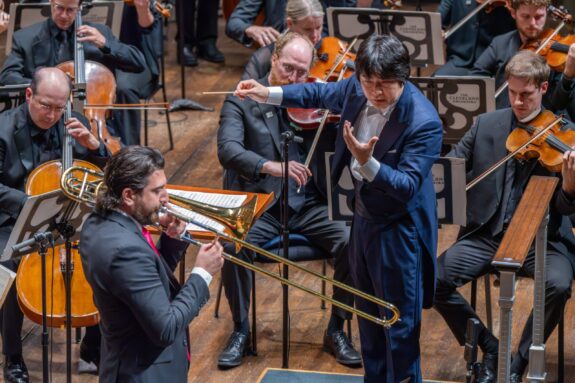
Nino Rota may be most famous for his film scores for Fellini and Coppola but he was a widely accomplished composer. His Trombone Concerto was written in 1966 and is full of a quirky, wry lyricism that makes it instantly memorable. Brain Wendel, the Cleveland Orchestra’s principal trombone since 2022, made his first concerto appearance with the ensemble with this piece, savoring its singing voice while never glossing over its sharper moods. Rota cleverly worked moments of agility and articulation into the piece, but its lyricism is the continuous thread that unites a questioning first movement, a slow movement that turns from tension to tenderness and back and a lively finale. Wendel’s tone was debonair throughout, landing even the most intricate passages with flawless intonation. It was a welcome chance to hear him in extended solos as well as a worthy taste of Rota’s music.
Far more familiar in the repertory is, of course, Saint-Saëns’s ‘Organ’ Symphony, which the composer himself planned to be a sort of magnum opus. Having hit his target, he never wrote another symphony, declaring that he had given everything he had in the work. Familiarity can dull the impact of the piece in a rote performance but absolutely nothing was routine on this occasion. Yamada took ownership of the piece as if Saint-Saëns had written it just for him. Nothing was exaggerated or eccentric but it felt as if every moment of the score had been examined anew and brought to life for the first time. Yamada clearly loves this music, and he communicated that enthusiasm to the orchestra who communicated it to an eager audience.
In this performance, the opening of part one was not something to be endured until the main theme starts. Instead, each chord hung in the air with anticipation. Instead of fussing over the details of the notes in the strings’ figurations in the main theme, Yamada vividly established the atmosphere and got on with it, which surely must have been the composer’s intention. The ebb and flow of the movement felt, well, organic. When the massive instrument of name made its first entrance in the quiet slow movement, it helped establish an emotional impact with its tummy-wobbling pedal tones. It makes me wonder if Saint-Saëns’s true expression in the slow movement had more to do with sensuality than the surface religiosity which everyone assumes. The orchestra caught just such an intensity, suspending the softly clashing chords near the end of the movement with a tenderness that was breathtaking.
On to the second part (which is structurally akin to the scherzo and finale of a four-movement symphony), and the performance grew even more compelling. I have heard conductors take the scherzo a little slower in a fruitless attempt to clarify the strings’ repeated notes. Here, Yamada launched into the scherzo at a blistering pace, but the Cleveland strings worked like demons, articulating the figurations with more clarity than one would think possible. The interleaved presto passages included glittering scales from the orchestral piano as the winds wove around it. After the reflective linking passage set up expectations, the finale proper got underway with volleys of chords between the thundering pipe organ and the full orchestra. The succeeding passage included two pianists playing rippling arpeggios that sparkled like sunlight on waves. Yamada give this part of the movement ample space but tightened up the tempo with the following fugue, building up a delirious energy as movement catapulted into a spectacular coda, controlled but compelling like few others I have heard in decades of listening.
We already knew Yamada was good. Now we know he is even better than that and, happily, we have another concert before he leaves. What will he do with a demanding program of Takemitsu, Stravinsky and Robert Schumann at the Blossom Music Center? The anticipation is intense!
Mark Sebastian Jordan
Featured Image: Brian Wendel plays Rota with Kazuki Yamada and the Cleveland Orchestra © Julian Dubé/TCO
Thanks for a fine review.
Based on last night’s performance, it would not be a disappointment if Mr. Yamada were selected to lead TCO.
We hope tomorrow night is not a washout.
Me too! Either way, I’ll be there, with umbrella…