
 Germany Landshut Chamber Music Festival 2026 [1]: Chamber Soloists, Rathausprunksaal, Landshut, Lower Bavaria, 25-30.8.2026. (MC)
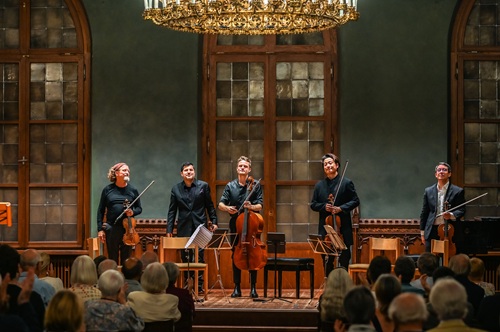
This was the fourth Landshut Chamber Music Festival, held in the Lower Bavarian town of Landshut on the River Isar, and from 26th to 30th August 2026, eighteen international musicians performed in six chamber concerts.
The Landshut Chamber Music Festival was founded in 2022 by violinist Mikhail Pochekin and Peter Haarpaintner, president of the Freunde der Musik Landshut (Friends of Music Landshut), with the inaugural festival taking place in 2023. Pochekin considers it a great honour to serve as artistic director in Landshut, ‘an old and very beautiful city in Lower Bavaria’ with a ‘very rich musical tradition’. All the concerts are held in the spectacular nineteenth century Rathausprunksaal (Grand Hall of the Town Hall), whose continuous wall painting depicts a celebrated chapter in the city’s history: the lavish Landshut Princely Wedding of 1475, when George of Bavaria-Landshut married the Polish Princess Hedwig Jagiellon.
26.8.2026 – Concert One
Mendelssohn – Piano Trio No.2 in C minor, Op.66 (1845)
Kodály – Duo for violin and cello, Op.7 (1914)
Mozart – String Quintet No.4 in G minor, K.516 (1787)
At first, Hungarian composer Kodály might seem like an odd fit between Mozart and Mendelssohn, two great composers of the Classical and early Romantic periods. Yet Kodály was really a traditionalist at heart and stuck closely to established classical forms.
Opening the concert was Mendelssohn’s four movement Piano Trio No.2 in C minor. Bearing a dedication to Louis Spohr and serving as a birthday gift to his sister Fanny Mendelssohn. A work of Mendelssohn’s maturity the players, led by Diana Tishchenko with cellist Ivan Karizna and pianist Michail Lifits, brought out the deeply passionate and often sombre character of the writing.
The opening movement evoked a vessel in peril at sea with energetic sections of storm followed by passages of relative calm. Marked Andante espressivo the slow movement had the disposition of a deeply felt ‘song without words’ with all three instruments breathing together. Next an elfin Scherzo a soundworld comprising scurrying and ghostly textures. Boldly sparkling and passionate the Finale: Allegro appassionato felt like witnessing a struggle between triumph and adversity.
Although Kodály wrote his three-movement Duo for violin and cello in 1914 at the beginning of World War One it was another decade before it was heard. Here Kodály successfully combines formal forms with the Hungarian folk music that he avidly collected. It has been a while since I last heard the Duo for violin and cello and I was struck by the work’s originality and level of strength and energy required to bring it off. Violinist Christian Tetzlaff and his son cellist Simon Tetzlaff seemed made for the demands of Kodály’s Duo. It felt that both players were in a conversation with each other which was sometimes heated and sometimes cordial. One can’t help imagining the spectacular countryside of Kodály’s Hungarian homeland from verdant valleys in summer to rugged hills in stormy winter weather. Both violin and cello made a magnificent sound. I enjoyed hearing the marked difference in sonority of each instrument especially when the violin in its high range contrasted with the cello’s low register. Standing out was the finale marked Maestoso e largamente ma non troppo lento – Presto where the folk characteristics of Kodály’s writing were unmistakable. Throughout both players displayed striking virtuosity and generated abundant drama. In all the excitement Christian Tetzlaff had to reattach a string that had worked off the bridge, yet it didn’t detract from this winning performance.
Mozart’s String Quintet No.4 in G minor concluded the concert. Written in 1787, the year of Don Giovanni – arguably the pinnacle of his achievement – it belongs to a remarkable succession of enduring masterpieces. Scored for two violins, two violas and cello the players were led by Christian Tetzlaff with Mikhail Pochekin, WenXiao Zheng, Jano Lisboa and Simon Tetzlaff. With the additional viola this G minor Quintet came across as a deep, dark-hued and melancholic masterpiece, rich in exceptional moments.
Opening the G minor score the performance of the intense and feverish Allegro was unfailingly steadfast. Following on, the Minuet discharging austerity and tension starkly contrasted with the trio; a sunny interlude. Here the five players demonstrated interplay of the highest level. Serving as a balm the sorrowful and reflective Adagio ma non troppo was so engaging, and I wonder if Mozart was describing a romantic relationship. Decisively led by the leader the closing movement began with a tense and dissonant Adagio. Sending a shiver down my spine, the terse transition to the radiant Allegro was made in heaven. A blithe rondo skipped along creating an ending that I take as affirmation rather than irony. This was an outstanding three-work concert with players operating at an elevated level. In addition, the quality of the hall’s acoustics cannot be overpraised.
Musicians – Christian Tetzlaff (violin), Mikhail Pochekin (violin), Diana Tishchenko (violin), WenXiao Zheng (viola), Jano Lisboa (viola), Simon Tetzlaff (cello), Ivan Karizna (cello), Michail Lifits (piano)
27.8.– Concert Two
Mozart – Piano Quartet No. 1 in G minor, K.478 (1785)
Berg – Adagio from the Chamber Concerto (1923–25) (arranged for violin, clarinet & piano)
J.S. Bach – Five Fugues from J.S. Bach The Well-Tempered Clavier (arrangement for string quartet by Mozart, K. 405 (1782)
Shostakovich – Piano Quintet in G minor, Op. 57 (1940)
(Bayerischer Rundfunk [Bavarian Broadcasting] recorded this live concert for transmission at 20.03 on 10.11.2026.)
Spanning some two hundred years this four-work concert ranged from Mozart’s arrangement of Five Fugues from J.S. Bach’s The Well-Tempered Clavier written circa 1722-42 to Shostakovich’s Piano Quintet in G minor, Op.57 from 1940.
Leader Mikhail Pochekin, Jano Lisboa (viola), Simon Tetzlaff (cello) and Martina Consonni (piano) took to the stage for Mozart’s Piano Quartet No.1 in G minor, K.478. Commissioned by publisher Franz Anton Hoffmeister, Mozart’s G minor Piano Quartet expanded the traditional piano trio by adding a viola. Hoffmeister intended it for amateur players, but it proved too demanding. Written in 1785, around the time of The Marriage of Figaro, this masterpiece of Mozart’s chamber music often reflects the opera’s influence.
From the opening Allegro, the substantial piano part proved rich in melody, at times it sounded as if Martina Consonni was the soloist in a piano concerto, while the strings each given an unusually active role played with ebullience. The Andante’s long, melancholic cantabile lines were ravishing played with a rare elegance, especially noticeable in Consonni’s piano part. Closing with a Rondo certainly lightened up the character of the work. Led by Mikhail Pochekin, his players delivered the uplifting, good-humoured writing with complete engagement.
It was 1925 when Alban Berg completed his Chamber Concerto for piano and violin with thirteen wind instruments. He dedicated the score to Arnold Schoenberg his former mentor. Often described as being the ‘heart of the work’ the Adagio movement in 1935 was separately arranged for violin, clarinet and piano. It was this trio version performed by Diana Tishchenko, Pablo Barragán and Martina Consonni. Commencing the work an austere theme was introduced by piano and violin and later joined by the clarinet to haunting effect. Striking throughout were the changing moods and wide dynamics together with the scrupulous precision of the playing. Remaining with me was the steely beauty and disquieting calm that pervaded much of this beautifully performed score.
During a period of serious study of baroque counterpoint in 1782 Mozart arranged for string quartet a set of Five Fugues K.405 from J.S. Bach’s solo keyboard work The Well-Tempered Clavier. Scored for a standard quartet of two violins, viola and cello the parts were taken by leader Diana Tishchenko, Luis Suarez, Jano Lisboa and Simon Tetzlaff. Although it is not unusual to encounter Mozart’s transcriptions dismissed as trivial, here the Five Fugues were afforded genuine consideration and were both engaging and quite beautifully performed.
Widely recognised as a masterwork of the chamber music repertoire Shostakovich’s Piano Quintet in G minor came about when his lifelong friends in the Beethoven Quartet requested a piano quintet for them to perform with the composer at the piano. Written in 1940 alongside his reorchestration of Mussorgsky’s opera Boris Godunov Shostakovich was awarded the inaugural Stalin Prize with a considerable cash sum for the acclaimed five movement quintet.
Without doubt I was looking forward to hearing the Piano Quintet as it is not a work I get to hear in concert too often. Amid Shostakovich’s use of the traditional romantic forms and traces of the baroque, fascinating for me was identifying the hidden elements of his dark and edgy satire. Mikhail Pochekin led the quintet that comprised string players Luis Suarez, WenXiao Zheng and Ivan Karizna together with pianist Michail Lifits. Opening with a Prelude – Lento, the bold and weighty playing created a tremendous wall of sound almost pushing me back in the seat. Marked Adagio, the four-voiced Fugue was given with splendid precision and noticeably the writing developed considerable passion and concluded in an attractive manner. Undoubtedly the crowning glory of the work the turbulent Scherzo – Allegretto led by Pochekin was extremely hard driven, bold and determined. Memorable in the Intermezzo was the leader’s theme over pizzicato cello in turn joined by the viola and piano. In the finale, marked Allegretto, the playing of the two principal themes stood out: the first waltz-like, the second march-like, revealing the biting sarcasm I heard in the music. Equally striking was the serenade-like quality of the writing before the work’s abrupt ending.
The audience showed its appreciation with applause and cheers, and many rose to their feet. As an encore, leader Mikhail Pochekin and his players repeated the Scherzo – a highly popular choice.
This Landshut concert embodied chamber music at its best – a true meeting of minds.
Mikhail Pochekin (violin), Diana Tishchenko (violin), Luis Suarez (violin), WenXiao Zheng (viola), Jano Lisboa (viola), Simon Tetzlaff (cello), Ivan Karizna (cello), Michail Lifits (piano), Martina Consonni (piano), Pablo Barragán (clarinet)
28.8. – Concert Three
Rachmaninov – Trio élégiaque No.2 in D minor, Op.9 (1893)
Brahms – Piano Quartet No.3 in C minor, Op.60 (1875)
The third chamber concert in Landshut offered an absorbing two-work programme, contrasting Russian and German compositions written less than twenty years apart.
Rachmaninov had only graduated from the Moscow Conservatory the year before he completed his Trio élégiaque No.2 in D minor in 1893. It was immediately written as a memorial to his hero Tchaikovsky, whose sudden death prompted Rachmaninov to inscribe the score ‘In Memory of a Great Artist.’
Scored for piano, violin and cello, the parts were taken by Eldar Nebolsin, Ivan Pochekin and Ivan Karizna. It is a substantial work, with the first and second movements sometimes taking more than twenty minutes each to perform. Making a tremendous impact was the massive first movement Moderato – Allegro vivace. Right from the doom-laden piano chords, the rich cello sound and plaintive violin that opened the score it was easy to marvel at the glorious wash of sound the players created. Breathtaking was the aching sorrow of the music, which steadily gathered in dramatic intensity.
The second movement Andante uses a theme from Rachmaninov’s symphonic poem The Rock in eight variations, with virtuosic piano writing for Eldar Nebolsin. Mightily impressive was the trio’s ardent performance heightening the music’s passionate character. Marked Allegro risoluto – Moderato, the shorter finale opened with a fearsome piano statement before the trio launched into a vivid, eventful dialogue. Full credit is due to Nebolsin, Ivan Pochekin and Karizna for their wholehearted performance in this physical and emotionally demanding Rachmaninov masterpiece. In my view, this Rachmaninov Trio would have worked even better if played after the Brahms.
After the interval came Brahms’s Piano Quartet No.3 in C minor from 1875. It was the result of a thorough revision of an earlier unfinished piano quartet. Designed by Brahms on a substantial scale two large outer movements flank a pair of smaller sized central movements notably a short but splendid Scherzo. Scored for piano, violin, viola and cello the parts were taken by Michail Lifits, Mikhail Pochekin, Jano Lisboa and Yuya Okamoto. I always view Brahms’s C minor Trio as an expression of his love for Clara Schumann and after hearing this account nothing has changed.
Initially warm and comforting, like a blanket, the first movement, Allegro non troppo, gradually gathered fervent emotional intensity. The players approached the Scherzo with ebullience, allowing its energy to brim over without ever becoming coarse. Marked Andante, the third movement has been described as a ‘song without words’. Here it was welcoming and romantic yet restrained, with the intimate interplay between the instruments particularly striking. In the finale, the amiable opening soon gave way to heated, rapid playing that never felt uncontrolled.
This was another hard to fault chamber concert where the standard of performance was top drawer.
Mikhail Pochekin (violin), Ivan Pochekin (violin), Jano Lisboa (viola), Ivan Karizna (cello), Yuya Okamoto (cello), Michail Lifits (piano), Eldar Nebolsin (piano)
Michael Cookson