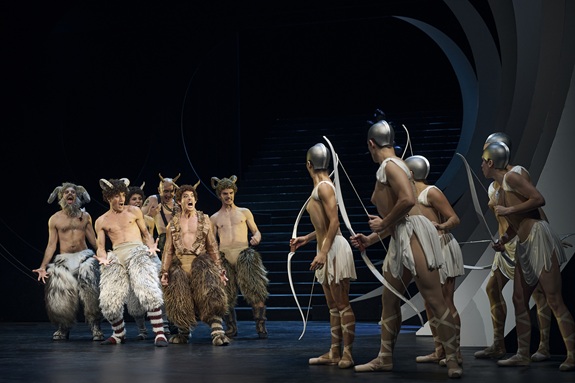
 Austria Cavalli, La Calisto: Soloists, L’Arpeggiata / Christina Pluhar (conductor). Theater an der Wien, Vienna, 16.9.2026. (AD)
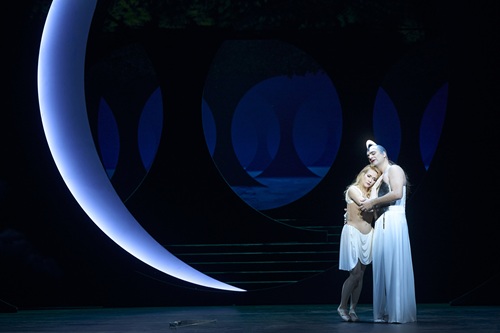
When Jupiter breaks the boundaries of what is permissible and Mercury begins spinning his ingenious plots, someone usually ends up paying dearly for it…
No, this is not another astrological forecast. It is the plot of La Calisto by Francesco Cavalli, the 17th-century Venetian composer, whose opera has opened the new season at Theater an der Wien. This is hardly a small Baroque experiment for a niche audience. On 8 November, the same production by Stefan Herheim will arrive at the Staatsoper Unter den Linden in Berlin as part of Barocktage 2026…
Why this opera, and why now?
Over the past few years, there have been plenty of moments when one might have thought: when is that deus ex machina finally going to turn up and put an end to this whole mess? And then Jupiter descends from the heavens onto a land scorched by fire. Literally. Dressed as a firefighter. His noble intentions do not last long, however, and he soon decides to seduce the beautiful Calisto. But what lies behind the whims of the forces that govern our lives?
Herheim offers no immediate answer. Instead, he draws us into a visual feast: a lavish, indecent and very funny carnival. Gender, appearance and social roles shift before our eyes. Naked orgies, obscene dances, lustful satyrs. For some, the erotic excess may be too much. There is, after all, a blazing vulva, not to mention Nature appearing in all the voluptuous glory of the Venus of Willendorf.
Much of the production’s carnival atmosphere comes from the sound of L’Arpeggiata under Christina Pluhar. Nothing in their playing feels like a museum reconstruction. Quite the opposite: it lays bare the living nerve of the score. Playfulness is inherent in the very nature of Baroque music, and Pluhar lets it break free through echoes of jazz and rock ’n’ roll, almost as if setting little riddles for the ear: will we catch the allusions or not? Will we believe these sonic illusions? With this comes the revival of an almost forgotten way of experiencing the world, one in which myth had not yet become literature, and gods and mortals shared the same reality, constantly interfering in one another’s lives. It is the sound of L’Arpeggiata, together with Pluhar’s charisma, that creates a rare resonance between the production’s shifting meanings and the sheer musical feast.
The audience laughs as though watching a late-night talk show. And then, gradually, it stops being quite so funny…
There are clearly several layers of meaning at work here, and Stefan Herheim is in no hurry to settle on any one of them. This play of meanings becomes one of the production’s central dramatic devices, holding the audience’s attention almost flawlessly. What could be more Baroque than the illusion that you have understood everything, only for one new detail to rearrange the entire structure?
At first, Calisto’s story may seem like a reimagining of victimhood. An ordinary nymph becomes a star, and not merely in the celestial sense, but in the distinctly modern, almost celebrity sense of the word. Wrapped in fur and dark glasses, Calisto looks like an instantly recognisable figure of public success.
Vera-Lotte Boecker makes this transformation particularly convincing. Her Calisto is both disarmingly spontaneous and startlingly contemporary. One might feel that Boecker’s vocal style sits somewhat outside the conventional Baroque idiom. To my ears, however, this particular vocal character fits Herheim’s conception remarkably well. His Calisto is no longer simply a nymph drawn from ancient myth: she is a figure being transformed before our eyes into something distinctly modern, public and almost glamorous. Boecker’s expansive, brilliant voice belongs to that transformation.
One might even think that Herheim has stripped Calisto of her conventional status as victim altogether and made her a co-author of her own fate. And fate turns out to be closer than we imagine…
Renato Dolcini, who embodies both Mercury and Fate, makes Mercury an almost omnipresent figure in the production. He is there in scene after scene: a secret adviser, a discreet intriguer, at times almost a shadow ruler. There is something quicksilver about Dolcini’s Mercury, in both voice and physical presence: fluid, agile, endlessly adaptable. His Mercury is always ready with the next move, finding ideas, strategies and ways around obstacles, never quite aware that each clever solution may already be shaping what comes next.
At the very beginning of the production, Calisto strikes a bargain with Mercury. That one detail changes the complexion of everything that follows The drama begins to look less like a chain of misfortunes befalling the heroine and more like a game. Sex, within this game, becomes an instrument of social ascent. Herheim takes the idea to an almost indecent degree of literalness: Calisto’s rise up the social ladder coincides with a bed flying above the stage as she has sex with Jupiter.
Milan Siljanov’s Jupiter is not power exercised from a distance. He is charming, intensely physical and frighteningly convincing. His transformation into Diana is achieved not through costume alone: Siljanov sings Jupiter’s seduction scenes in Diana’s guise in an effortless falsetto. It is a remarkable transformation. Jupiter and Jupiter-as-Diana are by no means always entrusted to the same singer, and Herheim’s decision to keep them in a single body becomes another powerful element of the production’s game with identity. Power changes its voice as easily as it changes its guise.
The real Diana, in Luciana Mancini’s performance, mesmerises with a searing mezzo. Her vocal lines soar into the stratosphere and plunge into the depths, as if tracing the very way our emotions live, through their sudden ascents and falls. There is little of the cool ‘lunar silver’ one might expect from Diana. Mancini’s voice is too warm, too sensuous, too intensely physical for the chastity her character so insistently proclaims. Diana may belong to the Moon, but Mancini’s voice burns. She declares one thing and desires another, demanding constancy while proving anything but constant herself. The contradiction is almost too perfect. Or is it another game?
Nothing is quite what it seems.
The Baroque gave us a particular sensitivity to illusion: what we see is forever revealing itself to be only the first layer of reality. Behind this reimagined story of victimhood, another layer begins to emerge. And the question that unlocks it is this: does Calisto have a will of her own in this story? Or is everything happening according to Jupiter’s will? Or perhaps it is Juno’s rage that determines the course of events?
Giuseppina Bridelli’s Juno brings a very different force into this game. Her mezzo has a dark core and considerable weight, but it is the edge she gives the voice that is most striking. Her fury is more than jealousy: the firmness of the tone and the bite of her attack make Juno’s anger sound less wounded than punitive. She seems driven by the need to restore an order that has been broken, and once that order is disturbed, someone has to pay, whether or not they are the one who caused the damage.
What is this story about, if behind jealousy we begin to hear something closer to a passion for order? Is it a story of seduction, or of Calisto’s own secret intrigue? Of violation or accommodation? Victimhood or complicity? Is everything happening according to Calisto’s own desire, or is she, after all, merely a puppet? The question is not quite so simple. A game, as we know, can have many levels of meaning. And this one leads us through them only to let meaning slip away at each new level, revealing how illusory it can be.
One could go much further into the details of the voices, the orchestra, the costumes. But something else matters more: the remarkable unity between Herheim’s directorial vision and every participant in this theatrical and musical feast. It is this unity that makes the production as a whole a genuine work of art — and that is rare. It allows us to move beyond the brilliance of its individual elements and descend into the deeper layers of meaning, into the depths of the myth itself.
Who, after all, are Jupiter, Mercury, Diana and Juno? Are they simply characters who govern human destiny from outside? Seen from another angle, they begin to resemble the forces of the unconscious at work within us. Mercury is the intellect that is forever inventing, interpreting, offering us explanations and slipping solutions into our hands, without necessarily understanding where those solutions will lead. Jupiter is the way we form connections and find our place within the social hierarchy: how we establish ourselves in the world, how we relate to power and how we exercise it ourselves. Juno is the law within us, the force that demands that a violation be corrected and someone held responsible, without necessarily distinguishing between justice and punishment. Diana is our emotional life in all its contradictions: the feelings that create the perpetual tension between who we believe ourselves to be and what we actually desire.
Mythological consciousness gave these forces names, faces and divine status. Modern psychology is more likely to speak of unconscious motives, prohibitions, defenses and inner conflicts that shape our desires and decisions. Seen this way, the entire carnival unfolding around Calisto can be read as a mystery play of her own unconscious, disguised as external circumstance.
But if the forces governing Calisto are not outside her but within her, does that make her any more the author of her own fate? The production leaves us with a thought that is deeply uncomfortable for the modern mind: we shape our own destiny through decisions whose deeper meaning remains elusive to us. We have ceased to believe in gods, without noticing that the forces we once called by their names have not disappeared. They still govern us — from within the unconscious.
Alexandra Derbeneva
Featured Image: Stefan Herheim’s production of La Calisto © Matthias Baus/Theater an der Wien
Production:
Director – Stefan Herheim
Set design – Silke Bauer
Costume design – Yashi
Lighting – Stefan Herheim and Karl Wiedemann
Video – Roman Hagenbrock
Choreography – Beate Vollack
Cast:
Calisto – Vera-Lotte Boecker
Giove – Milan Siljanov
Diana – Luciana Mancini
Endimione / Furia II – Arnaud Gluck
Giunone / L’Eternità – Giuseppina Bridelli
Linfea / La Natura – Marcel Beekman
Mercurio / Il Destino – Renato Dolcini
Satirino / Furia I – Jake Arditti
Pane – Juan Sancho
Silvano – João Fernandes