
 United States Various: Lisa Batiashvili (violin), Gautier Capuçon (cello), Jean-Yves Thibaudet (piano). Wu Tsai Theater, David Geffen Hall, New York, 24.10.2026. (ES-S)
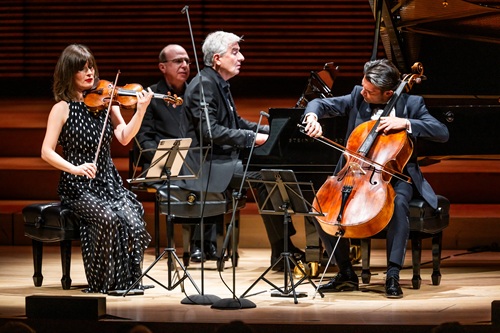
Shostakovich – Piano Trio No.1 in C minor, Op.8
Debussy – Piano Trio in G major
Dvořák – Piano Trio No.3 in F minor, Op.65
Encore: Manu Martin – The Lim Symphony of Oceans Trio
Since joining forces in 2018, violinist Lisa Batiashvili, cellist Gautier Capuçon and pianist Jean-Yves Thibaudet have periodically toured together. Following a 2023 appearance at Carnegie Hall, the three musicians returned to New York, this time to David Geffen Hall under the auspices of the New York Philharmonic. Their program contrasted two youthful works by Shostakovich and Debussy, both composed during their teenage years, with an expansive trio written by Dvořák in his maturity.
Of the three works, Shostakovich’s single-movement Piano Trio No.1, which he composed at 17 and originally titled Poème, revealed the most distinctive musical voice, albeit in nuce. Capuçon’s cello introduced the descending chromatic motif with a plaintive intensity, to which Batiashvili’s violin responded with equal expressiveness. The musicians sharply delineated the shifts between bursts of driving rhythmic energy, occasionally tinged with sarcasm, and moments of sweeping, distinctly Russian lyricism. Yet the transitions remained remarkably fluid, and the lyrical passages never lapsed into sentimentality. Particularly memorable was the Andante section, where the cello’s melody passed to the violin above the piano’s delicately articulated three-note chords in quavers, creating a moment of exceptional intimacy. Thibaudet’s rhythmic precision gave the more agitated passages additional impetus. Even in the most forceful moments, the three players maintained an assured balance, lending coherence to the work’s disparate episodes.
Debussy’s Piano Trio in G major, by contrast, seemed closer to a polished student exercise than to the work of a composer who had already found his individual voice. Written in 1880 but not published until 1986, its predominantly Romantic idiom and occasional salon-piece character offered little indication of Debussy’s later harmonic innovations. Batiashvili, Capuçon and Thibaudet approached the score with elegance, maintaining a graceful melodic flow and rhythmic buoyancy. At times, however, the individual personalities of the three distinguished soloists were more apparent than their collective identity as a chamber ensemble. The Scherzo’s pizzicato passages were crisp and characterful. The finale gathered convincing momentum, providing a satisfying conclusion to the work.
Composed just three years after Debussy’s trio, Dvořák’s Third Piano Trio was similarly rooted in the Romantic tradition, with Brahms’s imprint particularly evident in its densely interwoven instrumental writing, dramatic contrasts and extensive thematic development. In the opening Allegro ma non troppo, the musicians sustained the movement’s underlying tension while preserving clarity in the exchanges among the three instruments. In the Allegretto grazioso, the piano introduced a melody with hints of Bohemian folk music, while the players deftly negotiated the rhythmic interplay between its duple meter and the strings’ continuous triplet figures.
In the Poco adagio, long lyrical phrases passed naturally between violin and cello supported by the piano’s measured chords, with Capuçon’s beautiful tone and Batiashvili’s expressive flexibility lending warmth to the dialogue. But despite the sensitivity of the playing, the movement’s expansive lyricism could not entirely disguise the conventional character of some of its thematic material. The Allegro con brio finale regained momentum, its folk-inflected gestures and furiant-like accents handled with precision and assurance. In spite of the conviction of the performance, the work’s considerable length did occasionally expose limitations in its thematic inventiveness.
There was only one encore: Manu Martin’s The Lim Symphony of Oceans Trio, a 2025 arrangement conceived especially for Batiashvili, Capuçon and Thibaudet. It draws on music from Symphony of the Oceans (LIM III), the third installment of the LIM Trilogy, an interdisciplinary project created by Susan Lim and Christina Teenz Tan that combines classical music, animation and science. Pleasant enough on the surface, the brief piece evoked sophisticated background music with a Hollywood sheen.
Edward Sava-Segal