 United Kingdom Death of a Naturalist: Sarah Richmond (mezzo-soprano), Malachy Frame (baritone), Hard Rain SoloistEnsemble (Aisling Agnew [flute], Sarah Smith [clarinet], Thomas Jackson [violin], David McCann [cello], Daniel Browell [piano]). Harty Room, Queen’s University, Belfast, Northern Ireland, 14.11.2026. (RB)
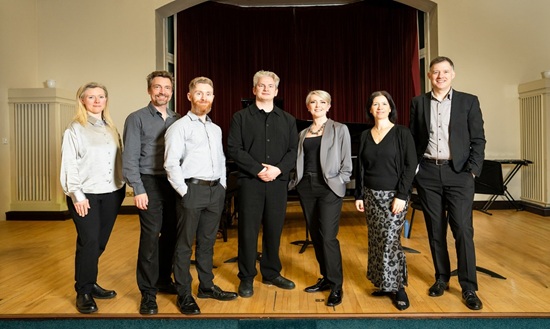
This programme of contemporary works from the Hard Rain SoloistEnsemble featured four new song cycles. The programme looked at the relationship between human beings and nature drawing on the medium of poetry. It challenged the idea that humanity is separate from and superior to nature. It also looked at how patriarchal culture has subordinated women and made them more acquiescent. Sarah Richmond and Malachy Frame joined Hard Rain as guest soloists.
The recital opened with Birding by Ear by the US composer Perry Goldstein. It was developed in collaboration with the writer Richard Powers, and it is scored for baritone, piano, violin and cello. It consists of six bird-themed poems which explore man’s desire for connection with the natural world. The six movements are: ‘White-throated Sparrow’; ‘Mockingbird’; ‘Lyrebird’; ‘Famous Bird Sayings’; ‘Barred Owl’; and the ‘Morning Chorus’. Rather than transcribing bird songs, the ensemble playfully interacts with the human mnemonics in Powers’s poems.
There was much to admire in this performance from Hard Rain and Malachy Frame. I enjoyed the avian vocalisations which appeared in various guises throughout the work and the distinctive musical themes and patterns. Malachy Frame maintained beauty of tone throughout and, like all great Lieder interpreters, he was very attentive to diction and conveying the meaning of the words. There was tight coordination between the three instrumentalists in ‘Mockingbird’ as they traded fragmented rapid-fire motifs. ‘Lyrebird’ had a more reflective, poetic feel and provided an opportunity to reflect on the damage caused by human intrusion into wild habitats. ‘Famous Bird Sayings’ coursed with rhythmic vitality and Frame brought out the quirky humour in Powers’s poem. Goldstein uses lower instrumental registers to create a nocturnal world in ‘Barred Owl’. The darkness of this world was beautifully realised by the ensemble as they skilfully conveyed humankind’s alienation from the natural world. ‘The Morning Chorus’ opened with a series of overlapping bird calls from all the instrumentalists. It culminated in a section with warmer, richer sonorities from the instrumentalists and Frame as finally a connection was forged. It is an amazing, highly inventive work that deserves to be much better known.
Pablo Casals famously performed and championed the traditional Catalan folk song ‘El cant dels ocells’ (‘Song of the Birds’) in recitals and used it as a plea for peace. Steven Isserlis commissioned a new version from Sally Beamish which was composed in 1998. David McCann’s performance of Beamish’s version captured the haunting, contemplative quality of the work. The rich, sumptuous cello textures were gorgeous, and the vocal line was highly lyrical and affecting.
The first half of the concert concluded with the world premiere of Áine Mallon’s Songs from Revered Scorned Women. This work is a song cycle in five movements for mezzo-soprano and piano trio. The five movements are: ‘Pandora’; ‘Eve’; ‘Medusa’; ‘The Marys’; and ‘Me’. Each movement uniquely adopts the perspective of a woman drawn from history, mythology or religion who has served as the archetype for misogynistic treatment or the establishment of patriarchal standards. The movements explore Pandora’s curiosity which was deemed sinful; Eve’s burden of guilt and sin; Medusa’s ordeal of sexual assault, victim blaming and subsequent demonisation; and the complex dichotomy faced by the Marys (the virgin Mary and Mary Magdelene) which explores entrenched moral judgements on virginity and promiscuity. (This dichotomy was a favourite preoccupation of James Joyce who often referred to his wife, Nora Barnacle, as whore and Madonna.) The final movement considers how these narratives impact on modern women.
This performance from Sarah Richmond and Hard Rain was absolutely first-rate and it deserves to put this work on the musical map. The piece is an amalgam of different styles and draws on musical theatre as well as Classical tonal and more modernist language. The juxtaposition of piano trio and mezzo-soprano provide a chamber music intimacy. The vocal line sounded incredibly demanding with its rapid shifts from sustained lyricism to declamation and music hall comedy. Sarah Richmond rose to the challenge with virtuoso aplomb.
‘Pandora’ is a reflection on the criminalisation of female curiosity symbolised by the character’s fateful opening of the box which unleashed suffering on to humanity. The wordless lyrical vocalise which opened the movement had a contemplative questioning feel. The subsequent rhythmic interactions between Richmond and the piano trio balanced the need to question with the consequences of doing so. In ‘Eve’ the music had a heavier more introspective feel which was conjured up by resonant lower register sonorities on the cello and piano. In a highly experimental section Richmond stopped singing and did a spoken stand-up comedy routine where God said to Adam, ‘Oh, I’ve made you a helper – someone to cook your food, do the laundry, have your kids….’. ‘Medusa’ had a jagged percussive quality, and Richmond conjured some striking contrasting vocal colours. ‘The Marys’ fused together the two Biblical characters and there were striking juxtapositions as the music moved from the sacred to the profane. The final movement, ‘Me’ seemed to weave together motifs from the preceding four movements. This is a brilliant composition, and I hope it will feature as a staple regular in future concert hall programmes.
The second half opened with a short, animated film by Paula Caffrey which provided a light-hearted diversion. It was followed by Sarah Lianne Lewis’s Relativity and Revelation for mezzo-soprano, piano and two singing bowls. The cycle sets poems by the American poet J L Williams alongside traditional Japanese Haiku. This avant garde piece was performed with enormous conviction by Sarah Richmond and Daniel Browell. They succeeded in conveying delicate impressionistic sonorities, but I did not find this piece particularly inspiring or interesting. Jane O’Leary’s Buaneitilt consisted of three short pieces for solo flute which sought to convey the movement of various creatures in flight. Aisling Agnew performed the pieces with immaculate finish and attention to detail but again this was not a particularly engaging piece.
The concert concluded with a performance of Greg Caffrey’s Death of a Naturalist. This song cycle sets four poems from Seamus Heaney’s poetry collection of the same name. It was originally composed for piano and baritone, but Caffrey later transcribed it for flute, bass clarinet, violin, cello and baritone. The four poems in the set offer biographical insights into the poet ranging from early memories of his father ploughing a field to the ups and downs of married life.
This was once again a very impressive performance from Malachy Frame and Hard Rain. I liked the rhythmic momentum which the instrumentalists brought to the first song and the way in which they realised the sense of physical exertion associated with the horse-drawn plough. Frame brought weight gravitas to the vocal line. There were minor balance issues between Frame and the instrumentalists although they were soon resolved. Frame sang with great lyricism in the third song entitled ‘Poem’ against affecting suspended lines in the woodwind. In the final song entitled ‘Honeymoon Flight’ Frame and the instrumentalists conjured up suspended weightless sonorities. The cycle ended on a note of quiet trust and resignation.
All the performers are to be applauded for bringing enormous conviction, cultivation and polish to these new works. They certainly made a strong case for the song cycles by Goldstein, Mallon and Caffrey. I hope these performances will lead to these works being performed much more widely and finding a permanent place in the concert hall.
Robert Beattie
Perry Goldstein – Birding by Ear (2019)
Sally Beamish – Song of the Birds (1998)
Áine Mallon – Songs from Revered Scorned Women (2025) (world premiere)
Paula Caffrey – Of course a movement was something different from a tree (Animated film) (2023)
Sarah Lianne Lewis – Relativity and Revelation (2015)
Jane O’Leary – Buaneitilt (2022)
Greg Caffrey – Death of a Naturalist (2020/22)