 Netherlands Liszt Utrecht Piano Competition 2026 [1] – Festival Phase: Thomas Kelly, Kang Tae Kim, Alexander Kashpurin, Chia-Yang Hsu, Alberto Ferro, Minkyu Kim, Rune Leicht Lund, Sunah Kim (piano), Lea Hausmann [violin], Sam Shepherd [cello], Dana Zemtsov (viola), Ib Hausmann (clarinet) and Alberto Navarra (flute). TivoliVredenburg, Utrecht, 18–21.1.2026. (LV)

Composers – Liszt, Weber, Liszt/Weber, Liszt/Beethoven, Mahler/Friedman, Bartók, Prokofiev, Martucci, Lyadov, Chopin, Kapustin, Ustvolskaya, Stravinsky and others
After a week of grueling concentration and 32 recitals, the Liszt Utrecht Piano Competition has reached its decisive point. Eight pianists appeared across four festival days at TivoliVredenburg in a demanding sequence of solo, chamber and thematic programs, the competition testing not only endurance and technique but imagination, judgment and stylistic breadth. Along the way, each of the eight semi-finalists contributed illuminating – at times genuinely stunning – moments, before the jury selected Thomas Kelly, Kang Tae Kim and Alexander Kashpurin as the three pianists who would advance to the Grand Final.
The competition’s structure is as exacting as it is revealing. Each pianist performs Liszt’s B minor Sonata, a program devoted to Weber and Liszt’s transcriptions of Weber, a chamber-music recital featuring both composers and a free-form thematic recital of each contestant’s own devising under the banner ‘Liszt Stories’. Another distinctive feature of Liszt Utrecht is the use of different assigned pianos for the various rounds – Bechstein, Fazioli, Bösendorfer, Steinway and Yamaha – adding another variable to be negotiated. Heard in close succession, these programs create not repetition but accumulation: a composite portrait of how each pianist builds large and small forms, collaborates, curates programs and, ultimately, defines Liszt for themselves.
On the first day, Thomas Kelly distinguished himself with almost classical authority in a B minor Sonata that unfolded in a single, coherent, enormously powerful arc, notable less for display than for inevitability. The opening emerged with firmness rather than drama and, as the work progressed, difficulties were absorbed seamlessly into the musical fabric. Tempos remained stable, transitions carefully judged and the final pages arrived not as an eruption but as a structural resolution. In an era when pianists often emphasize visible intensity, Kelly’s Liszt was inward, monumental and focused.
That same discipline carried into Kelly’s Weber. His account of Liszt’s arrangement for solo piano of Weber’s already stunning Konzertstück recalled Donald Tovey’s assertion that Weber’s pianistic writing ‘conclusively proves’ him among the great instrumental virtuosos. And Kelly’s own brilliance never obscured the music’s chills and thrills. Kelly’s ‘Liszt Stories’ recital, ‘Pastoral’, was beautifully proportioned and intellectually coherent, though it also revealed a potential limitation. The very control that served him so well elsewhere occasionally muted the sense of danger Liszt invites. In Les Préludes and the Liszt/Beethoven Sixth Symphony transcription, the soundworld was larger than life, yet at moments felt carefully managed rather than risk-embracing.
Kang Tae Kim approached Liszt from a different angle. His B minor Sonata began with volcanic energy – forceful, driven and urgent – before settling into a more fluent, poetic and relatively stable trajectory. As the work progressed, Kim found a persuasive narrative flow, shaping lyrical episodes with warmth and flexibility. The closing sections achieved coherence through momentum rather than architectural inevitability.
Kim’s ‘Liszt Stories’ recital, ‘Music of the City – a festival of everyday life’, was devoted to Venice – real, remembered and imagined. From Canzona Napoletana and Rossini/Liszt arrangements to Venezia e Napoli, La campanella and Stravinsky’s Trois mouvements de Petrouchka, the program unfolded as a sequence of atmospheric scenes. Color and character were central strengths. At times, however, the abundance of surface imagery risked blurring the larger dramatic arc; and Petrouchka, while brilliantly executed, briefly pulled focus away from the Lisztian narrative rather than deepening it.
Alexander Kashpurin’s trajectory was the most unexpected. A last-second substitute, he quickly became one of the competition’s most arresting presences. His B minor Sonata, like Kim’s, began volcanically – but unlike Kim’s, it remained largely unrelenting. The opening was explosive and the intensity scarcely abated. The result was thrilling commitment, though at the cost of contrast: moments inviting repose or transformation were often pressed forward, leaving less space for structural breathing.
Kashpurin’s Weber Sonata No.2, Op.39, revealed a more varied palette. The opening was mysterious and inward, gradually unfolding into a concluding Rondo that felt genuinely transcendent – a reminder that his volatility can serve poetry as well as force. His ‘Liszt Stories’ recital, ‘A Story of One Life’, pushed that volatility to its limits. The performance of Galina Ustvolskaya’s Piano Sonata No.6 was ferocious and unsettling, played with uncompromising intensity. It was gripping, but its extremity occasionally overshadowed the surrounding works, giving the program a confrontational weight that challenged narrative balance.
The chamber music round proved quietly decisive. Removed from solo dominance, pianists were required to listen, blend and respond. The overall level was high, but violinist Lea Hausmann and cellist Sam Shepherd from the Amatis Trio stood out for cohesion and generosity. Hausmann played with warmth and poise; Shepherd completed the texture with eloquence and steadiness. Clarinettist Ib Hausmann’s appearance in movements from Weber’s Grand Duo Concertante offered a reminder of Weber’s wit and theatrical ease.
Selected for the finals by an international jury – Andrea Bonatta, Suzana Bartal, Mariam Batsashvili, Severin von Eckardstein, Janina Fialkowska, Saskia Giorgini, Pierre van der Westhuizen, Yingdi Sun and chairperson Cynthia Wilson – Kelly, Kim and Kashpurin will appear on 24 January with the Netherlands Radio Philharmonic Orchestra, conducted by Stéphane Denève, in the Grote Zaal of TivoliVredenburg, where prizes of €25,000, €12,000, and €8,000, along with a €2,000 Audience Prize, will be awarded. Kang Tae Kim will play Liszt’s Concerto No.1 on a Fazioli, Thomas Kelly will do Liszt No.2 on a Fazioli and Alexander Kashpurin Liszt No.1 on a Steinway.
Liszt Utrecht 2026 has succeeded in presenting three sharply defined artistic identities – architectural control, narrative fluency and volcanic intensity – each illuminating a different facet of Liszt’s legacy, and each posing its own questions and solutions to how that legacy is being carried forward today.
Laurence Vittes
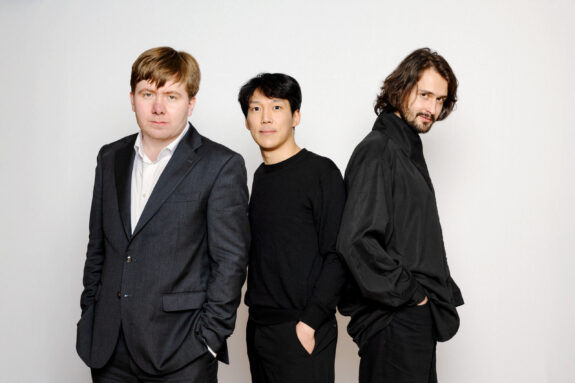
Featured Image: The three finalists at Liszt Utrecht 2026: (l-r) Thomas Kelly, Kang Tae Kim, Alexander Kashpurin © Allard Willemse