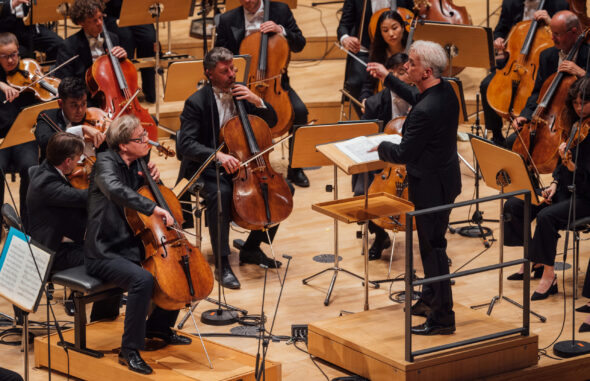
 Germany Dresden Music Festival 2026 [4] – Hannah Kendall, Elgar: Jan Vogler (cello), London Philharmonic Orchestra / Edward Gardner. Kulturpalast Dresden, 26.5.2026. (MC)
Hannah Kendall – The Spark Catchers (2017)
Elgar – Cello Concerto in E minor, Op.85 (1919); Symphony No. 2 in E-flat major, Op.63 (1911)
Titled ‘British Orchestral Sensation 2’ the London Philharmonic Orchestra opened the concert with Hannah Kendall’s The Spark Catchers. Programmed next, either side of the interval, were two Sir Edward Elgar works separated by only six years the Cello Concerto a masterwork followed by the great Symphony No.2.
Originally the opening work was to be Dame Judith Weir’s Forest (1995). Its replacement was London born Hannah Kendall’s The Spark Catchers a symphonic poem commissioned by the BBC Proms where it was premiered in 2017 at London’s Royal Albert Hall. Kendall’s inspiration was Lemn Sissay’s poem of the same name that she described ‘as incredibly evocative’. The poem and orchestral score pay tribute to the matchwomen workers of Bryant and May’s London match factory in Bow that in 1888 went on strike in protest of the dangerous work conditions.
Kendall has described how ‘specific words and phrases from Sissay’s text have established the structure of the work, and informed the contrasting musical characteristics created within the piece’s main components’. An evocative score The Spark Catchers had impressive forward momentum and striking crescendos. My attention was held right from the opening with the sound of wind and string sections pulling against each other to the concluding section where the weighty brass and strings are overlayed by repetitive trumpets chords. Now I have Kendall’s programme note I hope it is not too long before I hear The Spark Catchers again.
Elgar Cello Concerto has been described as ‘a cornerstone of the solo cello repertoire’ and I agree that it is a masterwork. Charged with intensity Elgar set about writing the score whilst haunted and disillusioned after the cataclysmic disaster of World War One. It feels as if Elgar was writing a letter of farewell to the England he once knew, now irretrievably lost.
At the premiere given in 1919 Felix Salmond was cello soloist with Elgar conducting the London Symphony Orchestra at the Queen’s Hall in London. The first performance was described as a ‘disaster’ due to under-rehearsal, yet the Cello Concerto has become one of the most popular ever written and provides numerous challenges to the performer.
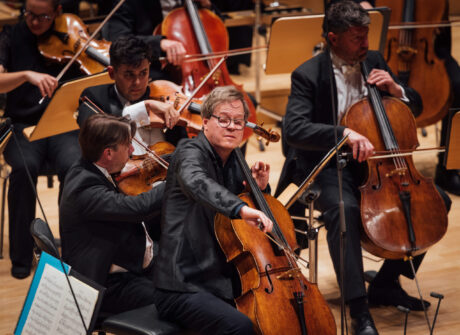
German born, now New York based, cello soloist Jan Vogler makes everything look and sound so easy. In his hands the cello the Stradivari ‘Ex Castelbarco/Fau’ (1707) produces a gorgeous mellow sound. In the opening movement Vogler started out conveying less expression than one often hears today yet did soon increase the intensity of this moving and appealing score. Standing out was the enchanting way the cello yearns despairingly just prior to the reprise of the opening theme.
In the short Lento – Allegro molto with its scherzo-like section high on virtuosity the scampering race contrasted starkly with the prevailing sense of nobility. The heart of the score the lyrical Adagio had Vogler achieving a heart-breaking longing that felt like shedding tears. It was utterly compelling.
As it always seems to do with the finest soloists like Vogler the finale with its mix of feelings and emotions gripped me from start to the highly satisfying conclusion. Evoked during the main theme were scenes of monarchy and pageantry reminding me of Elgar’s own Pomp and Circumstance March. I have heard cello soloists drowned out by errant conductors. Not here, as Gardner and his players were sensitive to Vogler’s playing. Clearly well-prepared the London players under Gardner got on with the job and delivered a sterling performance.
Elgar dedicated his Second Symphony to the memory of King Edward VII, who had died in 1910. At the head of the score, he added a quotation from a Shelley poem ‘Rarely, rarely comest thou, Spirit of Delight!’ He described his symphony as ‘The passionate pilgrimage of the soul.’ Elgar’s inspirations for the work remain matters of conjecture. Some say it was his response to the death of the King, or maybe an expression of feeling for his romantic muse, Mrs Alice Stuart-Wortley nicknamed ‘Windflower’. Elgar himself conducted the Queen’s Hall Orchestra in the premiere in May 1911. Its rather lukewarm response was a disappointment for Elgar.
One of Elgar’s finest, the E-flat major symphony is a richly scored and imaginatively lyrical work. The opening movement Allegro vivace e nobilmente has abundant contrasting emotions. The London Philharmonic Orchestra knew this work well and under Gardner provided a big, warm sound interspersed with playing of great beauty in passages that must be related to romantic love and infatuation. At certain points I was reminded of music from Holst’s The Planets (1914-17).
The Larghetto second movement is a funeral march. The theme is said by some to be an elegy to the deceased King Edward VII, yet more likely it was composed in tribute to the death of his friends August Johannes Jaeger and Alfred Edward Rodewald. Under Gardner, Elgar’s writing had a heartbreaking quality, passionate and tormented by turns. Marked Rondo (Presto) the movement was described by the composer as ‘very wild and headstrong.’ Gardner brilliantly transitioned the breezy and brisk tempo to another level of volume and intensity on all instruments including percussion. In the closing movement Moderato e maestoso the orchestra was in its element producing music of stress and tension with shades of anger. Then the change of direction by Gardner who was in harmony with Elgar’s final pages so beautifully introspective and peaceful.
At the Kulturpalast, the visiting London Philharmonic Orchestra, under Edward Gardner, earned high praise, while Jan Vogler delivered a masterful account of Elgar’s Cello Concerto. Once again, the Dresden audience responded enthusiastically.
Michael Cookson
Featured Image: Cellist Jan Vogler and the London Philharmonic Orchestra conducted by Edward Gardner © Oliver Killig