
 United Kingdom Liszt, Medtner, Chopin, Hillborg, Beethoven: Alexandre Kantorow (piano). Wigmore Hall, London. 28.5.2026. (CSa)
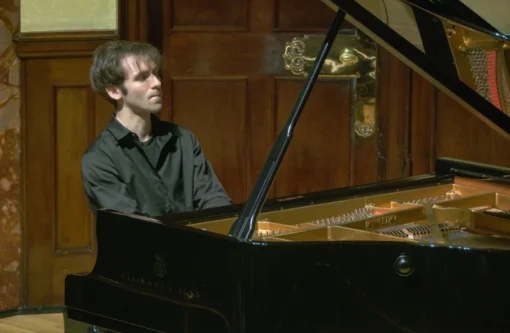
The poet Heinrich Heine described Liszt’s pianism as ‘a deluge of heaven-storming ideas mixed with moments of sweetness and fragrance, while Robert Schumann wrote of being overwhelmed by a mixture of ‘wildness, tenderness, boldness and airy grace.’ Listening to the French pianist Alexandre Kanorow, erstwhile winner of the Tchaikovsky Piano Competition, recipient of the prestigious Gilmore Artist award, and still just 29 years old, one wonders if a comparison with Liszt or some of his greatest interpreters cannot be made, such is the astonishing technical command, immense power, thrilling risk taking and spiritual intensity of this young pianist’s playing.
In a programme which began with the extrovert high Romanticism of Chopin, Nikolai Medtner, and of Liszt himself, and ended with the introspection and spiritual depth of late Beethoven, Kantorow charted an ecstatic journey through the piano repertoire of much of the nineteenth century.
The recital began uncompromisingly with Liszt’s vast and increasingly complex set of Variations on a Theme from a Bach cantata – Weinen, Klagen, Sorgen, Zagen (‘Weeping, lamenting, worrying, fearing’) based on a text which reflects on unavoidable suffering experienced on the true path to Christian redemption. Its sentiment of inconsolable grief must have resonated with Liszt whose daughter Blandine had died shortly before the piece was written. Kantorow, hammering out the mournful chromatic descent with his left hand while delicately weaving the 43 variations with his right, transformed the keyboard into a vast symphonic world. Indeed, from the thundering start to the intense concluding chorale, one could hardly believe that such a wealth of sound could issue from a single instrument.
The Russian-born composer and pianist Nikolai Medtner was a small child when Liszt died in 1886, yet he grew up in a musical world that was very close to Liszt’s era. Although in form and tone Medtner’s works were more influenced by Brahms than by Liszt, his captivating but rarely heard Piano Sonata in F minor – the first of 14 – was a logical and fascinating way in which to end the first half of the recital. Kantorow tapped the restless energy which courses through the opening Allegro and invested the lyrical central movement with restrained and unsentimental beauty. The luxuriant textures of the powerful finale were articulated with remarkable transparency, underscoring the brilliance of this bafflingly neglected work.
Kantorow’s only foray into 21st-century piano repertoire came after the interval in the form of an 11-minute solo work he commissioned with support from the Gilmore International Piano Festival from the Swedish composer Anders Hillborg. In an acknowledgment to the city of Kalamazoo Michigan where the Gilmore festival is based, The Kalamzoo Flow navigates us along the city’s river, a shimmering, fluid, watery world, an in which, to quote Hillborg, ‘dazzling textures emerge: gleaming rippling passagework that gives way to driving toccatas, as well as resonant chorales like vast submerged bells’. Played with the utmost delicacy and precision, it was followed without pause by a gorgeously coloured, almost air born account of Chopin’s Prelude in C sharp minor.
The high point on the published programme was Beethoven’s final piano sonata, No.32 in C minor, Op.111. There was something equally elemental in Kantorow’s interpretation. The brooding opening Maestoso began with deep premonitory bass rumbles presaging a powerful volcanic eruption. What emerged was monumental in scale and breathtaking in volume and speed, yet carefully shaped. The resulting psychological tension he generated was not simply to be attributed to mere technical velocity, but to the rock-solid pulse he maintained throughout. The second movement Arietta – a set of variations that dissolve into transcendent trills – floated airily while the syncopated jazzy modernity of the ‘boogie-woogie’ section was navigated with rhythmic precision. The concluding passages built up into an ethereal, magnificent crescendo of glorious sound.
Although clearly exhausted by his mental and physical exertions, Kantorow summoned the necessary strength to give the audience an encore – Liszt’s famous transcription of Isolde’s Liebestod from his son-in- law Wagner’s opera Tristan und Isolde. Beginning with soft simplicity, Kantorow’s shimmering tremolos and rapid arpeggios built into a massive, transcendental climax. An extraordinary end to an exceptional recital.
Chris Sallon
Liszt – Variationen über das Motiv von Bach, S180
Nikolai Medtner – Piano Sonata in F minor, Op.5
Chopin – Prelude in C sharp minor, Op.45
Anders Hillborg – The Kalamazoo Flow
Beethoven – Piano Sonata No.32 in C minor