 Austria Massenet, Manon: Soloists, Chorus and Orchestra of Vienna State Opera / Betrand de Billy (conductor). Broadcast live (directed by Dominik Kepczynski) from the Vienna State Opera 17.1.2026. (JPr)

Coming to this livestream rather unprepared I thought this Manon might be a new production, certainly Act I looked like it with the chiaroscuro lighting, a 1930s French railway station concourse with huge clock, populated by gendarmes and commuters (real or carboard cutouts), standing stock-still or moving in a stylised fashion (not quite, but similar to the Monty Python’s Ministry of Silly Walks). But no, Andrei Şerban’s Manon premiered on 3 March 2007 with Anna Netrebko (Manon) and Roberto Alagna (Des Grieux) and was conducted by Bertrand de Billy who had returned again for this current revival.
Massenet was something of the musical heir to Gounod who had taken on board some of Wagner’s new musical ideas. Massenet composed 25 operas, including Thaïs (1894) – whose symphonic intermezzo is a familiar concert piece – and Don Quichotte (1910) but it is really only Manon (1884) and Werther (1892) which are regularly put on today. When first seen Manon was hailed as a French work that could truly match the popular versimo operas of the day, as well as Wagner’s music dramas. Now it is probably somewhat overshadowed by Puccini’s more successful 1893 version of Abbé Prévost’s original novel L’Histoire du Chevalier des Grieux et de Manon Lescaut.
So, Massenet’s Manon just about clings to its place in the repertory, even though its tale of a young girl from a small town with a fatal attraction to riches and pleasures – and who reaps what she sows – has long been an irresistible vehicle for composers, as well as star sopranos! Manon is a rather odd work for several reasons: firstly, it has the ‘heroine’ centre stage for most of it and dubiously ‘celebrating’ her passion, not only for Des Grieux, but also a life of luxury. Then, Massenet and his librettists (Henri Meilhac and Philippe Gille) make the story less bleak than in their source material and include two very busy outdoor scenes, some moments of intimacy, a church scene, a tense gambling one, and the almost obligatory ballet divertissement (here in Act III).
The major issue with Manon is that it is an opéra comique – almost operetta-ish at the beginning – with all the spoken dialogue and some broad comedy despite the subject matter. It spends some time for Manon and Chevalier des Grieux to get together, before tearing them apart, before bringing them back together for a passionate reunion. There is a gambling scene – something of a homage to Verdi’s La traviata – followed by a final act that could only have inspired Puccini as (spoiler alert!) Manon dies in Des Grieux’s arms, and which is not exactly comique. Massenet really makes it difficult to connect with the plight of the lovers because of all the shifts in tone and a rather rushed ending.
Şerban and designer Peter Pabst were clearly influenced by French film noir and in Act I of this revival we meet two pimps Guillot and de Brétigny – given fairly nuanced characterisations by Andrea Giovannini and Clemens Unterreiner – arriving with their charges; three lively, hard-to-handle, glamorous young women given wonderful vignettes from Hyejin Han, Florentina Serles and Teresa Sales Rebordão. Because her parents are disturbed by Manon’s fondness for luxuries and frivolity she is on her way to a convent. Kristina Mkhitaryan brings the romantically fickle Manon to life. Perhaps too wise beyond her years and clear that what she wants is riches and not the rosary. Black-haired and wearing a beret, white blouse and classic black suit this Manon cannot look like a virginal teenager (almost 16). Nor can Benjamin Bernheim as the suited and booted Des Grieux – supposedly a feckless ‘youth’ – who Massenet has fall in love rather too swiftly once he touches Manon’s hand whilst sitting on a station platform bench and who instantly is also able to persuade her to run away with him.
A lack of funds has Manon and Des Grieux living in a sparsely furnished garret in Paris overlooking the Eiffel Tower and they are first seen relaxing in their underwear on a brass bedstead. Finally unable to resist the jewels de Brétigny offers when he arrives with her cousin Lescaut Manon allows Des Grieux to be rather perfunctorily abducted by his father at the end of the act (not one of Massenet’s finest moments).
The first scene of Act III has the opera’s demi-monde promenading at the Cours-la-Reine in Paris (now the Moulin Rouge) where there are deals being done of all sorts. Manon having abandoned Des Grieux arrives with de Brétigny, in an extravagant black and silver sparkly gown and is literally put on a pedestal. Oddly Şerban has a down-and-out figure with a radio cross the stage and this is not further developed. Having discovered that Des Grieux is distraught over her rejection and has entered the seminary at St Sulpice, seeking solace in religion and all set to become a priest, Manon rushes to him in order to win him back. In the very dark vestry with the shadow of a rose window there is a crucifix, leather settee and chair, and little else. Manon begs forgiveness before seducing Des Grieux all too easily and they run off together.
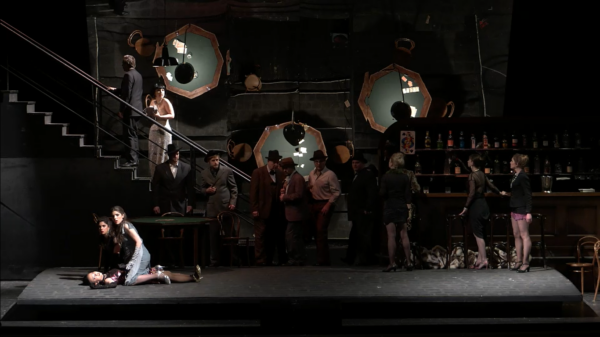
After this the remaining acts are something of an anti-climax! There is some interminable gambling though the faro tables are intriguingly reflected in a huge mirror and Manon now looks the epitome of a screen siren in her silver lamé. The vengeful Guillot and Des Grieux (still in clerical garb) clash, and Des Grieux is accused of cheating at cards and Manon of being immoral and both are arrested. In the final act there is a hint of a forest and Lescaut and Des Grieux seem to be in army uniform (his father, Le Comte des Grieux, got him released) and he is hoping to rescue Manon. However, she is exhausted and desperately ill and dies – rather hurriedly again – in Des Grieux’s arms proclaiming, ‘And that is the story of Manon Lescaut’.
There are some inspired arias in Massenet’s score, especially for Manon beginning with ‘Je suis encor’ tout étourdie’ in Act I which Kristina Mkhitaryan sang resplendently. Her sound has a depth and richness reminiscent of her Russian compatriot Netrebko allied to a smooth legato, reliable coloratura and laser-sharp high notes. Her rendition of Manon’s second-act ‘Adieu, notre petite table’, as she bids farewell to her life with Des Grieux, had a profound sadness and her death scene was heart-rending.
While his bearing is not as aristocratic as was another legendary Des Grieux, Alfredo Kraus, there is a certain nobility to every role Benjamin Bernheim essays. The vocal demands of Des Grieux hold no fears for his splendid voice that is totally secure throughout its range and without any register breaks and with the most eloquent of floated top notes when the score demands. There was an intense emotion to all his singing with a suitably guileless account of ‘En fermant les yeux’ about a future with Manon that was not to be. When duetting with Mkhitaryan there was undoubted chemistry and some wonderfully full-throated and impassioned singing from them both.
The role of Lescaut is rather underwritten and a youthful looking Stefan Astakhov threw himself in to what there was of it. Even in uniform he is clearly a bit of a wheeler-dealer and in the end, a ‘loser’, especially as a gambler! Dan Paul Dumitrescu had considerable gravitas but was a rather dour as Des Grieux’s father. The impeccably committed Vienna State Opera chorus made their usual splendid contributions.
On reflection, the opera does have significant longueurs – scene-changing pauses notwithstanding – and Bertrand de Billy was not entirely able to disguise these. However, the orchestra – as you might expect – played excellently for him and they gave sensuousness and depth of feeling to Massenet’s soaring melodies in a performance full of rhythmic verve and Gallic élan. There was little hint that de Billy ever indulged his singers, which can happen from time to time, as I occasionally need to write elsewhere.
Jim Pritchard
Featured Image: Andrei Şerban’s Manon Act IV © Weiner Staatsoper
Cast:
Manon Lescaut – Kristina Mkhitaryan
Chevalier des Grieux – Benjamin Bernheim
Le Comte des Grieux – Dan Paul Dumitrescu
Lescaut – Stefan Astakhov
Guillot de Morfontaine – Andrea Giovannini
Brétigny – Clemens Unterreiner
Poussette – Hyejin Han
Javotte – Florentina Serles
Rosette – Teresa Sales Rebordão
Innkeeper – Jaroslav Pehal
Two Guards – Dritan Luca, Alejandro Pizarro-Enriquez
Production:
Staging – Andrei Şerban
Stage, Costumes, Video and Lighting – Peter Pabst
Chorus master – Thomas Lang
How is it possible, in 2026, to write that ‘there are some inspired arias in Massenet’s score’? This opera is a masterpiece from beginning to end.
Such hasty and superficial judgments are unacceptable today — especially from a reviewer, whose task should be to discuss the performance he attended, not to spout nonsense about works that have been successfully performed for more than a hundred years.
I would also add that, at least to my taste, far too much space is devoted to the stage direction, and far too little to the music itself. Thank you for your attention.
JP for S&H replies: What an odd comment! If you believe opera is only music then please stick to listening to CDs or any modern equivalent. Opera – by every meaning of the word – means a combination of music, drama …and STAGING!
The word ‘masterpiece’ is overused and Massenet was no Verdi, Wagner or Puccini …to name three. Much of what is wrong about his Manon is outlined in my review which also praises the composer’s ‘soaring melodies’ which together with those arias (mentioned above) make sitting though its exorbitant length worthwhile. In brief, the subject matter does not suit its ‘operettaishness’ (especially in 2026) and its resulting uneven tone, there are ‘underwritten’ characters and a weak dramatic structure – especially its episodic nature – that leads to a rushed denouement, etc. etc.