 Hungary Kurtág: birthday concerts, MŰPA and BMC, Budapest, 20-22 February 2026. (AK)
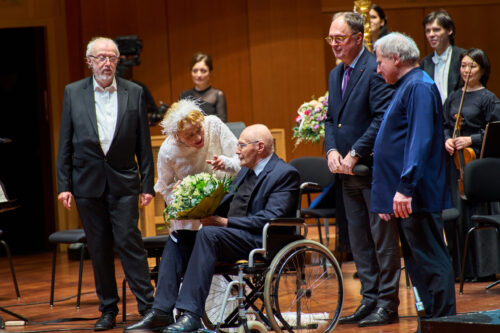
Celebrated Hungarian composer György Kurtág reached his 100th birthday on Thursday 19th February 2026. Although in a wheelchair, Kurtág is still very active, continues to compose, to teach and to attend concerts. His mind is sharp and his energy level is mind-blowing.
His birthday celebrations in Budapest included thirteen days of concerts between 15th and 28th February, with outstanding artists from Hungary as well as abroad. The intensive celebrations incorporated three days of high-quality conferences on Kurtág: many local Hungarian musicologists presented in Hungarian but scholars from abroad also contributed English presentations on various aspects of Kurtág’s work. For the programme during this time click here.
Most surprisingly, it was not only the world of musicians who participated in the celebrations. Announcements were made on Budapest buses and trams congratulating Kurtág warmly on his birthday. I do not know how many of these took part in broadcasting these pre-recorded statements and for how many days but I experienced them during my three-day stay on three trams and one bus which is all the public transport I used. Posters at tram stations also displayed Kurtág’s large photo and respectful congratulations to him. How many cities/countries in the world would celebrate their classical musicians in such a manner? (And would there have been such citywide displays of congratulations in Budapest if the mayor of the city was someone else, not Gergely Karácsony?)
I attended three concerts (20th, 21st and 22nd February), all displaying various elements of Kurtág’s tapestry of compositions. All concerts were rich in content and masterly compered, piece by piece in Hungarian as well as in English, by music historian Gergely Fazekas. The information he provided was a masterclass in what and how to communicate. The two-language verbal interludes between musical compositions made the concerts relatively long but nobody seemed to have complained or left. Significantly, each of the concerts was attended by Kurtág who also attended a post-concert reception on 20th February: he was still there talking to many people when I left utterly exhausted, long after my bedtime.
20.2.2026, MŰPA (Művészetek Palotája, Palace of Arts): Maria Husmann (soprano), Pierre-Laurent Aimard (piano), Máté Szűcs (viola), László Fenyő (violoncello), Concerto Budapest / Andras Keller (conductor)
Beethoven – B major String Quartet, Op.130: V. Cavatina
Bartók – Piano Concerto No.3, BB 127
Kurtág – Petite musique solennelle en hommage à Pierre Boulez 90; Double Concerto for cello and piano, Op.27, No.2; Movement for viola and orchestra; Die Stechardin (world premiere of Kurtág’s second opera)
Presumably the idea of programming stemmed from the assumption that Kurtág’s musical mother tongue was Bartók while that of Bartók’s was Beethoven. The relevant short programme notes in the booklet for the thirteen-day festival referred to the parallel between Kurtág’s movement for viola (composed for his diploma concert in 1955) allegedly in Bartók’s style and Bartók’s piano concerto (composed in 1945). However, arguably, Kurtág’s viola piece had more in common with Bartók’s Viola Concerto (composed also in 1945) than with the piano concerto. Either way, Kurtág compositions on the programme were plentiful for performers and audience alike, the piano concerto might not have been missed. My understanding of the Bartók piano concerto differs from that of international soloist Pierre-Laurent Aimard who played the piece with full passion but not with the gentle lyricism which Bartók might have imagined for the slow middle movement. However, solo clarinet (Csaba Klenyán) and solo flute (Orsolya Kaczander) motives were beautifully presented, providing lyrical bird imitations.
Much to my shame (as an ex-cellist), Kurtág’s Double Concerto for cello and piano was new to me. It needs – and had on this occasion in László Fenyő – a virtuoso cellist who can deal with tricky technical problems as well as singing cantilena passages (plus with changing cellos in a matter of seconds). The composition is fascinating and can be seen on several YouTube performances (although changing for the second cello, as specified by Kurtág and implemented by László Fenyő at the concert, is not evident on the videos I looked at).
The star piece of the programme was the much-awaited world premiere of what was announced as Kurtág’s second opera. However, I am not sure if the piece belongs to the genre of opera. Composed by Kurtág during 2023-2025 for soprano and large orchestra (although orchestrated by Zsolt Serei), Die Stechardin is a one-act monodrama to a libretto by Christoph Hein. The storyline deals with the relationship of 18th-century polymath Georg Christoph Lichtenberg and the much younger Maria Dorothea Stechard. She died at a very early age; in Kurtág’s opera she tells her love story from the afterlife. Skilfully staged by Csaba Káel with costume design by Kati Zoób, soprano Maria Husmann delivered a deeply moving performance. Whether the piece should be staged or performed as a concert piece is debatable. In either context it could make a good companion piece to Bartók’s Bluebeard’s Castle.
Concerto Budapest under András Keller delivered superbly throughout the evening and well done to leader Zsófia Környei for having the stamina for her short orchestral solo at the end of a demanding concert.
21.2.2026, BMC (Budapest Music Centre): Eszter Gyüdi (soprano), Miklós Lukács (cimbalom), András Szalai (cimbalom, celeste), Tamás Zetényi (cello), Korossy Quartet (Csongor Korossy-Khayil and Éva Osztrosits [violins], András Kurgyis [viola], Gergely Devich [cello])
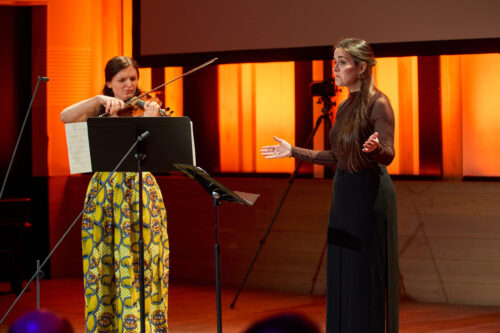
Solo and chamber music by Kurtág: Signs, Games, Messages for solo cello (selections); Ligatura Message to Francis Marie, Op.31/b (string quartet and celeste); Attila József Fragments, Op.20 (solo soprano); 6 moments musicaux, Op.44 (string quartet); 13 pieces for two cimbaloms from Games; S.K. Remembrance Noise, Op.12 (soprano and violin); Officium Breve in memoriam Andreae Szervánszky, Op.28 (string quartet)
This concert was pure Kurtág with a combination of formations demonstrating Kurtág’s wide-ranging inventions even within short pieces. The performers were of the younger generation, wholly dedicated to Kurtág’s musical language. Excellence permeated the whole concert but I still wish to make special mention of soprano Eszter Gyüdi for her musical as well as dramatical portrayal of her two pieces, the mind-blowing virtuosity of cimbalom players Miklós Lukács and András Szalai, and violinist Éva Osztrosits’s virtuoso solo passage on conclusion of the Op.12 piece.
22.2.2026, BMC
The third day of the Kurtág conference included performers discussing the challenges of Kurtág pieces as well as experienced composers offering reactions to them. On conclusion, five students of the Liszt Academy performed Kurtág’s Wind Quintet Op.2, composed in 1959. Recently staff at the Kodály Institute have discovered the manuscript of this composition among the literary estate of the musicologist László Eősze, thus a performance during the current Kurtág festivities was timely. Coached by their teacher Mátyás Antal, the five students gave an excellent performance: Zselyke Fehér (flute), András Winklár (oboe), József Zsupos (clarinet), Dávid Blaga (bassoon), Hunor Szabó (horn).
Chamber music by György Kurtág and György Ligeti, concert dedicated to Vera Ligeti
Péter Bársony (viola), Dumitrache Horia (clarinet), Zoltán Fejérvári (piano), Eszter Haffner (violin), Anna Molnár (soprano or mezzo), Ditta Rohmann (cello), Szabolcs Zempléni (horn)
Kurtág – Signs, Games, Messages for viola (selection); Splinters, Op.6c (solo piano); Hommage a R. Sch, Op.15d (clarinet, viola, piano); Signs, Games, Messages for string trio (selection); Fancsikó and Pinta (fragments), Op.40 (voice and piano)
Ligeti – Sonata for solo cello (1948-1953); Etude (Cordes à vide, solo piano); Der Sommer (voice and piano); Trio for Violin, Horn and Piano
Kurtág and Ligeti hail from the same background and met at their entrance exam to the Budapest Music Academy in September 1945. Kurtág was three years younger but they became lifelong friends.
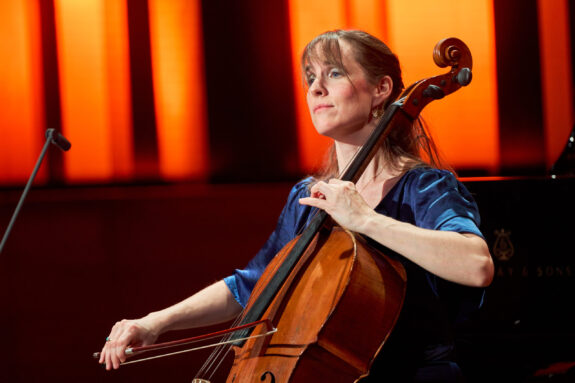
This evening concert – alternating Kurtág and Ligeti pieces – provided virtuosity, lyricism, humour and all what the centenarian Kurtág and the late Ligeti could have wished for. It also gave the audience a deep insight into the variety of both composers’ work. I marvel the performers who, as their colleagues at the previous two concerts reported above, had the courage to deliver in the presence of Kurtág himself. As an ex-cellist, I wish to praise specially Ditta Rohmann whose cello playing technique as well as musicianship is exemplary.
Finally, on the strength of the conferences and concerts which I attended there, I would like to rename the Budapest Music Centre as World Music Centre. May they continue to flourish.
Agnes Kory
Featured Image: Cellist Ditta Rohmann © Bálint Hrotkó/BMC
Excellent report. Thank you!
I was there, it was one of the most enthralling and moving weeka in my life.
Jean Paul Curtay (a cousin of György Kurtág).