
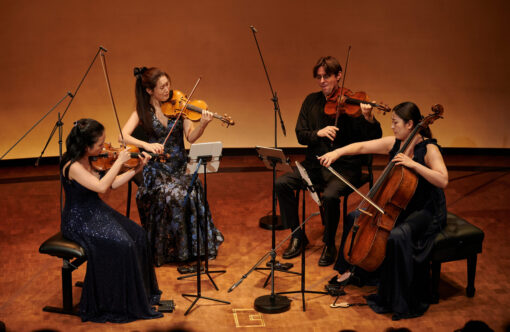
 United States Dutilleux, Ravel, Schubert: Esmé Quartet (Wonhee Bae, Yuna Ha [violins], Dimitri Murrath [viola], Yeeun Heo [cello]). Stephen A. Schwarzman Auditorium, Frick Collection, New York, 1.3.2026. (ES-S)
Dutilleux – Ainsi la nuit
Ravel – String Quartet in F major
Schubert – String Quartet No.14 in D minor D810, ‘Death and the Maiden’
Since its founding as a museum in 1935, The Frick Collection has cultivated chamber music as an essential extension of its artistic identity. It launched its chamber music series three years later, creating one of New York’s most respected intimate concert venues, balancing established masters with emerging instrumentalists and ensembles. For many young artists, a first appearance at the Frick has served not merely as an introduction to the city but as a mark of artistic maturity – an endorsement grounded in musicianship, stylistic integrity and long-term promise rather than novelty. The Esmé Quartet’s debut last Sunday, pairing twentieth-century French repertoire with ‘Death and the Maiden’, Franz Schubert’s late String Quartet in D minor, belonged naturally to this tradition.
Formed in 2016 in Germany by musicians of Korean descent, the Esmé Quartet gained international attention after winning the 2018 Wigmore Hall International String Quartet Competition. Since then, it has appeared at major venues and festivals.
Opening a debut recital with Henri Dutilleux’s Ainsi la nuit – a work admired but rarely programmed – was a quietly daring gesture, signaling a willingness to privilege substance over immediacy. Commissioned in 1976 by the Koussevitzky Foundation for the Juilliard Quartet, the piece occupies a distinctive place within postwar modernism, less doctrinaire than Boulez and less overtly mystical than Messiaen. Dutilleux described it as an example of his technique of ‘progressive growth’ in which fragmentary ideas generate forward movement through subtle transformation. He invoked Proust when speaking of the score, and the music indeed unfolds through half-remembered gestures and recurring cells that seem to insist on their own return.
Divided into seven closely linked sections, Ainsi la nuit unfolds as a study in suspended motion. Its network of ‘parentheses’ and returning fragments can easily dissipate into mere surface color. The Esmé Quartet maintained structural tension across its discontinuities. Small motifs passed from instrument to instrument – sometimes unchanged, sometimes subtly altered – creating a quiet uncertainty of memory and recognition. Harmonics glowed without becoming decorative, pizzicatos were precise without dryness and muted textures retained inner definition. The players shaped the silences as carefully as the notes. The result was less impressionistic haze than a sequence of sharply etched nocturnal images, connected by a finely judged sense of proportion.
Like Henri Dutilleux, Maurice Ravel wrote only one string quartet. A relatively early work, the Quartet in F major already displays the meticulous craftsmanship and harmonic refinement that would later define Ravel’s mature style. Placed after Ainsi la nuit, it did not feel like a retreat into lyricism but rather a reorientation toward clarity: where Dutilleux suspends motion, Ravel articulates it with supple precision.
From the opening bars, the four musicians favored architecture over color and sensuality, maintaining transparent textures and alert rhythms so that the interplay between fluid melody and underlying rhythmic tension emerged with almost geometric definition. What prevailed was the soundscape of Ravel the classicist. In the scherzo, the pizzicatos did not float but had bite. The slow movement unfolded with restrained warmth, its long lines sustained without sagging. In the finale, precision became propulsion, the music’s restless drive arising organically from rapid figurations etched with almost austere exactitude.
If the Ravel was governed by poise and proportion, Schubert’s ‘Death and the Maiden’ introduced inquietude. From the stark unison opening, a sense of inevitability took hold. The quartet’s discipline held firm under pressure; instead, the individual voices gained heightened urgency. In the Allegro, first violin Wonhee Bae projected the principal theme with a concentrated, forward-driving tone and tensile line, while second violin Yuna Ha shadowed the line with alert responsiveness. The growing tension was tightly controlled through rhythmic insistence rather than weight or sheer volume. The trajectory felt inexorable, as though the movement were unfolding along a path already set in motion.
The Andante con moto variations – based on a theme drawn from Schubert’s earlier lied Der Tod und das Mädchen – were shaped with particular care. Dimitri Murrath’s viola and Yeeun Heo’s cello introduced the theme in octaves, their shared line establishing a grave, almost ritual tread before it passed to the upper strings in transformation. Each variation unfolded as a distinct psychological state – spare, veiled, briefly luminous – before yielding again to stark inevitability. Avoiding sentimentality, the players allowed Schubert’s oscillation between defiance and resignation to register with unsettling directness.
The Scherzo had an almost abrasive edge, its accents sharply profiled. Wonhee Bae’s attack in the upper register lent the opening gesture a steely intensity, while the lower strings answered with muscular insistence. The effect was not playful but driven, the dance character shadowed by something more urgent and unsettled. The Trio offered only provisional relief, its lyricism remaining contained.
The quartet maintained taut rhythmic control in the tarantella-like finale. Even at high speed, their cohesion – both rhythmic and tonal – held the music in disciplined alignment as momentum gathered. Yeeun Heo’s cello provided a firm rhythmic spine, anchoring the swirling upper voices with unsentimental steadiness. The dance impulse never quite dissolved into abandon; instead, the trajectory tightened toward a conclusion that seemed more than ever foreordained – as Death calmly assures the maiden in the lied: ‘Bin Freund und komme nicht zu strafen’ (‘I am a friend and come not to punish’).
Edward Sava-Segal