
Klaus Mäkelä’s imminent arrival brings Sibelius, Lindberg and a thrilling Walton surprise to Chicago Symphony Orchestra’s 2026-2027 Season
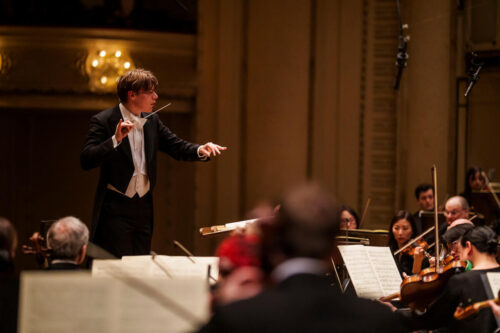
The Chicago Symphony Orchestra’s upcoming season has been announced, and there is a lot I could say about it. Let us start with the obvious: with the 2026-2027 season, we are one year closer to the official start of the Klaus Mäkelä era with the CSO. In many ways, it feels as though the young Finn is already here. Over the past two seasons, he has spent an increasing number of weeks on the podium at Orchestra Hall and, even before this, Mäkelä seemed everywhere in the local imagination. He was all that anyone who follows the CSO could talk about.
With his arrival now imminent, I am struck by how indefinable his musical identity remains as a conductor. He is clearly a congenial partner for the orchestra. He favors the large orchestral staples that suit the Chicago sound, but there are hints of an interest that wanders beyond these well-worn tropes. Based on the hints, I went so far as to bet my spouse that we would see Andrew Norman’s Play on the Chicago schedule for the upcoming season. Mäkelä has conducted it in Oslo, Amsterdam and Berlin in recent years, and it seemed logical he would bring the piece to Michigan Avenue.
It turns out that I was wrong: Play is not part of the season. What we get instead is better. William Walton’s Belshazzar’s Feast arrives in October with baritone Thomas Hampson as soloist, and it is a genuinely thrilling choice. Walton’s 1931 oratorio is one of the 20th-century’s great showpieces: brash, visceral and scored for enormous forces, with choral writing so relentless it may push Donald Palumbo’s chorus and the CSO’s celebrated brass to their limits. The piece is underperformed and underappreciated.
Both the Norman and the Walton demonstrate a curiosity beyond the standard canon, something that my Play bet rested upon. This inquisitiveness makes further appearances in Mäkelä’s programming: he has made interesting choices by showcasing works by Magnus Lindberg, Pierre Boulez and Giovanni Gabrieli. It is in these nooks and crannies of the repertoire that I find the most hope for Chicago’s Mäkelä era. More Sibelius is expected, but more Lindberg and Boulez would be truly welcome.
The ‘big’ pieces remain the backbone of his residency, at least for 2026-2027. We will hear Mahler’s Ninth Symphony in October and Shostakovich’s Fourth in September, and the latter is paired with Sibelius’s Seventh.
Mäkelä returns in spring to close the season. A new co-commissioned work by Magnus Lindberg receives its U.S. premiere alongside his Violin Concerto No.1 and Sibelius’s First Symphony. The Lindberg concerto is a ferociously demanding piece, and its pairing with Sibelius’s exuberant Symphony No.1 is inspired. Mäkelä’s season finale is Beethoven’s Symphony No.9. Between a fall residency and spring visits by Mäkelä, the orchestra embarks on a European tour in January, visiting Cologne, Hamburg, Baden-Baden, Vienna, Luxembourg and Paris – a rigorous itinerary for any ensemble.
About that Beethoven Ninth. The performance serves as the capstone of a season-long review of the composer’s oeuvre which, to be frank, feels like an overdone unifying thread. It was not so many years ago that the musical world celebrated Beethoven’s 250th anniversary – with endless cycles. The pandemic disrupted Chicago’s own celebrations which were meant to include all the symphonies and piano sonatas. Next season’s survey feels like a do-over. Lang Lang and Paavo Järvi will spend three concerts on the five piano concertos, and Marek Janowski comes in November to conduct the Symphony No.5. Since Janowski has spent his later years cleaning the performance cobwebs off such standard works, it will be interesting to hear how he enlivens a score we all know by heart.
The recitals surrounding the survey are impressive in their own right. In spring, Leif Ove Andsnes will perform Beethoven’s final three piano sonatas, each compressing and rethinking inherited forms. Evgeny Kissin plays an all-Beethoven recital including the Diabelli Variations, then joins cellist Gautier Capuçon and violinist Maxim Vengerov for a chamber evening surveying the piano trios, including the ‘Ghost’ and ‘Archduke.’ Pianists Bruce Liu and Rudolf Buchbinder weave individual sonatas into broader programs. It adds up to a comprehensive picture of the composer, even if the concept itself is slightly tired.
Jean-Yves Thibaudet serves as the season’s Artist-in-Residence. Besides a chamber recital with longtime collaborators violinist Lisa Batiashvili and Capuçon, he plays Khachaturian’s Piano Concerto with the CSO in the winter, paired with Zemlinsky’s lushly scored The Mermaid. It is a program well worth the trip downtown.
As Mäkelä enters, Riccardo Muti is exiting – to a point. As Music Director Emeritus, he remains a fixture. His recent concerts have held a nostalgic quality. He is returning to the repertoire he has championed for decades which includes Rossini’s Stabat Mater in April. More compelling, however, is his December program which features Richard Strauss’s Oboe Concerto with principal William Welter. The concerto was composed in 1945 at the direct request of John de Lancie, a young American GI stationed near Strauss’s home in Garmisch who would go on to become the Philadelphia Orchestra’s principal oboist. It is music of extraordinary serenity written in the shadow of catastrophe. Muti and Welter should find something essential in it.
Other guest conductors complete the season. Over two weeks of concerts, Manfred Honeck will present Mahler’s Symphony No.1, songs from Des Knaben Wunderhorn, Bruckner’s unfinished Symphony No.9 and a world premiere by Mason Bates, The Escapist Symphony. Esa-Pekka Salonen returns for a single, high-voltage week that features Yunchan Lim playing Liszt’s Piano Concerto No.2. Jaap van Zweden also visits, bringing Julia Wolfe’s Liberty Bell, a work that continues Wolfe’s fascination with American history. Van Zweden and Wolfe are frequent collaborators, and their chemistry should bring a necessary edge to the November slate. Finally, Tan Dun makes his CSO podium debut and will conduct several of his own works, including the Water Concerto.
The season feels like a bridge. One side is anchored by the tradition Muti represents. The other reaches toward the unwritten future of the Mäkelä years. There is enough grit in the ‘nooks and crannies’ to keep us interested while we wait for the new era to truly begin. In shifting from the authority of the old guard to the fluid, curious energy of the new, we are being treated to a transition in real time.
Full 2026-2027 season information is available here.
Zach Carstensen