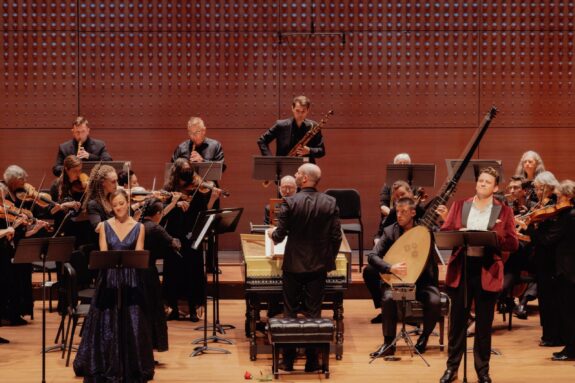
 United States Lincoln Center’s Summer for the City [2] – Of Rivers and Roses: Handel and Shaw: Lauren Snouffer (soprano), Aryeh Nussbaum Cohen (countertenor), Dashton Burton (bass-baritone), Philharmonia Baroque Orchestra / Peter Whelan (conductor). Alice Tully Hall, New York, 6.8.2026. (DS)
Handel – Selections from Water Music Suite No.1; Selections from Apollo e Dafne; Selections from Il trionfo del Tempo e del Disinganno; ‘Who calls my parting soul’ from Esther; ‘To thee thou glorious son of worth’ from Theodora; ‘Oh, di per me felice!/Se teco vive il cor’ from Radamisto
Caroline Shaw – Is A Rose: ‘The Edge’, ‘And So’, ‘Red, Red Rose’
Encore: Handel – ‘The Flocks shall leave the Mountains’ from Acis and Galatea
Peter Whelan, the artistic director of the Philharmonia Baroque Orchestra, proved that the cutting room can be an excellent place for music – even when it comes to Handel’s untouchable perfection. As part of Lincoln Center’s Summer for the City, the San Francisco-based ensemble performed with guest singers to a packed hall in their first return to New York in four years. The evening’s draw was a fluid performance that mixed Handel’s works with contemporary pieces from Caroline Shaw’s song trilogy, Is A Rose, that use texts by Robert Burns, Jacob Polley and Gertrude Stein. The Shaw was commissioned by Philharmonia Baroque Orchestra and written for mezzo-soprano Anne Sofie von Otter.
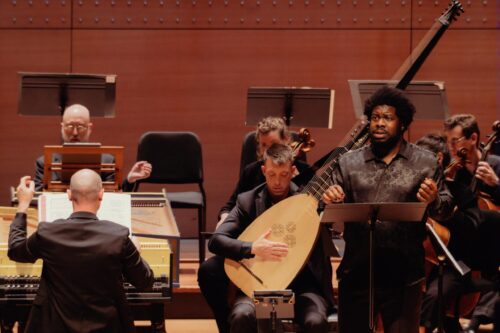
The Philharmonia plays on Baroque instruments with sterling finesse, and they hit high marks from the opening work, a selection of movements from Handel’s Water Music. Their horns were particularly impressive (challenging parts were easily overcome) and set the bar high. Four selections from Apollo and Dafne followed that were both sprightly and heart-wrenching, and they gave Whelan an opportunity to showcase his compelling conducting style. Nate Helgeson on bassoon and concertmaster Manami Mizumoto on violin played an energetic duo from the position of soloists at the front, and singers Lauren Snouffer and Dashon Burton joined as Daphne and Apollo, each holding a rose. They proved a well-matched pair of expressive singers: Snouffer performed with charisma and a polished, beckoning voice, and Burton’s deep, sensual sound was magnified by sensitive vibrato.
Rather than pause for applause, an astute choice was made to move directly into Shaw’s ‘The Edge’. Her Is A Rose cycle marries the Baroque and the modern with uncanny ease, bridging the eras with panache in her adaptation of the recitative style through a modern lens. Burton remained to perform this urgent-sounding work (that at times popped with a tone similar to that of Sufjan Stevens, especially when Burton hit high pitches beyond his baritone range: it was originally written for a mezzo-soprano!).
Burton left the stage and another smooth shift led directly into selections from Handel’s Il trionfo del Tempo e del Disinganno. Countertenor Aryeh Nussbaum Cohen came out wearing a maroon smoking jacket and holding a rose. A stunning ambassador of this unique vocal range, he brought a palpable stillness to the hall with his smooth alabaster sound that swooned across Handel’s short surging phrases. As if the desire to applaud after so many connected streams of music was no longer containable, the audience burst out clapping adoration as the first half of the concert ended.
Following the intermission, the splicing of Handel around the remainder of Shaw’s song cycle continued with more notable editing decisions. Of particular beauty was Snouffer’s and Cohen’s performance of Handel’s ‘To thee though glorious son of worth’ from Theodora which had followed a selection from Esther that had flowed from Shaw’s ‘And So’: it matched the Handel in its articulation and sarabande-like lilt while unfolding across a reflective contemporary fabric.
We did get to applaud before another set from Water Music – and the movements were played out of order with a surprisingly delightful effect. Whelan’s tempi were exciting and made for gripping contrasts. The dynamics seemed to dance in step with the surges in Baroque phrasing that once again proved the Philharmonia are experts in that musical era. Without interruption, Cohen and Snouffer (who had changed out of an eye-popping fuchsia gown into a lovely navy embroidered dress) performed sections from Radamisto. The opportunity to hear these works live with a countertenor (rather than a mezzo-soprano) was like catching the glimpse of a rare, colorful bird and not to be forgotten.
They completed Shaw’s trilogy with the aria-infused ‘Red, Red Rose’, performed by Snouffer along with some subtle humming from the players and a mesmerizing contrabass pizzicato pulse. Whelan ended the evening’s cycle of music by returning to Il trionfo del Tempo e del Disinganno with a tender ‘Tu del ciel ministro eletto’ (sung by Snouffer whose voice showed a bit more strain than previously) that showcased Mizumoto’s responsive violin solo.
A welcome encore made staying past the credits (so to speak) of this cinematic evening particularly worthwhile. The three singers returned for a superb performance of Handel’s trio ‘The Flocks shall leave the Mountains’ from Acis and Galatea. And Burton’s performance of Polyphemus proved rowdy, purposefully abrasive and full of sardonic humor: certainly some of the best ever in classical myth staging.
Daniele Sahr
Featured Image: Lauren Snouffer (soprano), Aryeh Nussbaum Cohen (countertenor) and the Philharmonia Baroque Orchestra © Lawrence Sumulong