 Germany Bayreuth Baroque Opera Festival 2026 – Handel, Floridante: Soloists, Actors, Chorus of the Bayreuth Baroque Opera Festival, Worcław Baroque Orchestra / Markellos Chryssicos (conductor). Markgräfliches Opernhaus Bayreuth, 8.9.2026. (AB)
Not since its foundation in 2021 has the Bayreuth Baroque Opera Festival presented itself in such dark colours as in this year’s new production of Handel’s Floridante, a work first performed in London in 1721 and less familiar to today’s audiences than most of the composer’s other operas.
In festival director Max Emanuel Cenčić’s reading, the story of the fictitious general Floridante originally set in ancient Persia is transferred to Jane Austen’s England and becomes an unsettling exploration of sexual coercion, patriarchal authority and the struggle for female self-determination. Not every aspect of this concept is equally convincing, though the theatrical imagination behind it is, as always with Cenčić, exciting.
The dark atmosphere on the stage is established from the very beginning, during the overture: lightning flashes behind the windows of an English country house, thunder merges with the sharply pointed minor-key opening, and the screams of a terrified woman cut through the music before a male silhouette appears and she collapses.
The plot itself remains familiar opera seria territory: Oronte has murdered the Persian king Nino and seized power, while Nino’s surviving daughter has been raised as Elmira and believes herself to be Oronte’s child. Floridante, the successful general to whom she has been promised, returns expecting to marry her, only to discover that Oronte now desires Elmira himself and wants his inconvenient rival removed. Alongside this central conflict runs the second love story of Rossane and Timante, until questions of desire, legitimate rule and political succession become increasingly inseparable.
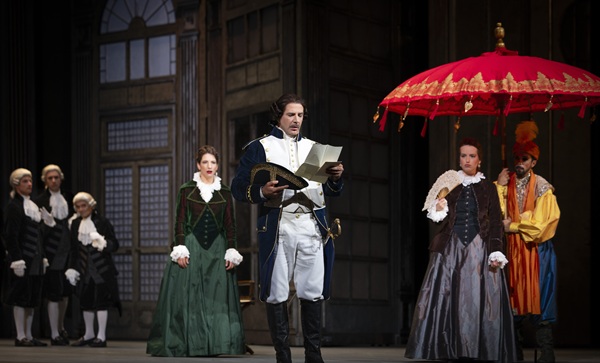
Cenčić’s transfer of the action to Georgian England initially proves rather persuasive. Helmut Stürmer’s elegant country-house interiors, completed after his death by Corina Gramosteanu, together with refined costumes also designed by her, establish a society in which property, inheritance, marriage and reputation appear to determine both personal freedom and social power; in that respect, the connection with Austen is far more than merely decorative.
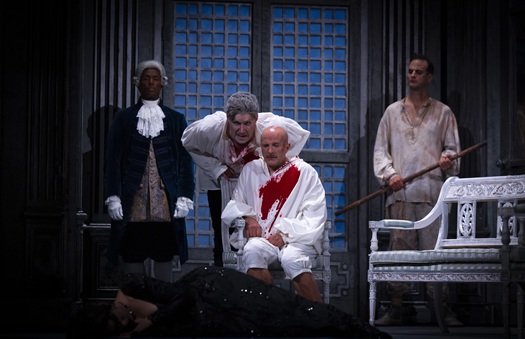
The difficulty is that Cenčić is ultimately interested in much darker territory than matrimonial calculation or social convention à la Pride and Prejudice. Lord of the manor Oronte presides over this household as a sexual predator whose authority reaches into its most private spaces, and once his sexual abuse of Elmira and physical brutality against Floridante are shown on stage, the elegance of the Georgian setting begins to feel incidental.
Nonetheless, there is much to admire, particularly Cenčić’s strong instinct for theatrical continuity and his ability to animate the formal structures of opera seria. During recitatives and arias, he introduces silent domestic episodes in which servants observe, disappear and return, while family rituals gradually reveal themselves as mechanisms of intimidation and control; these scenes are rarely mere occupation for otherwise inactive figures, but instead help sustain the momentum of an evening lasting close to four hours.
Less persuasive is Elmira’s psychological recovery after the abuse by Oronte, and here the production raises questions that it cannot fully resolve. Only Cenčić’s alteration of Handel’s ending follows the logic of his interpretation: whereas the original ultimately grants Oronte forgiveness in the lieto fine, this production has him killed, a conclusion that may abandon the Enlightenment ideal of reconciliation but, after everything we witnessed in this house, appears dramatically far more credible.
Musically, Floridante proves considerably more interesting than its relative neglect might suggest. It may not be Handel at his most spectacular, yet the score nevertheless unfolds through finely shaded emotional transitions, particularly beautiful duets such as Ah, mia cara, se tu resti between Floridante and Elmira in Act I, and an unusually inward quality throughout.
In the pit, Chryssicos responds to this with a performance of great intelligence, choosing tempi that remain buoyant without ever sounding driven and avoiding unnecessarily harsh accents. The Wrocław Baroque Orchestra plays with flexibility, transparency and precision, generating dramatic tension through rhythmic vitality and finely judged phrasing rather than exaggerated attack.
Cenčić himself makes Floridante a noble, restrained figure, singing with his familiar soft, velvety countertenor and resisting any temptation to inflate a role that is essentially more defensive than heroic. His coloraturas are admirable as is his phrasing, and he clearly remains the vocal centre of gravity throughout the evening. Sonja Runje’s Elmira has a more dramatic profile, her focused mezzo-soprano bringing solidity and clear definition to a character whose suffering is most effective when contained, even if the extremity of the staging occasionally invites greater emotional abandon. vocal phrasing and tone blended exquisitely with contralto Sonja Runje (who sang Elmira), particularly in their poignant showing refined technical control and emotional intimacy
Eva Zalenga gives Rossane brightness and charm, her initially almost soubrettish soprano gradually acquiring greater weight and determination, while Bruno de Sá, as Timante, once again displays an extraordinary command of his magnificent voice, combining brilliant, seemingly effortless upper notes with tenderness and coloratura of remarkable freedom. The comedy Cenčić gives him works beautifully and ultimately makes him the star of the evening.
Gerrit Illenberger’s Oronte is theatrically commanding, capable of creating an atmosphere of intimidation through physical presence and timing alone, while Yannis François, finally, gives Copalbo a firm, resonant bass and brings welcome stability to the rebellion against Oronte.
Thus, in its seventh year, the Bayreuth Baroque Opera Festival once again finds fascinating and exciting ways of presenting a relatively unknown work and bringing it back to life with extraordinary musical excellence. That is an impressive achievement and no small feat, given the direct competition the festival faces both in Bayreuth itself and, where Baroque opera is concerned, elsewhere in Germany and Austria. There are, indeed, very good reasons for Bayreuth Baroque to claim its place at the very top.
Andreas Bücker
Featured Image: [l-r] Sonja Runje (Elmira), Max Emanuel Cencic (Floridante), Eva Zalenga (Rossane) and Bruno de Sá (Timante) © Clemens Manser
Production:
Director – Max Emanuel Cenčić
Set design – Helmut Stürmer
Costume design and Completion of the set design – Corina Gramosteanu
Light design – Christoph Pöschko
Assistant Stage director – Constantina Psoma
Movement assistant – Dimitra Antonaki
Cast:
Floridante – Max Emanuel Cencic
Elmira – Sonja Runje
Timante – Bruno de Sá
Rossane – Eva Zalenga
Oronte – Gerrit Illenberger
Coralbo – Yannis François