 United States Various – ‘United in Sound: America at 250’ [2]: Ensemble Connect. Weill Recital Hall, Carnegie Hall, New York, 17.2.2026. (RP)
George Lewis – Broke
Valerie Coleman – Portraits of Langston
Barber – Adagio for Strings
Ives – String Quartet No.1, ‘From the Salvation Army’
Joplin – ‘The Entertainer’ (arr. for string quartet by Franz Beyer); ‘Paragon Rag’ (arr. for string quartet by William Zinn)
Ensemble Connect returned to Carnegie Hall with an ambitious and eclectic program of American music that traced the extraordinary trajectory American composers have traveled and continue to walk with the group’s singular blend of virtuosity, commitment and curiosity.
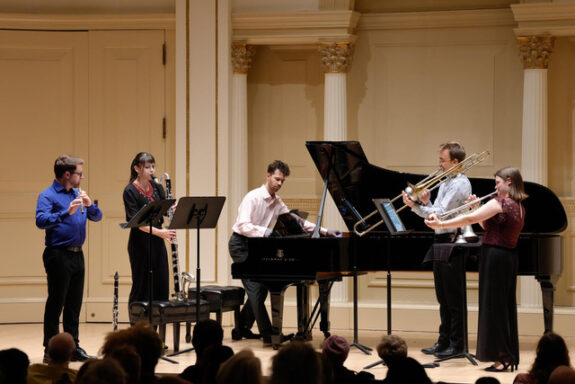
The New York premiere of George Lewis’s sextet Broke, a Carnegie Hall commission, opened the concert. (They performed the world premiere at Skidmore College a few days earlier.) Lewis is an American composer, musicologist and trombonist who currently serves as Artistic Director of the International Contemporary Ensemble. Broke is the sequel to Lewis’s 2022 octet ‘Breaking’, both of which are inspired by the first two books of Nigerian writer Chinua Achebe’s African Trilogy: Things Fall Apart and No Longer at Ease. Lewis describes Broke as sounding like an improvisation, played by musicians who had been given their instruments yesterday. It is not an easy listen, and Lewis made no apologies, advising that music, like life, is difficult. Sanguine as ever, he summed it up with ‘If you don’t like it, it’s not that long’. Someone who received a MacArthur Fellowship (‘genius grant’) has the latitude to say such things.
Broke was performed by flutist Cameron Cullen, clarinetist Nicole Martin, trumpeter Grace O’Connell, trombonist David Seder and pianist Joseph Vaz with focus and determination. At times, the music evoked the screams of feral animals, or the sort of sounds a child exploring an instrument for the first time would discover. Terrific trombone blasts and slides competed with equally jarring and intriguing sounds of extended techniques, particularly from the bass clarinet and piano. As Lewis suggested, Broke is not easy listening, but it is undeniably powerful and often compelling. Only the brave will program it. It linked directly in spirit to the music of Charles Ives that was heard later in the program. What must those few who heard his musical train wrecks for the first time in the early decades of the twentieth century have thought?
In the six-movement suite Portraits of Langston for flute, clarinet and piano, Valerie Coleman created musical sketches of people and places in Harlem and Paris that helped shape Hughes. Five were inspired by his poems – ‘Helen Keller’, ‘Danse Africaine’, ‘In Time of Silver Rain’, ‘Jazz Band in a Parisian Cabaret’ and ‘Summer Night’, which Nicole Martin read before each movement was played. The sixth, ‘Le Grand Duc Mambo’, was an evocation of a jazz club in Montmartre where Hughes worked as a busboy for 25 cents a night.
Coleman envisioned Portraits of Langston as a woodwind duet, with the piano primarily providing rhythm and atmosphere. Her stylistic palette encompasses big-band swing, cabaret music, mambo, African drumming, traditional spirituals and stride piano technique. In this performance by Cameron Cullen, Nicole Martin and Joseph Vaz, the superb melodies and dialogue that Coleman, herself a flutist, crafted for the two wind instruments were captivating, transcending time, place and musical style.
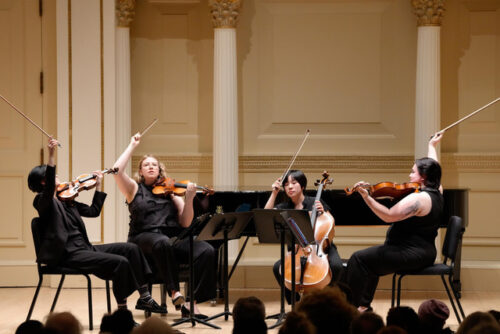
The second half of the concert opened with Barber’s beloved Adagio for Strings, performed by violinists Laurel Gagnon and Coco Mi, violist Abby Smith and cellist Elena Ariza in its original version for string quartet. The performance captured the aching beauty of Barber’s ascending melodic line and the piece’s intense, piercing harmonies with particular clarity. These, together with the dignity of the performance, unleashed the piece’s deep well of emotions.
Charles Ives was a practical New Englander who chose to work in the insurance industry and feed his family rather than follow the starving-artist route. He was a chip off the old block – his father was a bandmaster who reveled in the clash of disparate sounds. The elder Ives’s idea of a good time was to have several bands march towards each other, each playing a different tune.
Ives’s String Quartet No.1, ‘From the Salvation Army’ was completed in 1909 and received its premiere in 1957. It took the likes of Leonard Bernstein to get this music before the public. Ives began the String Quartet while a student at Yale University but didn’t complete it until around 1909. The movements were originally conceived for organ, with or without strings. The melodies that course through it are hymns, such as ‘From Greenland’s Icy Mountains’, ‘All Hail the Power of Jesus’ Name’, ‘Stand up, stand up for Jesus’ and ‘Shining Shore’. They were once part of the American musical vernacular but are unknown to many in these more secular times. What has not faded is the sense of community and purpose that still coursed through New England towns at the turn of the twentieth century and which Ives embedded in his music.
This performance was notable for its lightness, and it revealed the deftness with which Ives incorporated the hymn tunes into the quartet’s musical fabric. The players made clear that this was music that Ives knew well and cherished. In the second movement, European antecedents were felt and heard, especially the music of Dvořák, whose time in America coincided with Ives’s student days. A meatier sound would have added to the depth of the performance, but beauty and grace were the trade-offs.
Joplin’s ‘The Entertainer’ and ‘Paragon Rag’ arranged for string quartet ended the concert. He died impoverished and disease-ridden, maintaining to the end that ragtime was a form of classical music meant to be played in concert halls. Ensemble Connect’s performance left no doubt that Joplin was correct.
Rick Perdian
Featured Image: [l-r] Cameron Cullen (clarinet), Nicole Martin (clarinet), Joseph Vaz (piano), David Seder (trombone) and Grace O’Connell (trumpet) © Fadi Kheir