
 Germany Wagner, Lohengrin: Soloists, Chorus of Hamburg State Opera, Hamburg Philharmonic State Orchestra / Omer Meir Wellber (conductor). Hamburg State Opera, 3.4.2026. (DM-D)
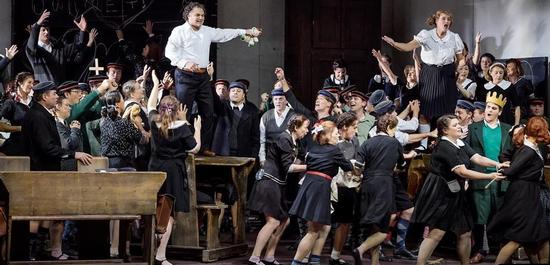
This was the 55th performance overall, and one of many revivals, at Hamburg State Opera of a 1998 production of Lohengrin, directed by Peter Konwitschny, one of the leading and still active representatives of Regietheater. While the initial premiere may have been controversial, the production has since achieved cult status. Set in a school room in Germany during the reign of Emperor Wilhelm II (1890-1918), all the characters are schoolboys and -girls in period dress, with the exception of Lohengrin. They move and generally behave like teenagers in the throes of adolescence – insecure, awkward and coltish in their movements and behaviour, prone to sudden and unexpected mood swings. They take turns imitating and playing at being teachers, writing with chalk on an old-fashioned blackboard and hanging up a display chart of male and female anatomy in a prominent position for the bridal chamber scene – the ‘bed’ consisting of three gymnastics mats covered with a large white sheet.
Whenever the school children were on the stage they were bustling about in well-choreographed chaos and exuding endless adolescent energy. Omer Meir Wellber could probably not help reflecting that high level of energy in his energetic reading of the score, for which he chose brisk tempi; the Prelude and Act I together came in at 60 minutes, by way of example. In his attention to detail, Wellber emphasised quirky moments in the interaction of orchestral groups.
Sara Jakubiak was very good as Elsa, a youngster forced to become a grown up far too soon and asking the forbidden question due to immaturity more than anything else. Her voice was youthfully fresh but already as well rounded as necessary. Tómas Tómasson was predominantly rough as Telramund, sacrificing some vocal beauty. Yulia Matochkina was a very powerful Ortrud, with an elegant vocal line and an exceptionally controlled and compelling outburst at the end of the opera. Gábor Bretz sang King Henry with a well-positioned, sonorous bass. Szymon Mechlińsky was more than reliable as the Herald.
Without doubt this was yet another occasion for a spectacular performance by Klaus Florian Vogt as Lohengrin. His command of the role is, most surprisingly, ever growing and developing, he seems to discover new nuances with every performance. His voice floats effortlessly, and every word he sings comes across clearly, without the need for surtitles. Projection is such that the voice seems to be everywhere in the space at the same time, with no noticeable lapse between production and hearing, rather than the sound being audibly produced and emitted from the singer’s mouth and conveyed from there. Vogt’s vocal performance of opera is for me the quintessence of singing, comparable in terms of vocal range to Margaret Price, Renato Bruson and Kurt Moll.
Daniel Meyer-Dinkgräfe
Production:
Director – Peter Konwitschny
Revival director – Petra Müller
Stage design – Helmut Brade
Costume design – Inga von Bredow
Lighting design – Manfred Voss
Chorus director – Alice Meregaglia
Dramaturgy – Werner Hintze
Cast:
Heinrich der Vogler – Gábor Bretz
Lohengrin – Klaus Florian Vogt
Elsa von Brabant – Sara Jakubiak
Friedrich von Telramund – Tómas Tómasson
Ortrud – Yulia Matochkina
The King’s Herald – Szymon Mechlińsky
Four Brabantine Nobles – Mziwamadoda Eipho Nodlayia, Colin Atkins, Chao Deng, Keith Klein
Four Bridesmaids – Bettina Rösel, Martina Ber, Kistina Susuc, Veselina Teneva