
 United States Schubert, Beethoven, Liszt: Khatia Buniatishvili (piano). Stern Auditorium, Carnegie Hall, New York, 14.4.2026. (ES-S)
Schubert – Piano Sonata in B-flat major, D.960
Beethoven – Piano Sonata No.17 in D minor, Op.31, No.2, ‘The Tempest’
Liszt – Mephisto Waltz No.1; ‘Gretchen am Spinnrade’ from 12 Lieder von Franz Schubert; Hungarian Rhapsody No.6 in D-flat major
Encore: Liszt – Hungarian Rhapsody No.2 in C-sharp minor (trans. Horowitz)
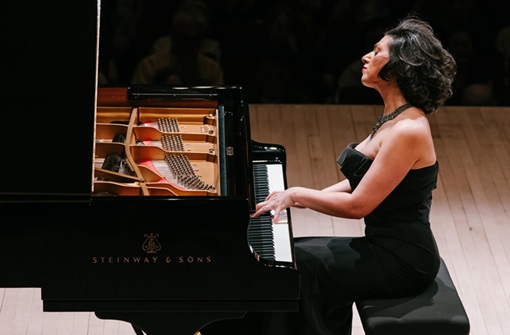
At Carnegie Hall, Khatia Buniatishvili presented a program that brought together works by Schubert, Beethoven and Liszt in a sequence that resisted any straightforward historical or stylistic logic. Instead of tracing a progression, the evening juxtaposed distinct approaches to time and form, with Beethoven’s ‘Tempest’ Sonata serving as a pivot through which Schubert’s inwardly sustained line and Liszt’s more overtly theatrical language come into focus. What ultimately unified the evening was not the program itself but Buniatishvili’s consistent interpretive instinct – one that favors immediacy, contrast and the shaping of discrete moments.
Schubert’s Piano Sonata in B-flat major made that tendency immediately audible. Buniatishvili began in an unusually withdrawn soundworld, her pianissimo carefully shaded, the initial theme suspended in a kind of luminous stillness. The effect was striking in isolation but less persuasive as the movement unfolded. Direction, grounded in a steady pulse essential to sustaining the movement’s breadth, proved difficult to maintain, as tempo adjustments stretched or compressed phrases in ways that foregrounded their immediate character rather than their function within a larger line. The bass trill, instead of anchoring the music’s latent tension, emerged as one expressive event among others, its structural role diffused.
At moments, this suggested an alternative way of hearing the movement: as a sequence of states, each carefully shaped and held in suspension with little connection between them. The sense of return, fundamental to Schubert’s design, was correspondingly weakened. The same attention to detail and sensitivity to color that defined the reading also contributed to its instability at the level of form.
The Andante sostenuto extended this further. A markedly slow tempo inhibited the accumulation of tension, even as Buniatishvili’s control of quiet dynamics remained striking, her tone retaining focus and density at the softest levels. The contrast between its sections, which shapes its expressive trajectory, was absorbed into a largely uniform stillness. The music did not collapse, but its forward motion became less clearly defined, its weight distributed across isolated moments rather than forming a continuous arc.
The Scherzo brought a welcome shift in character. The lighter, more agile writing proved more accommodating to Buniatishvili’s flexible phrasing, the quick exchanges and pointed accents lending the movement an immediacy more aligned with its design. The Trio, more grounded in its rhythmic profile, introduced a degree of weight, though without fully stabilizing the pulse.
The finale continued this emphasis on individual gestures. Its contrasting ideas were vividly profiled, and Buniatishvili’s handling of tempo gave the music a certain volatility. Direction, while never entirely obscured, proved difficult to maintain as the movement progressed, its momentum repeatedly redirected rather than sustained.
Beethoven’s Piano Sonata No.17 (‘The Tempest’) refracted the same interpretive priorities through a more overtly rhetorical design. The opening movement’s alternation between arpeggiated openings and more agitated figuration suited Buniatishvili’s emphasis on contrast, while its quasi-improvisatory character allowed the recitative-like passages to be shaped with a clear sense of character. In the more inward passages, the sonata seemed to echo the soundworld of the Schubert that had opened the program. Here, her approach did not so much disrupt the musical argument as recast it, bringing the work’s rhetorical surface into sharper relief, though at the expense of its underlying tension. The movement’s differentiated ideas were not always fully integrated, and the pulse – less explicit than in Schubert, but no less necessary – remained unsettled.
The Adagio shifted that focus toward a more sustained line, the shaping of phrases lending the music a certain intensity, though with a corresponding narrowing of its expressive span. In the finale, Buniatishvili’s command of rhythmic tension and rapid figuration was evident, yet the movement’s drive unfolded less as a sustained surge than as a succession of energized impulses.
The Liszt works that closed the program brought Buniatishvili’s virtuosity to the fore, aligning readily with the music’s outward rhetoric. The Mephisto Waltz No.1 unfolded through rapid shifts of character and texture, vividly projected, the music propelled forward with an energy that rarely flagged. In the ‘Gretchen am Spinnrade’ transcription, the spinning accompaniment was smoothly controlled, but the strain in Schubert’s original lied remained under-realized, the music’s motion sustained largely as surface figuration. Hungarian Rhapsody No.6 built its excitement through accelerating tempo and growing sonority but increasingly drew attention to the mechanics of performance rather than the shaping of the musical line.
Hungarian Rhapsody No.2 in Vladimir Horowitz’s transcription, delivered as an encore at extreme speed and volume, closed the evening with an emphasis on virtuoso display above all else – a telling outcome in a program where Schubert’s D.960, so often a point of culmination, opened the recital, and Liszt’s rhapsodies became the point of arrival.
Edward Sava-Segal