
 Germany Dresden Music Festival 2026 [7] – Schubert: Trio Moreau. Palais im Grossen Garten, Dresden, 29.5.2026. (MC)
Schubert – Piano Trio No.1 in B-flat major, Op.99, D898; Piano Trio No.2 in E-flat major, Op.100, D929
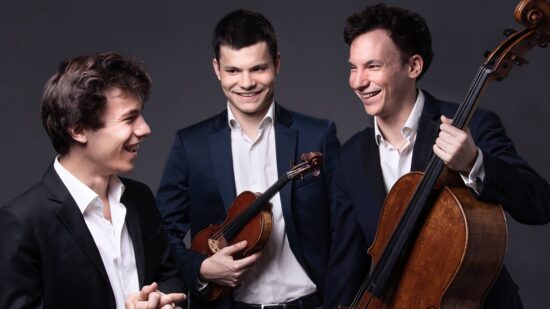
A genuine family affair the Trio Moreau comprises of three Moreau siblings Jérémie (piano), David (violin) and Edgar (cello). For their first ever recording as a trio the brothers have recently released Schubert’s two magnificent Piano Trios, including piano trio arrangements of four of his popular lieder. So, it was no surprise the Trio Moreau for their Palais im Grossen Garten recital chose to perform Schubert’s two Piano Trios, both pinnacles of Viennese chamber music.
In 1828 Schubert wrote his pair of large-scale piano trios around a year before his premature death aged only thirty-one. No less a figure than Robert Schumann described them as ‘an angry celestial apparition rising above the musical scene of the time.’
Schubert wrote music in the late-classical era bridging across to the early-romantic era as did his contemporaries Mozart and Beethoven. As expected, the Trio Moreau especially Edgar a top-drawer cellist and noted solo performer, seemed to place emphasis on romantic aspects and personal expression, wide dynamic contacts and uninhibited emotional expression. Perhaps some might find this prominence on the cello out of balance with the violin and piano, yet I expected this approach and for my taste it worked so commendably well.
Unlike the E-flat major Trio, it seems likely that Schubert didn’t ever hear a public performance of his radiant B-flat major Trio. Following his demise, his brother Ferdinand found the score lying in a heap of manuscripts. A fresh and lyrical work of beauty it is likely that much of the B-flat major score was inspired by the Styrian countryside.
With the B-flat major Trio the challenging opening movement ripe with captivating melodies and repeated themes in varying keys was adeptly achieved by the Moreau. There was a slight buccaneering feel to the playing, and I did enjoy the sections that generated a squally character. Blessed with a glorious, sweet melody introduced on the cello, the slow movement, one of the most alluring in all chamber music, was given a glorious performance by the Moreau.
A weightier, more epic work than B-flat major the E-flat major Trio presented few problems for the Moreau. Despite appearing amiable and upbeat on the surface, there was a discernible undertow of anxiety, uncertainty and melancholy. It felt like a self-depiction of Schubert as an itinerant figure or wanderer, an outsider who perseveres with optimism yet continually encounters setbacks.
In the second movement (Andante con moto) the main theme is the best-known part of the work having been used in several film soundtracks. Jérémie’s piano contained the tread of a funeral march or procession and over this the cello introduced the big theme. Initially the mood wasn’t sad but cheerful, although later the gait became heavier and increasing melancholy. Striking were the Moreau in the two climaxes that vacillated between delight and anguish.
Opening canonically there is an abundance of melody in the roistering Scherzo and the Moreau excelled. Referring to it as a Minuet Schubert said it is best played ‘at a moderate pace and piano throughout.’ In the contrasting energetic trio section outstanding was the way the Moreau transitioned to a clumping Ländler, the traditional Austrian country dance.
This was a mighty successful all-Schubert concert; the Trio Moreau were a telling partnership and provided no shortage of romantic drama. Such a strong connection was evident it felt as if their instruments were people engaged in coherent dialogues.
Michael Cookson